Peptide Research & Handling
What vendor-reported lab results and peer-reviewed aggregation research can—and cannot—say about shaking, foaming, and reconstituted peptide stability.
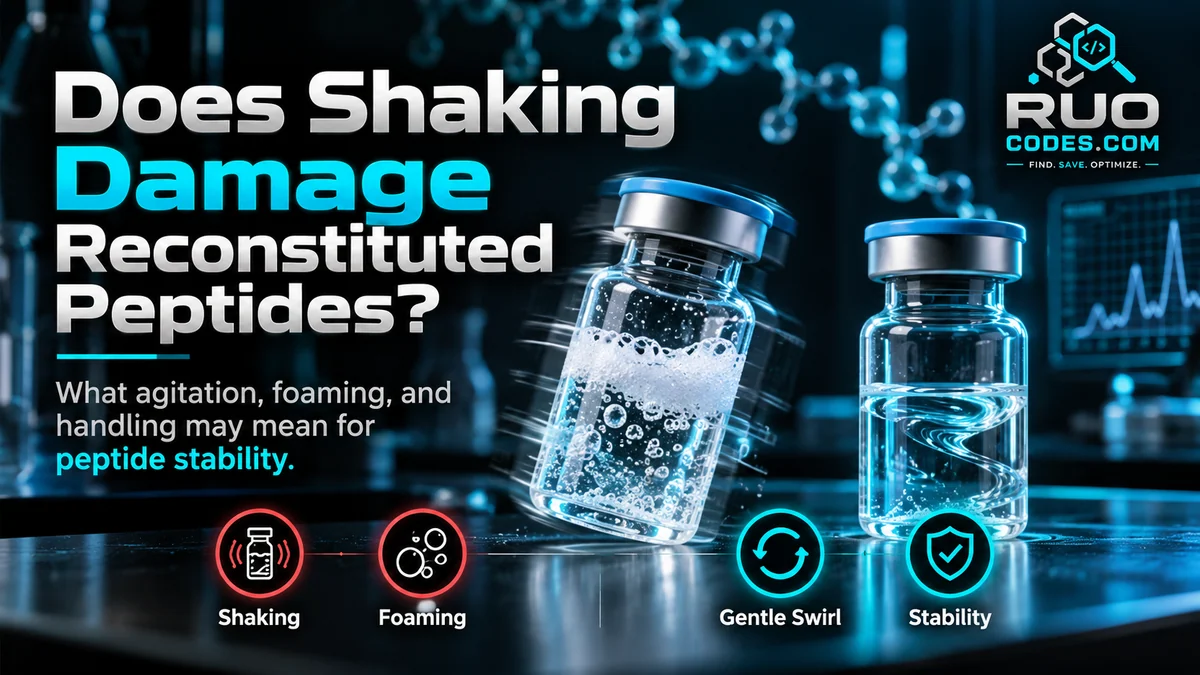
Does shaking damage reconstituted peptides? The short answer
Not necessarily. A brief shake alone does not establish that a peptide has degraded. The outcome depends on the peptide, formulation, concentration, container, temperature, and the duration and intensity of agitation. Gentle rolling or swirling remains a reasonable laboratory default when the compound-specific handling instructions permit it.
A vendor-reported GLP-3R comparison describes no measurable change in HPLC purity after roughly 60 seconds of shaking. That is a limited, compound-specific report—not proof that all peptides tolerate shaking, that foaming is harmless, or that the sample retained biological activity.
- Avoid unnecessary foaming and prolonged agitation.
- Follow compound-specific solvent, storage, and handling instructions.
- Do not infer purity, potency, or sterility from a clear appearance.
- Keep vendor reports distinct from peer-reviewed evidence.
Research-use-only notice: This article discusses laboratory handling of research materials. It does not provide instructions for human or animal administration, establish clinical safety, or replace a validated laboratory protocol.
What did the reported GLP-3R shaking comparison show?
The warning “do not shake” is common in peptide handling. It is useful as a conservative instruction, but it should not be interpreted as evidence that every brief accidental movement destroys a vial.
The Peptide Crafters study link supplied for this article is associated with a vendor-reported comparison of GLP-3R, described as a 39-amino-acid peptide. The supplied report describes two normally handled control vials and one vial shaken vigorously for approximately 60 seconds, with HPLC and LC-MS used for comparison.
Evidence and access limitation
At the October 7, 2026 review, we could not independently retrieve the complete study or inspect its underlying certificates of analysis through the supplied link. The figures below are vendor-reported figures from the supplied study summary, not results independently verified by RUO Codes. This report is not presented as a peer-reviewed study. The original chromatograms, sampling details, formulation, and analytical limits would be needed for a stronger assessment.
Reported shaken-versus-unshaken results
| Measurement | Result reported in the supplied summary |
|---|---|
| Control-vial HPLC purity | Approximately 99.6–99.7% |
| HPLC purity after approximately 60 seconds of shaking | Approximately 99.6–99.7% |
| New impurity peaks | None reported as detected |
| LC-MS comparison | No truncation or fragmentation reported in the supplied summary |
| Biological activity, sterility, and complete aggregation profile | Not established by the reported HPLC-purity and molecular-mass comparison |
The appropriately narrow interpretation is that the reported methods did not detect a difference under the conditions described. “No measurable change” is bounded by the methods and their sensitivity; it does not mean that every possible physical or chemical change was excluded.
What can HPLC and LC-MS establish about peptide integrity?
HPLC separates components under a chosen chromatographic method. A purity percentage often represents relative chromatographic peak area. It is not automatically an absolute assay of peptide content, and some changes may not be resolved or detected by that method. The detector response, sample preparation, integration, and method specificity matter.
LC-MS combines liquid chromatography with mass spectrometry and can help establish whether detected species have the expected molecular mass. Matching mass is useful evidence, but it does not alone establish intact three-dimensional structure, biological activity, sterility, or the absence of all aggregates.
A stability assessment may need additional, question-specific methods. For example, the peer-reviewed GLP-1 aggregation work discussed below used size-exclusion chromatography alongside other techniques to characterize oligomers. See the guide to what each peptide COA test actually measures and the COA verification checklist for the distinction between identity, purity, content, and other testing.
Why can foaming and air–water interfaces matter?
Vigorous mixing can create bubbles, renew air–water interfaces, and expose peptide molecules to container surfaces. Depending on the peptide and formulation, interactions at those interfaces can contribute to adsorption or aggregation. A peer-reviewed review of peptide physical stability identifies surfaces, interfaces, agitation, concentration, pH, excipients, and temperature as relevant variables. [2]
Visible foam is a reason to reduce unnecessary agitation, not an analytical measurement of how much peptide has been lost. Conversely, the absence of visible foam does not prove that there are no aggregates or interfaces. A clear solution is not a substitute for an appropriate stability assay.
The useful laboratory principle is to avoid unnecessary mechanical and interfacial stress while achieving dissolution using the method specified for the material. The statement “motion always destroys peptides” is too broad, but “foaming is the only risk” is also too broad.
What did the cited peer-reviewed GLP-1 aggregation study actually test?
The 2023 paper Glucagon-like peptide 1 aggregates into low-molecular-weight oligomers off-pathway to fibrillation studied GLP-1 and its C-terminal amide derivative, GLP-1-Am. These are not interchangeable with the vendor-reported GLP-3R material. [3]
For its fluorescence-kinetics measurements, the paper describes incubation at 37°C, readings every 30 minutes, and five minutes of orbital shaking at 600 rpm before each reading. That protocol must not be described as uninterrupted 600-rpm shaking. The paper also investigated aggregation using size-exclusion chromatography during extended incubation with agitation.
The results demonstrate that oligomer formation and fibrillation depend on the particular peptide and experimental conditions. They do not establish a universal “50-hour safe window,” prove that incidental handling is harmless, or validate a general storage lifetime for other peptides. Laboratory protocols also vary in concentration, pH, container, and readout; a shaking speed alone is not a complete exposure description.
The connection to everyday laboratory handling is therefore mechanistic, not a direct validation of every brief shake: interfaces and agitation can matter, but a prolonged aggregation experiment cannot simply be equated with a single short handling event.
What other factors affect reconstituted peptide stability?
There is no single, evidence-based threat ranking that applies to all peptides. Physical aggregation and chemical degradation can occur through different pathways, and the dominant risk depends on the material and formulation.
Temperature and time in solution
Temperature affects reaction rates and physical stability. Refrigeration may be appropriate for some formulations, but “4°C” is not a universal guarantee. Use the supplier’s compound-specific stability data and the laboratory’s validated procedure. Some materials require different storage conditions, and some must be used promptly after preparation.
Light and oxidation
Light exposure and oxidation can affect susceptible formulations. Protection from direct light is a reasonable precaution when specified, but the magnitude of the effect depends on peptide sequence, solvent, dissolved oxygen, container, and exposure conditions. A dark storage location does not replace temperature control or material-specific instructions.
Freeze–thaw cycles
Freezing and thawing can expose a sample to concentration changes, interfaces, and other stresses. Repeated cycles may be undesirable, but the supplied sources do not establish a universal 5–15% loss per cycle. Where freezing is appropriate and validated, aliquoting can reduce repeated thawing of the same sample. It is not a blanket instruction to freeze every reconstituted peptide.
Long-term solution storage
Reconstitution changes the formulation and its stability requirements. A universal “two to four weeks” shelf life is not supported for all compounds, diluents, or containers. Follow material-specific analytical stability data, and distinguish chemical stability from microbial control. Lyophilization can improve stability, but it does not stop every degradation pathway or make storage conditions irrelevant.
pH, solvent, concentration, and container
pH and solvent choice affect solubility, chemical reactions, and aggregation. There is no universal pH 5–6 optimum for all peptides. Do not adjust pH or substitute a diluent based on a generic internet rule. Follow the specified formulation and consider compatibility with the intended laboratory assay. [2]
For a broader overview, consult the peptide storage guide, while treating compound-specific validated instructions as the deciding source.
Does bacteriostatic water prevent peptide degradation?
No antimicrobial preservative is a general guarantee of peptide stability. Bacteriostatic Water for Injection is labeled as water containing benzyl alcohol as a preservative; the particular product label must be checked for its formulation, compatibility, and restrictions. [4]
The antimicrobial purpose is distinct from preventing oxidation, hydrolysis, deamidation, or aggregation. Preservatives and excipients can themselves affect formulation behavior, so it is also too broad to claim that every peptide degrades at exactly the same rate in bacteriostatic water and sterile water.
A preservative does not establish sterility after mishandling, make a research material suitable for administration, or supply a validated storage lifetime. For laboratory preparation, use the specified diluent and the applicable safety data and protocol.
What is a cautious laboratory approach to reconstitution?
The reconstitution guide provides related background. The material’s instructions and the laboratory’s validated procedure take priority over any general guide.
- Check the material and formulation. Confirm identity, specified solvent, intended concentration, container requirements, and storage instructions before preparation.
- Use controlled addition and the prescribed mixing method. When the protocol permits it, add diluent gently and avoid introducing unnecessary bubbles or directing a forceful stream into the material.
- Prefer gentle rolling or swirling when appropriate. Stop once dissolution is achieved. Do not impose a universal 30–60-second mixing time or a universal room-temperature waiting period.
- Do not improvise stronger agitation. Vortexing, sonication, warming, and changes of solvent or pH should be used only when justified by the material-specific method. These techniques are not inherently forbidden in every validated research protocol, but they are not interchangeable with gentle mixing.
- Assess unexpected changes using the protocol. Persistent particles, precipitation, discoloration, or cloudiness require investigation. Clear appearance does not prove intactness; do not assume that extra shaking will solve a formulation problem.
- Document storage and handling. Track preparation time, temperature exposure, and any permitted freeze–thaw events. Use compound-specific stability evidence rather than a generic shelf-life countdown.
What are the limits of the reported shaking result?
The vendor-reported comparison does not establish long-term behavior after repeated agitation, outcomes for other sequences or formulations, effects of temperature or pH changes, or behavior under vortexing or sonication. Its HPLC and LC-MS comparison also does not by itself demonstrate retained biological activity or a complete absence of aggregation.
Even if the original results are confirmed, a small comparison with two control vials and one shaken vial would remain a limited experiment. The appropriate conclusion is specific to the material, methods, and conditions tested—not a universal handling exemption.
Frequently asked questions
Does an accidental shake mean a reconstituted peptide is ruined?
Not automatically. A short handling event is not, by itself, evidence of degradation. Assess the compound-specific instructions and the nature of the event. Neither reassurance from a generic article nor clear appearance can confirm the sample’s analytical condition.
Why is gentle swirling usually preferred to vigorous shaking?
Where compatible with the protocol, gentle mixing can achieve dissolution with less unnecessary foaming and interfacial stress. The risk is formulation-dependent; the absence of visible foam is not proof of stability.
Does the reported GLP-3R result apply to all peptides?
No. The supplied vendor summary reports HPLC purity of approximately 99.6–99.7% after a roughly 60-second shake, but that report is compound-specific and has not been independently verified here from the original COAs. It does not establish universal stability or biological activity.
Does 99.6% HPLC purity prove that a peptide remains active?
No. Chromatographic purity is a method-dependent measurement of detected components. It is not automatically absolute peptide content, a functional activity assay, a sterility test, or a complete aggregation assessment.
Does bacteriostatic water protect against heat, light, or chemical degradation?
Its preservative function does not provide a general guarantee against chemical or physical degradation. Diluents and excipients can affect stability, so compatibility and storage must be established for the formulation.
How long can a reconstituted peptide be stored?
There is no universal answer. Use compound-specific stability data for the particular solvent, concentration, container, and temperature. A general two-to-four-week rule or a fixed loss-per-thaw percentage is not a substitute for those data.
Sources and citations
- Peptide Crafters: “Does Shaking Damage Reconstituted Peptides?” Study link supplied for the vendor-reported GLP-3R comparison. Commercial-source report; full study and underlying COAs could not be independently inspected at this review. The figures are identified as reported, not independently confirmed.
- “Factors affecting the physical stability (aggregation) of peptide therapeutics.” Interface Focus (2017). Peer-reviewed review covering formulation and environmental variables, including interfaces and agitation. Mechanistic context; not a direct replication of the GLP-3R shaking comparison.
- “Glucagon-like peptide 1 aggregates into low-molecular-weight oligomers off-pathway to fibrillation.” Biophysical Journal (2023). Peer-reviewed GLP-1/GLP-1-Am aggregation study. Its fluorescence protocol uses five-minute shaking periods before readings; its results are not universal handling thresholds for other peptides.
- DailyMed: Bacteriostatic Water for Injection labels. Official product-label listings for preservative composition and product-specific restrictions. These labels do not validate research-peptide stability or authorize administration of research materials.
Related RUO Codes research guides
- How to Reconstitute Peptides: Step-by-Step Guide
- How to Store Peptides
- What Every Test on a Peptide COA Actually Measures
- How to Verify a Peptide COA Before You Buy
- Retatrutide research encyclopedia entry
- RUO Codes vendor vetting standard
Supplier context: the supplied study summary attributes the comparison to Solution Peptides. The Solution Peptides vendor page is a directory resource, not independent scientific verification of the reported study. Vendor relationships and promotional offers do not establish laboratory findings.