By Chad E., Founder of RUO Codes. Last reviewed October 11, 2026.
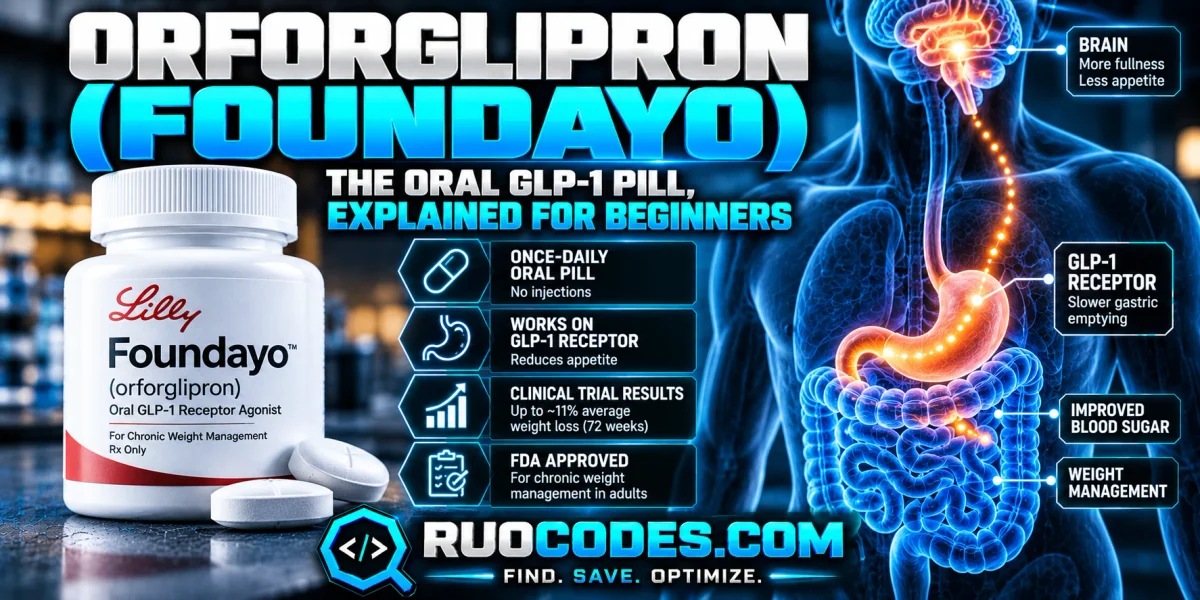
Orforglipron, sold as Foundayo, is a once-daily GLP-1 pill from Eli Lilly that the FDA approved on April 1, 2026 for adults with obesity, or with overweight plus a related health condition. Unlike most GLP-1 drugs, it is not a peptide, and you can take it with or without food or water.
TLDR
- What it is: A once-daily pill that works on the same GLP-1 receptor as Wegovy and Zepbound. The brand name is Foundayo.
- Is it a peptide? No. It is a small molecule. That is why it survives the stomach and does not need a needle or a fasting routine.
- Is it approved? Yes. The FDA approved it on April 1, 2026 for chronic weight management in adults. It is a prescription drug.
- Results: In the 72-week ATTAIN-1 trial, the highest dose produced about 11% average weight loss, versus about 2% on placebo. Injectables like semaglutide and tirzepatide have shown higher averages in separate trials.
- Side effects: Mostly stomach-related: nausea, constipation, diarrhea, vomiting. It also carries a thyroid tumor warning, like other GLP-1 drugs.
- Cost: Lilly lists self-pay pricing from $149 a month for the lowest dose, and as little as $25 a month with commercial insurance and a savings card.
- The research-peptide angle: It is a real, approved medicine. A "research use only" version sold online is an unverified copy, not the real thing.
What is orforglipron?
Orforglipron (say it "or-FOR-gli-pron") is a drug that switches on the GLP-1 receptor. That is the same target hit by semaglutide (Ozempic, Wegovy) and tirzepatide (Mounjaro, Zepbound). GLP-1 is a gut hormone. When the receptor is activated, appetite drops, you feel full sooner, and blood sugar is better controlled.
The difference is the form. The older drugs are peptides, short chains of amino acids that your stomach would normally break down, so most are injected. Orforglipron is a small molecule, a compact chemical that is built to survive digestion. A Japanese company, Chugai, discovered it, and Eli Lilly licensed it in 2018.
Is orforglipron a peptide?
No, and this matters if you follow the peptide world. Orforglipron has no amino acid backbone. It is a "non-peptide" GLP-1 receptor agonist. Think of it as a key that was cut a different way to fit the same lock.
Because it is not a peptide, it does not need an injection, refrigeration games, or the strict morning fasting rules that come with oral semaglutide (Rybelsus). Lilly says Foundayo can be taken any time of day, with or without food or water.
Where does it stand with the FDA?
Sources: FDA approval announcement; current prescribing information.
- April 1, 2026: The FDA approved Foundayo for adults with obesity, or with overweight plus at least one weight-related condition, alongside a reduced-calorie diet and more physical activity.
- Early April 2026: It became available through LillyDirect, telehealth providers, and then retail pharmacies.
- Type 2 diabetes: The weight-management approval is the one confirmed in the sources I reviewed. Lilly says it is studying and submitting orforglipron in other uses, including type 2 diabetes. Check Lilly's current labeling for the latest.
What did the clinical trials show?
Sources: ATTAIN-1; ATTAIN-2; ACHIEVE-4.
ATTAIN-1: weight loss in adults without diabetes
This was a 72-week, placebo-controlled phase 3 trial of 3,127 adults with obesity, published in the New England Journal of Medicine in September 2025. Everyone also received diet and exercise guidance.
Average weight change at 72 weeks:
- Lower trial dose: 7.5% loss
- Middle trial dose: 8.4% loss
- Highest trial dose: 11.2% loss
- Placebo: 2.1% loss
For people who stayed on the highest dose, Lilly reports an average loss of about 27 pounds (12.4%), versus about 2 pounds on placebo. At that dose, 54.6% of people lost at least 10% of their body weight, 36% lost at least 15%, and 18.4% lost at least 20%. On placebo, those numbers were 12.9%, 5.9%, and 2.8%.
Blood pressure, waist size, and blood fats also improved. About 5% to 10% of people on orforglipron stopped because of side effects, versus about 3% on placebo.
A note on doses: the trial used capsule strengths. According to the ACHIEVE-4 paper, the 36 mg trial capsule is equivalent to the 17.2 mg tablet, which is the top strength of the approved product. So the approved tablet numbers look different from the trial numbers, but they describe the same top dose.
ATTAIN-2 and ACHIEVE: people with type 2 diabetes
ATTAIN-2 enrolled more than 1,600 adults with obesity or overweight and type 2 diabetes, and was published in The Lancet in November 2025. A newer trial, ACHIEVE-4, was published in The Lancet on September 30, 2026. It studied 2,749 adults with type 2 diabetes and a higher risk of heart problems, comparing orforglipron to insulin glargine for about two years.
- Major heart events happened in 4.2% of the orforglipron group and 5.0% of the insulin group. That met the goal of showing orforglipron was not worse than insulin for heart safety.
- It did not prove orforglipron protects the heart, because the statistical range was wide.
- Stomach side effects were far more common with orforglipron (62.1% vs 14.2%).
- Clinically significant or severe low blood sugar was less common with orforglipron (6.8% vs 19.2%).
What is still being studied
Lilly is running trials in other areas, including high blood pressure (ATTAIN-HYPERTENSION, with more than 1,000 participants across two studies). This design paper does not establish a blood-pressure benefit; outcome results are still needed.
How does it compare to Wegovy and Zepbound?
Sources: STEP 1; SURMOUNT-1; ACHIEVE-3.
Short answer: the pill avoids injections, while injectable medicines have shown bigger average weight loss in separate obesity trials. In STEP 1, injectable semaglutide averaged 14.9% weight loss at 68 weeks; in SURMOUNT-1, tirzepatide averaged 15.0% to 20.9% at 72 weeks, depending on dose. ATTAIN-1 reported 11.2% for the highest orforglipron trial dose using the treatment-regimen estimate, and Lilly reported 12.4% using its on-treatment estimate. These are not head-to-head results.
Be careful with these side-by-side numbers. They come from different trials, with different people, different lengths, and different ways of counting. Direct head-to-head trials are needed to compare these obesity treatments reliably. ACHIEVE-3 compared orforglipron with oral semaglutide in type 2 diabetes; that is a different population and comparator from injectable Wegovy or Zepbound for obesity.
| Feature | Orforglipron (Foundayo) | Semaglutide | Tirzepatide |
|---|---|---|---|
| Type | Small molecule | Peptide | Peptide |
| How taken | Daily pill, no food or water rules | Weekly injection (or daily pill with fasting rules) | Weekly injection |
| Reported average loss | About 11% to 12% (72 weeks) | 14.9% in STEP 1 (68 weeks) | 15.0% to 20.9% in SURMOUNT-1 (72 weeks) |
| Receptors hit | GLP-1 | GLP-1 | GLP-1 and GIP |
What are the side effects and warnings?
Sources: Foundayo prescribing information.
The most common side effects are stomach-related: nausea, constipation, diarrhea, vomiting, indigestion, and belly pain. Gastrointestinal symptoms are well-described class effects, often appearing when treatment starts or the dose increases. Their frequency varies by drug and trial, and symptoms can sometimes be severe.
Lilly's labeling also lists these warnings:
- Thyroid tumors: Foundayo carries a boxed warning about the potential risk of thyroid C-cell tumors. The human relevance of rodent findings with other GLP-1 receptor agonists has not been determined; orforglipron itself did not produce tumors in rodents. It should not be used by anyone with a personal or family history of medullary thyroid carcinoma, or with MEN 2.
- Pancreatitis, gallbladder problems, and dehydration that can strain the kidneys.
- Low blood sugar, especially with insulin or sulfonylurea drugs.
- Aspiration risk during anesthesia or deep sedation.
- Birth control pills may work less well. Lilly advises backup contraception for 30 days after starting and after each dose increase.
- Not combined with other GLP-1 drugs, not recommended while breastfeeding, and not established as safe for children.
This is not a complete list. The full prescribing information from Lilly and your doctor are the places for personal medical questions.
How much does it cost?
Sources: Lilly current pricing and eligibility.
Lilly's current coverage and savings page, checked October 11, 2026, lists:
- Self-pay: from $149 a month for the lowest dose, with a prescription.
- Commercial insurance: as little as $25 a month with the Foundayo savings card (terms apply).
- Medicare Part D: a $50-per-month option for eligible participants; restrictions apply.
Prices and coverage change, so confirm on Lilly's Foundayo site.
Orforglipron and the research peptide market
Sources: ArentFox Schiff analysis of the August 24, 2026 FDA letters.
Here is where readers of this site need to pay attention. Orforglipron is an approved prescription medicine, not a research peptide. The approved product should be obtained through a licensed pharmacy with a prescription, not through research-use-only listings.
Online listings labeled "research orforglipron" are not FDA-approved Foundayo and must not be treated as a substitute for a prescribed pharmacy product. A vendor COA does not establish clinical safety, approved dosing, or equivalence to Foundayo. The FDA has also been clear that a "research use only" label does not shield a seller when the rest of the website points to human use. In August 2026, the FDA issued warning letters to five online sellers and said the labels did not match what the sites were doing, citing dosing guidance, reconstitution calculators, and bacteriostatic water sold alongside injectables.
RUO Codes exists to point readers to vendors that show current independent testing for compounds that are legitimately sold for research. RUO Codes is a research-information and vendor-directory site, not a pharmacy or a source of prescription Foundayo. If you are curious about the science of GLP-1 compounds, our encyclopedia pages on semaglutide, tirzepatide, and retatrutide cover the research side. See our vendor testing and listing standards, supplier-vetting guide, and retatrutide phase 3 research overview.
What happens next?
- More data on heart safety, blood pressure, and type 2 diabetes outcomes.
- Possible approval for additional uses. Lilly reported submissions for weight management and/or type 2 diabetes in more than 40 countries in its April 2026 announcement.
- More competition from other oral GLP-1 candidates, which may affect pricing and access.
Frequently Asked Questions
Is orforglipron a peptide?
No. It is a small-molecule drug that activates the GLP-1 receptor. Semaglutide and tirzepatide are peptides.
Is orforglipron FDA approved?
Yes. The FDA approved it as Foundayo on April 1, 2026 for chronic weight management in adults with obesity, or with overweight plus a weight-related condition.
How much weight can you lose on orforglipron?
In the 72-week ATTAIN-1 trial, the highest dose averaged about 11% weight loss (about 12% for people who stayed on treatment), compared with about 2% on placebo. Individual results vary.
Is orforglipron better than Wegovy or Zepbound?
It is easier to take, since it is a daily pill without food or water rules. Injections have shown larger average weight loss in separate trials. No direct obesity trial comparing Foundayo with injectable Wegovy or Zepbound has settled the question.
What are the side effects of orforglipron?
Most often nausea, constipation, diarrhea, vomiting, indigestion, and abdominal pain. It also carries a warning about thyroid tumors, plus warnings for pancreatitis, gallbladder problems, and dehydration.
Can you buy orforglipron as a research chemical?
Research-use-only listings are not FDA-approved Foundayo or verified pharmacy substitutes. A COA does not establish clinical safety or equivalence. The FDA has said that research-only labeling does not protect sellers whose sites point to human use.
How much does orforglipron cost?
Lilly lists self-pay pricing from $149 a month for the lowest dose, and as little as $25 a month with commercial insurance and a savings card. Confirm current pricing with Lilly.
Is orforglipron approved for type 2 diabetes?
The confirmed approval in the sources reviewed is for weight management. Type 2 diabetes is under study and filing. Check Lilly's current labeling for the latest.
The bottom line
Orforglipron is a real step forward in convenience. It is a pill, it has no food or water rules, and it is approved and priced for everyday use. It is also a prescription drug, not a research peptide, and the safest way to get it is through a doctor and a licensed pharmacy. If you are here for the research side of GLP-1 science, the trials above are the best place to start.
Educational content only. Not medical advice. Talk with a licensed clinician about any prescription medicine.
Sources
- FDA. Foundayo approval announcement. April 1, 2026.
- Lilly. Foundayo prescribing information and medication guide.
- Lilly. Foundayo coverage, savings, self-pay pricing, and eligibility. Checked October 11, 2026.
- Lilly. Foundayo U.S. availability and ATTAIN-1 estimands. April 9, 2026.
- ATTAIN-1. Orforglipron for obesity treatment. NEJM, online September 16, 2025. PMID 40960239.
- ATTAIN-2. Orforglipron for obesity in adults with type 2 diabetes. The Lancet, online November 2025. PMID 41275875.
- ACHIEVE-4. Cardiovascular safety versus insulin glargine. The Lancet, September 30, 2026. PMID 42815506.
- Orforglipron tablet/capsule bioequivalence study. Diabetes, Obesity and Metabolism, 2026. PMID 41994902.
- ATTAIN-HYPERTENSION design and baseline characteristics. PMID 42830762.
- STEP 1. Once-weekly semaglutide in adults with overweight or obesity. NEJM, 2021. PMID 33567185.
- SURMOUNT-1. Tirzepatide once weekly for obesity. NEJM, 2022. PMID 35658024.
- ACHIEVE-3. Orforglipron versus oral semaglutide in type 2 diabetes. The Lancet, 2026. PMID 41765029.
- ArentFox Schiff. Five peptide vendors and research-use-only labeling. September 18, 2026.