For research and educational purposes only. Not legal advice. Regulatory information current as of October 3, 2026.
TL;DR
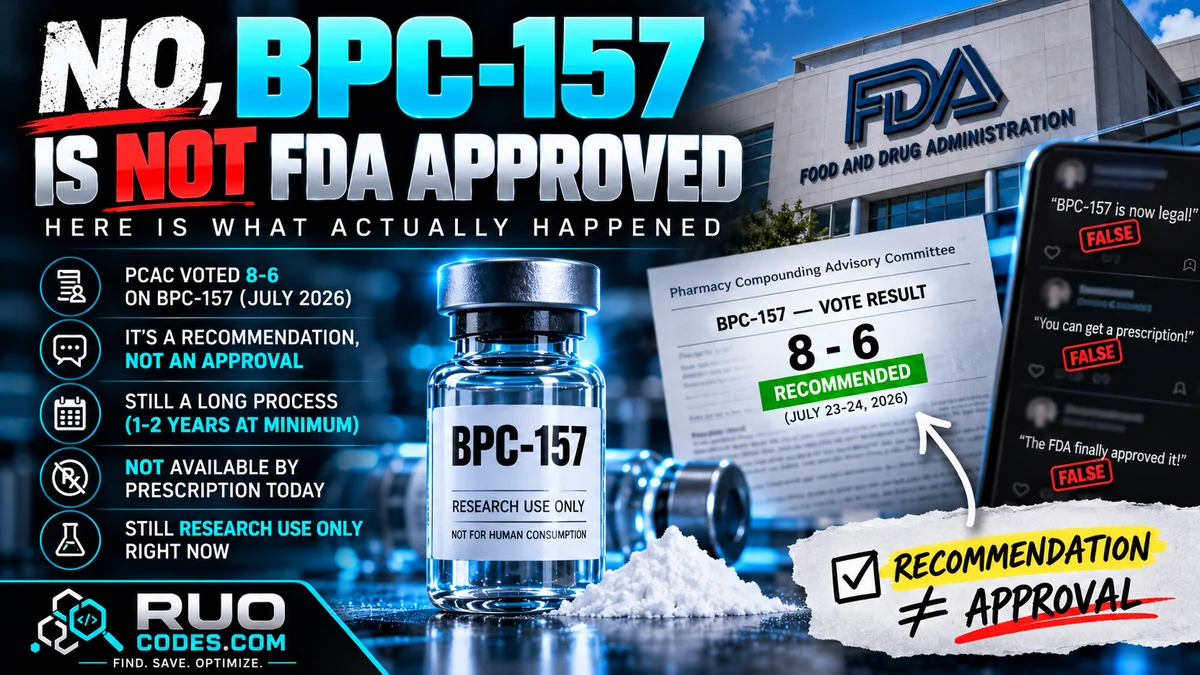
In July 2026, a government advisory panel voted to recommend that BPC-157 might eventually be allowed at licensed compounding pharmacies. That is it. BPC-157 is not FDA approved. You cannot get a prescription for it today. No doctor can legally prescribe it. Nothing changed on the ground. The process that could eventually lead to legal compounding access will take at minimum another one to two years — and that is if everything goes smoothly. The viral TikToks and social posts calling this an "approval" are wrong. Here is the full story.
You Have Probably Seen the Posts
"BPC-157 is now legal." "You can get a prescription!" "The FDA finally approved it!"
If you have spent any time in peptide communities this week, some version of that headline has crossed your feed. PBS NewsHour ran a story on September 29 that gave the news a second life, and now it is everywhere.
Here is the thing. The vote they are talking about happened back in July. And the people calling it an approval are getting it wrong in a pretty significant way.
This is not a knock on anyone getting excited. The news is genuinely encouraging if you understand what it actually means. But there is a big difference between "this compound took one step toward a potential legal pathway" and "you can now get this from your doctor." One of those is true. The other is not.
Let me break it down in plain language.
What Actually Happened in July 2026
There is a group called the Pharmacy Compounding Advisory Committee — a panel of scientists, doctors, and pharmacists who advise the FDA. Their job is to review specific compounds and give their recommendation on whether those compounds should be available through compounding pharmacies.
Think of it like a recommendation letter. The committee writes the letter. The FDA decides what to do with it. The committee does not make the final call.
On July 23 and 24, 2026, this committee reviewed seven peptides, including BPC-157. They voted 8-6 to recommend that BPC-157 be added to something called the 503A Bulk Drug Substances List. That list is basically a permission slip that would allow licensed compounding pharmacies — not regular pharmacies, but specialized ones that custom-make medications — to eventually prepare BPC-157 for individual patients.
The committee said yes, 8 to 6. That is a close vote, not a landslide.
But even that "yes" does not change anything today. Here is why.
The Recommendation Is Just the Beginning of a Long Process
When this committee makes a recommendation, the FDA has to go through a formal government process before anything actually changes. That process looks roughly like this:
- The FDA reviews the committee's recommendation and decides whether to move forward.
- If they do, they publish a proposed rule — essentially a draft of the new policy.
- The public gets a window to submit comments for or against it.
- The FDA reviews all those comments and writes a final rule.
- The final rule goes into effect on a set date.
That whole process, based on how long it has taken for other compounds in similar situations, realistically takes one to two years from the committee vote. That puts any real change at 2028 at the earliest — and that is the optimistic scenario.
Nothing about your current situation as a researcher changed in July, and nothing has changed today.
How the 503A compounding pathway works
The Same Vote Covered Six Other Peptides Too
BPC-157 was not the only compound on the table. Here is how the full July vote went:
| Compound | Vote | Outcome |
|---|---|---|
| BPC-157 | 8-6 | Recommended |
| TB-500 | 8-6 | Recommended |
| KPV | 8-6 | Recommended |
| MOTS-c | 7-5 | Recommended |
| Semax | Narrow majority | Recommended |
| Epitalon | Narrow majority | Recommended |
| Emideltide (DSIP) | 7-6 | Not recommended |
Every single one of these recommendations faces the same multi-year process before anything becomes operational. TB-500, which is widely used by researchers for recovery and tissue repair, got the same narrow 8-6 vote. So did KPV, which has significant interest for gut health research.
Keep an eye on all of these. The process applies equally to all of them.
How Did We Even Get Here?
A lot of this goes back to early 2026. In February, HHS Secretary RFK Jr. went on Joe Rogan's podcast and talked about wanting Americans to have legitimate, supervised access to peptides like BPC-157 and TB-500 instead of buying them through gray-market channels. He made it a stated policy goal.
That was not just talk. In March 2026, HHS formally announced that roughly 14 peptides would be reviewed for potential compounding access. The FDA convened the advisory committee in July specifically because of that policy direction.
That is actually meaningful context. Political will at the executive level is what pushed this review forward. Whether that same will stays consistent through the full rulemaking process is an open question — but the fact that it happened at all is a genuine signal that the landscape is shifting, just slowly and through proper channels.
RFK Jr. and what his peptide policy stance means
So Why Is Everyone Acting Like It Is Already Approved?
A few things are happening at once.
First, people who are genuinely excited about BPC-157 want it to be a bigger deal than it is, so they present it that way. That is human nature.
Second, the process is genuinely confusing. "Advisory committee vote" and "FDA approval" sound similar if you are not deep in how government regulatory processes work. Most people posting about this are not being deliberately dishonest — they just do not understand the difference.
Third, the PBS NewsHour story that ran September 29 reached a huge audience that had never heard of any of this. New people with no context got a simplified version of the story, and the simplified version lost the important caveats.
The result is a lot of well-meaning but inaccurate posts spreading through communities where people are making real decisions about where and how they research. That matters. Getting this wrong can lead to wasted effort chasing prescriptions that do not exist or misunderstanding what vendors can legally provide.
What This Means for You as a Researcher Right Now
Nothing about today's sourcing landscape has changed because of this vote.
BPC-157 is still available through Research Use Only vendors under the same framework that has applied for years. The enforcement environment — meaning which vendor behaviors attract FDA attention — is still driven by whether vendors make human-use claims, maintain proper testing documentation, and avoid therapeutic marketing language. The PCAC vote does not affect any of that.
If you are sourcing BPC-157 today, the same principles apply that have always applied. Third-party testing documentation — specifically mass spectrometry for identity and HPLC for purity from named, independent labs — is still the baseline standard that separates vendors operating defensibly from those that are not.
If and when BPC-157 eventually clears the full rulemaking process and becomes available through compounding pharmacies, that will create a new pathway. That would be significant news. But that is a 2028-or-later story, not a today story.
Peptide legal status by state · Full compound research encyclopedia
The Bottom Line
The July 2026 advisory vote is a real and meaningful step. If you have been following peptide policy for any length of time, it is the most encouraging regulatory signal the space has seen. The direction is right.
But a step toward something is not the thing itself. No prescription exists. No doctor can write one. No pharmacy can fill one. The timeline to any of that is measured in years, not months.
Watch this space. When the rulemaking actually advances — when a proposed rule gets published, when a public comment period opens, when a final rule gets issued — those are the moments worth updating your understanding of the landscape. Until then, the ground rules have not changed.
For the most current sourcing information, verified vendor testing standards, and the full compound research library, you can find everything at RUO Codes.
FDA 503A Bulk Drug Substances Nominated List · Alliance for Pharmacy Compounding
Frequently Asked Questions
Is BPC-157 FDA approved in 2026?
No. An advisory committee recommended in July 2026 that FDA consider placing it on a compounding pharmacy list. That recommendation starts a process that takes one to two years minimum. No prescription BPC-157 product exists today.
Can my doctor prescribe BPC-157 right now?
Not legally. There is no FDA-approved form of BPC-157 and no active compounding authorization. Until the rulemaking process completes, no physician can write a legal prescription for it.
Which peptides were recommended at the July 2026 vote?
BPC-157, TB-500, KPV, MOTS-c, Semax, and Epitalon all received recommendations. Emideltide (DSIP) did not. All six positive recommendations are subject to the same multi-year rulemaking process.
When will BPC-157 actually be available by prescription?
Based on historical FDA rulemaking timelines, the realistic estimate is 2028 at the earliest — and that assumes the process moves forward consistently. It could take longer.
Does this vote change anything for RUO vendors?
No. The advisory vote applies to the compounding pharmacy framework, which is separate from the Research Use Only supply chain. The enforcement environment for RUO vendors has not changed.
What is the difference between this vote and actual FDA approval?
A full FDA drug approval requires clinical trials, a New Drug Application, and years of review. This vote is about whether licensed compounding pharmacies could use BPC-157 as an ingredient — a completely different and narrower pathway, and one that still requires additional rulemaking before it becomes operational.
Sources
Alliance for Pharmacy Compounding — 503A Bulk Drug Substances Nominated List tracking — a4pc.org
FDA — 503A Bulk Drug Substances Nominated List — fda.gov
For research and educational purposes only. Not legal advice. Regulatory status current as of October 3, 2026.