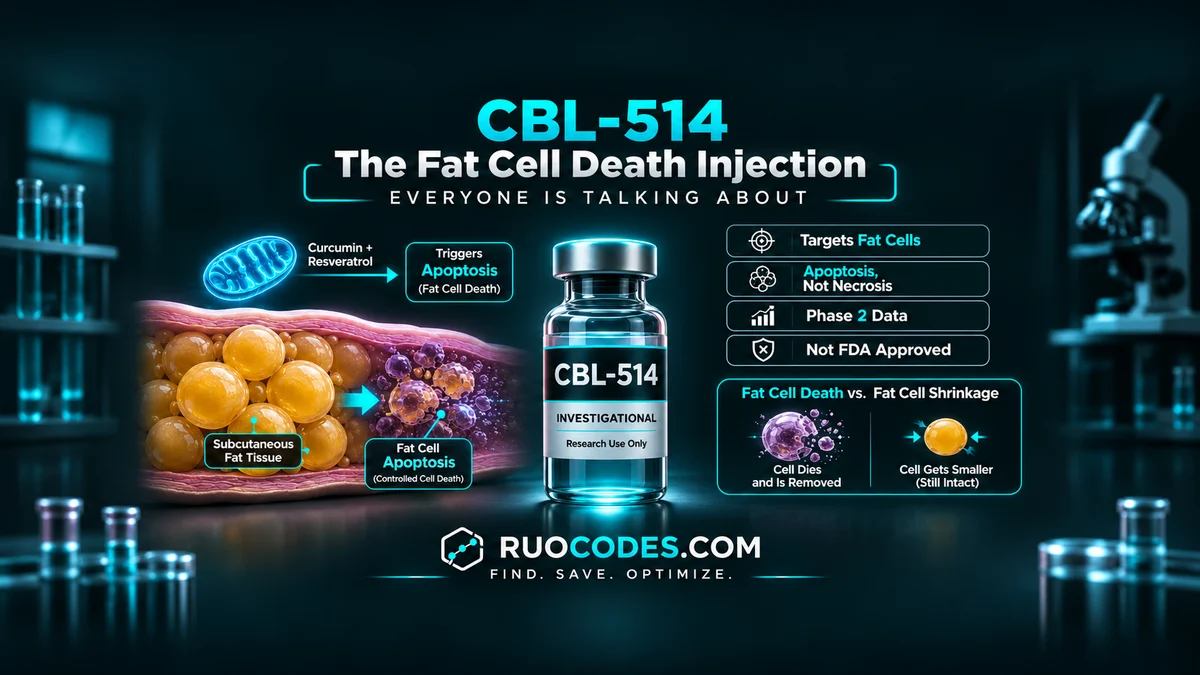
Updated November 17, 2026: corrected the description of CBL-514's composition. Its developer describes it as a small-molecule injectable. An earlier version of this post described it as curcumin and resveratrol, which we could not confirm in the developer's materials, so that material was removed.
If your social media feed looks anything like mine lately, you've probably seen someone claim that CBL-514 is going to dissolve belly fat in a few sessions and change body composition forever. The hype is real. The compound is real. The clinical trial results are genuinely impressive for what they set out to do.
But there's a lot being left out of those posts — specifically, what it actually takes to get those results. This isn't a hype post. This is the full picture, broken down for anyone trying to understand what CBL-514 actually is, what the science says, and why the most compelling use case right now might not be the one making the rounds on TikTok.
TLDR
- CBL-514 is not a peptide. Its developer, Caliway, describes it as a small-molecule injectable that triggers fat cell death in the treated area.
- It works by causing fat cells to self-destruct (apoptosis) rather than just shrink. That's the key difference from diet, GLP-1 drugs, or even most fat-dissolving treatments.
- The Phase 2 trial results were real and significant. 70% of people on the drug lost at least 150 milliliters of subcutaneous belly fat by 8 weeks after their last session, compared to zero on placebo.
- The administration is extremely intense. One full session is up to 50 injections across your belly, 120 milliliters of fluid, and up to 600 milligrams of drug — repeated up to four times, four weeks apart.
- 94% of people on the drug had injection site pain.
- CBL-514 is NOT FDA approved and NOT commercially available. Caliway, the company developing it, has explicitly stated it has not authorized anyone to sell or supply it. Phase 3 trials started in late 2026.
- The most interesting application right now may actually be Dercum's disease — painful fatty lumps with no approved treatment — where it uses far fewer injections and shows strong results.
- It is for research use only. Nothing here is dosing guidance or medical advice.
What Is CBL-514 and Where Did It Come From?
CBL-514 is an injectable compound developed by a Taiwan-based biotech company called Caliway Biopharmaceuticals. It is not a peptide. Caliway describes it as a first-in-class small-molecule lipolysis injectable delivered into subcutaneous fat tissue. [20]
Because fat cells sit underneath the skin, the drug goes directly into that layer, and it shows up in the bloodstream only at modest levels after the injections.
CBL-514 is entirely investigational. It has not been approved by the FDA, the TGA, or any other regulatory body for any medical use. Caliway published a formal statement in October 2026 specifically noting that CBL-514 is not commercially available in any country and that it has not authorized any party to sell or supply it. If you are seeing it offered through a research vendor, you should know that is happening without the developer's authorization. [15]
How Does It Actually Kill Fat Cells?
Two ways cells can die — and why the difference matters
Cells die in two fundamentally different ways, and understanding this helps explain why CBL-514 was designed the way it was.
Necrosis is chaotic cell death. The cell is damaged, swells, and bursts. When that happens, its contents spill into surrounding tissue and trigger inflammation. This is what deoxycholic acid (the active ingredient in the FDA-approved fat injection Kybella) does. Kybella's label calls it a cytolytic drug — it physically destroys the fat cell membrane. That's why it works for a small area like the chin, but its approved label also lists the risk of nerve injury, skin ulceration, and tissue necrosis at the injection site.
Apoptosis is controlled, programmed cell death. The cell runs an orderly shutdown: it shrinks, breaks down its own contents, packages them into small sealed fragments, and signals immune cells called macrophages to come clean up the pieces. No rupture. No spill. The surrounding tissue doesn't get the same inflammatory signal it would from necrotic cell death.
CBL-514 is designed to trigger apoptosis. That selectivity is the reason it can be spread across a large area like the belly rather than just a small area like the chin. In the Phase 2 trial, there were no cases of skin necrosis, ulcers, or nerve injury.
The molecular mechanism
The balance between life and death inside a cell is partly regulated by a pair of proteins: Bcl-2 (keeps the cell alive) and Bax (pushes it toward death). When the Bax side of that balance wins, the mitochondria release signals that activate enzymes called caspases, and caspase-3 is a primary executor of the shutdown sequence.
Caliway reports that in lab and animal studies, CBL-514 raised the Bax to Bcl-2 ratio, activated caspase-3, and caused dose-dependent fat cell apoptosis. It also blocks a protein called DYRK1B, which helps cells survive. Put simply, CBL-514 appears to be pushing multiple switches in the same direction: inhibit cell survival, promote cell breakdown. [1] [2]
Why fat cell death is different from fat cell shrinkage
Adults generally have a fixed number of fat cells. A landmark 2008 study published in Nature traced fat cells using carbon left in the atmosphere by Cold War nuclear bomb tests and found that about 10% of fat cells are replaced each year, while the total count stays approximately constant through adulthood — even after major weight loss. When you lose weight through diet, calorie restriction, or a GLP-1 drug like semaglutide, the fat cells mostly get smaller. They're still there. If you regain the weight, they fill back up. [3]
CBL-514, like liposuction and fat-freezing, removes or kills the fat cells in the treated area. The idea is that if the cells in an area are gone, they can't refill. Whether that holds long-term is one of the things Phase 3 is trying to establish.
What the Clinical Trials Actually Showed
Dose-finding study (2020)
The first trial that tells us anything about how well CBL-514 works ran in Australia with 43 people and no placebo group. COVID cut one dose group short at 7 people. Up to four sessions, two weeks apart, were given at three dose levels: 1.2, 1.6, or 2.0 milligrams per square centimeter of belly.
At four weeks after the last session, fat volume in the treated area was down about 5% at the lowest dose, 17% at the middle dose, and 23% at the top dose. At eight weeks it was approximately 4%, 14%, and 22%. The top dose reduced fat layer thickness by about 7 millimeters. The 2 mg/cm² dose became the standard going forward based on these results. [2]
Phase 2 trial (2022–2023, published 2025)
This is the trial that produced the results making the rounds on social media. It ran from February 2022 to March 2023 at five centers in the United States and Australia. 76 people were randomized — 2 to 1 — to CBL-514 or a saltwater placebo, with up to four sessions four weeks apart. Participants didn't know which group they were in. Most were women in their mid-40s with an average BMI of around 27.
The main question was: what share of people lost at least 150 milliliters of subcutaneous fat (measured by ultrasound)?
The results were real and statistically significant:
| Outcome | CBL-514 | Placebo |
|---|---|---|
| Lost ≥150 mL at 4 weeks post-treatment | 64% | 17% |
| Lost ≥150 mL at 8 weeks post-treatment | 70% | 0% |
| Lost ≥200 mL at 8 weeks post-treatment | 61% | 0% |
The average loss in the drug group was about 200 milliliters at four weeks and 210 milliliters at eight weeks — a bit less than a cup. People who fully completed the protocol lost about 280 to 315 milliliters. The largest single loss was over 750 milliliters.
One thing that tends to get left out: almost half the people who started didn't finish. 37 of the 75 treated participants dropped out for various reasons — strict weight requirements, missed visit windows, side effects, and voluntary withdrawal. Only 30 people met every rule for the per-protocol analysis. That matters when interpreting the numbers. The study was also designed to hold body weight constant; anyone whose weight moved by 3 kilograms or more was removed. This is a body-contouring trial, not a weight loss trial. [1] [7]
Phase 2b trials (2024–2025, Phase 3 ongoing)
Two larger Phase 2b trials have been run and reported by Caliway, though these have been published only in company press releases and investor materials rather than peer-reviewed journals.
CBL-0204 enrolled 107 people, split evenly between CBL-514 and placebo, with sessions every three weeks and fat measured by MRI. [12]
- At least one grade better on the doctor's scale at 12 weeks after last session: 77% drug vs. 19% placebo
- Two grades or more: 32% drug vs. 0% placebo
- Lost ≥150 mL by MRI at 4 weeks: 50% drug vs. 0% placebo
- Fat layer about 27% thinner than placebo at 4 weeks
CBL-0205 had 173 people at 15 US and Canadian sites across four groups including CBL-514, two comparison formulations (CBL-A1 and CBL-A2), and placebo. MRI fat volume at 4 weeks: CBL-514 down about 167 milliliters (22%), placebo up about 16 milliliters, and the two comparison formulations each down about 70 milliliters (around 11%). On the dual two-grade improvement measure — which is what Phase 3 is testing — 21% of CBL-514 hit it, compared to 0% on placebo. [13]
Phase 3 (SUPREME-01 and SUPREME-02) are both underway. The first patient in SUPREME-01 was dosed in September 2026. SUPREME-02 started enrolling October 29, 2026. Both are double-blind, placebo-controlled, with about 320 adults each in North America, up to four sessions every four weeks, and primary completion listed for mid-2027. [8] [9] [16] [17]
What One Full Treatment Session Actually Looks Like
This is the part that most social media posts skip. It matters a lot.
The Phase 2 and Phase 3 protocols describe the following procedures for trial participants:
Before the session: Participants took an oral painkiller. A topical anesthetic was applied to the belly. A cold pack was used if needed.
During the session: A grid was marked on each participant's stomach, with points spaced 2.45 centimeters apart (just under an inch). Each point received its own injection of 2.4 milliliters at a concentration of 5 mg/mL — that's 12 milligrams of drug per injection. A full session was 50 injections.
Per full session math:
- 50 injections
- 600 milligrams of drug
- 120 milliliters of fluid (about half a cup)
- Covering roughly 300 square centimeters of belly
After the session: A cold pack was applied. Participants stayed at the clinic for at least an hour while staff monitored their injection sites and vital signs. Participants went home with a diary to log changes to their skin.
The full course: Up to four sessions, four weeks apart. That's 200 injections, 2.4 grams of drug, and close to half a liter of fluid over the entire course.
For comparison, Kybella — the only FDA-approved fat-dissolving injection — treats the chin at the same 2 mg/cm² dose, but a full session is up to 50 injections of only 0.2 milliliters each, totaling 10 milliliters and 100 milligrams. CBL-514's belly session uses the same number of needle sticks but each injection is 12 times larger, delivering 12 times the fluid and 6 times the drug per session. The belly is simply a much larger area to treat than the chin. [18] [19]
Side Effects: The Real Numbers
The side effect data from the Phase 2 trial should be read carefully before forming an opinion on this compound. These are the injection site reactions:
| Reaction | CBL-514 | Placebo |
|---|---|---|
| Pain | 94% | 65% |
| Redness | 94% | 69% |
| Itching | 86% | 42% |
| Swelling | 84% | 65% |
| Warmth | 84% | 31% |
| Bruising | 78% | 85% |
| Skin discoloration | 71% | 12% |
| Firm areas under skin | 61% | 8% |
Bruising was about equal because both groups got the same needle sticks. The placebo group still had 65% pain from injections alone. Most reactions were mild to moderate. Severe reactions — all of them injection site pain — happened in 9 of 49 people on the drug. That's about 1 in 5 people experiencing severe pain.
About 60% of people with pain took something for it, mostly over-the-counter painkillers. About 90% had their pain resolve within a week. Two people stopped due to side effects: one for pain, one for discoloration.
In the dose-finding study, 95% of participants had itching and 20 people took antihistamines. Eight of the 43 participants withdrew due to side effects, mostly injection site pain.
A note on lipids: in the dose-finding study, four people had increases in triglycerides or cholesterol that investigators thought could be related to the drug — all four started near or above the upper limit of normal. In the Phase 2 trial, two people with pre-existing high cholesterol showed raised lipids at one visit. This is worth monitoring in future trials. No cases of skin necrosis, ulcers, or nerve injury were reported in either trial, but these trials do not establish a comparative safety advantage over Kybella. [1] [2]
The Visceral Fat Signal and GLP-1 Combination Research
A lot of the recent social media hype isn't just about belly fat — it's about visceral fat, the fat packed around organs inside the abdominal cavity. That's a different layer than what CBL-514 targets. CBL-514 goes into subcutaneous fat, which is the layer between the skin and the muscle wall.
At the European Diabetes conference in September 2026, Caliway presented an MRI analysis that pooled participants from both Phase 2b trials who had visceral fat data: 23 on CBL-514 and 17 on placebo, all with BMIs between 22 and 30. At four weeks after treatment, visceral fat was down about 12% in the drug group and up 6% in the placebo group. At a later visit, it was down 10% against up 12%.
This is worth noting — but also worth calibrating. That's a combined pool of 40 people from trials that weren't originally designed to measure visceral fat. It's a signal worth watching, not a proven finding. [14]
The more intriguing research direction is the GLP-1 combination work. When rats were taken off tirzepatide, the ones that had been on tirzepatide alone showed a 46% rebound in body weight four weeks later, compared to only 17% when CBL-514 had been added alongside it. Similar animal results have been reported with semaglutide and eloralintide. The FDA cleared a human trial combining CBL-514 with tirzepatide (CBL-0201WR) in August 2026. It plans to enroll about 120 people at 10 US sites, with subcutaneous belly fat by MRI as the primary measure. The logic is that GLP-1 drugs shrink fat cells and CBL-514 kills them, and killing cells that have been shrunk might reduce the rebound effect when someone stops the GLP-1.
That's a genuinely interesting hypothesis. The human trial will tell us whether the animal data holds up.
Dercum's Disease: The Most Compelling Current Application
This is the part of the CBL-514 story that isn't getting nearly enough attention.
Dercum's disease causes painful fatty lumps called lipomas, mostly on the trunk and the parts of the arms and legs closest to the body. There is no FDA-approved treatment. The condition significantly impacts quality of life for people who have it.
CBL-514 is being tested here under the name CBL-514D, administered differently than in the belly trials. Instead of a grid across a large area, the drug is injected directly into each individual lump, with the volume based on the lump's size on ultrasound.
Phase 2a results: In 12 people who received 10 or 15 milligrams per injection in up to two sessions, lump volume was down a median of 46% and 59% at four weeks. About a quarter of the lumps cleared completely. Pain dropped by a median of 4 points. [6]
Randomized Phase 2 results: Compared to placebo across up to five sessions, four weeks apart: pain was down 3.5 points on the drug versus 1.7 on placebo at week 16, 3.1 versus 1.9 at week 20, and 4.1 versus 1.7 at week 24. Those are consistent, meaningful separations on a pain scale for a condition with no current approved therapy. [11] [21]
The reason this is a more compelling application than belly fat treatment comes down to dose and burden. Injecting individual lumps requires far fewer injections at much lower total milligrams than spreading a grid across the entire abdomen. A lower total dose does not by itself establish a smaller side effect burden. The target is a painful condition with no approved treatment, and the reported pain reductions persisted across multiple visits. Comparative safety has not been established. For something with no approved treatment, even a moderate effect is meaningful.
What We Still Don't Know
The longest belly-fat follow-up data reported so far is 12 weeks after the last session. That means several important questions remain unanswered:
Does the fat stay off? No one has shown whether the reduced fat volume holds at 6, 12, or 24 months. Caliway has a follow-up study tracking people at 6, 9, and 12 months — those results will be worth watching closely.
What happens if someone gains weight? If fat cells in the treated area are gone, the biology suggests excess fat would have to go somewhere else or expand remaining cells. No human data exists yet on weight regain after CBL-514.
What do long-term lipid effects look like? The lipid signals in early trials were modest and mostly in people who already had elevated levels, but longer-term monitoring in Phase 3 will be more informative.
Will the Phase 3 endpoints hold? SUPREME-01 and SUPREME-02 are testing a stricter outcome than Phase 2 — a two-grade improvement on both the doctor's and patient's scale. That is a higher bar. Phase 2b data suggests 21% of participants hit that measure; Phase 3 will test whether that holds in a larger, more rigorously controlled group.
Is It Worth It? A Research Perspective
CBL-514 is effective in the clinical trials for what it was designed to do: reduce subcutaneous fat in a targeted area by killing fat cells. The Phase 2 numbers are genuinely strong, and the apoptosis mechanism differs from the cytolytic approach of Kybella. That mechanistic difference does not establish clinical superiority; comparative evidence is needed.
The honest research perspective is this: the question of whether it is worth it depends entirely on what someone is trying to solve.
For general belly fat reduction in someone with a healthy BMI who could address the same fat through diet, exercise, or a GLP-1 drug, the administration burden is high and the side effect profile — 94% injection site pain, significant itching, skin discoloration in 7 out of 10 people — was substantial in this trial. These findings do not establish a ranking against other research compounds. That's a real trade-off to weigh against a result that, while meaningful, is measured in roughly 200 milliliters over a cup-sized area.
For someone with Dercum's disease who has painful, disfiguring lumps and no other treatment options, the picture is different. Far fewer injections, lower total dose, a condition with no alternatives, and consistent pain reduction across multiple trial visits.
For the GLP-1 combination application, the hypothesis is compelling enough to watch as human trial data comes in over the next 12 to 18 months.
CBL-514 is not approved. It is not commercially available. Phase 3 is actively enrolling. Everything here is research-stage data for research-educated audiences.
Frequently Asked Questions
What is CBL-514 made of?
Caliway describes CBL-514 as a first-in-class small-molecule lipolysis injectable. RUO Codes has not confirmed its specific ingredients from Caliway's published materials.
How is CBL-514 different from Kybella?
Both are injectable fat-reduction compounds, but they work differently. Kybella (deoxycholic acid) is FDA-approved for chin fat and works by physically destroying the fat cell membrane, causing the cell to burst and release its contents — a form of cell death called necrosis. CBL-514 is designed to trigger apoptosis, a controlled, programmed cell death that doesn't cause the same inflammatory burst. CBL-514 also targets a much larger area than Kybella and uses significantly higher volumes per session. Neither is without side effects.
Is CBL-514 approved by the FDA?
No. CBL-514 is investigational. It is not FDA-approved, TGA-approved, or approved by any regulatory body for any use. Phase 3 trials started enrolling in late 2026 with primary completion expected in mid-2027. Caliway has explicitly stated that CBL-514 is not commercially available in any country and that it has not authorized anyone to sell or supply it.
How many injections is one session of CBL-514?
A full session in the Phase 2 and Phase 3 trials is up to 50 injections across a marked grid on the belly, spaced about 2.45 centimeters apart, covering roughly 300 square centimeters. Each injection delivers 2.4 milliliters of fluid and 12 milligrams of drug. A full session totals 600 milligrams and 120 milliliters. Up to four sessions are given, four weeks apart.
How does CBL-514 compare to GLP-1 drugs for fat loss?
They work in completely different ways and target different things. GLP-1 drugs like semaglutide and tirzepatide reduce appetite and produce fat loss throughout the body by causing fat cells to shrink. CBL-514 only works where it is injected, doesn't affect appetite, and was specifically designed to hold body weight constant. It falls into the body-contouring category, alongside liposuction and fat-freezing — treating one area at a time rather than producing whole-body weight loss.
What are the most common side effects of CBL-514?
In the Phase 2 trial, 94% of people on CBL-514 had injection site pain and redness, 86% had itching, and 84% had swelling and warmth. Skin discoloration was reported in 71% and firm areas under the skin in 61%. Most reactions were mild to moderate. Severe injection site pain occurred in about 1 in 5 participants on the drug. No cases of skin necrosis, ulcers, or nerve injury were reported.
What is Dercum's disease and why is CBL-514 being studied for it?
Dercum's disease causes painful fatty lumps called lipomas, mostly on the trunk and proximal limbs, with no approved treatment. CBL-514 is injected directly into each lump rather than spread across a grid, requiring far fewer injections and much lower total milligrams than the belly application. Phase 2 trials showed lump volume reduction of 46–59% and meaningful, consistent pain reduction versus placebo across multiple visits — results that stand out for a condition with no existing approved therapy.
Related Research
Sources
- Gold et al., Aesthetic Surgery Journal 2025 (Phase 2 trial).
- Goodman et al., Aesthetic Surgery Journal 2022 (dose-finding).
- Spalding et al., Nature 2008 (fat cell turnover).
- Rayalam et al., Phytotherapy Research 2008 (resveratrol, fat cells).
- Ejaz et al., Journal of Nutrition 2009 (curcumin, fat cells).
- Herbst et al., JAAD International 2025 (Dercum's Phase 2a).
- ClinicalTrials.gov NCT04897412 (Phase 2).
- ClinicalTrials.gov NCT07140939 (SUPREME-01 Phase 3).
- ClinicalTrials.gov NCT07526974 (SUPREME-02 Phase 3).
- ClinicalTrials.gov NCT05234736 (ingredients and blood levels).
- ClinicalTrials.gov NCT06303570 (Dercum's randomized trial).
- Caliway CBL-0204 topline results, Dec 11, 2024.
- Caliway CBL-0205 results, Feb 9, 2025.
- Caliway EASD 2026 visceral fat release.
- Caliway statement on misleading CBL-514 sales information, Oct 30, 2026.
- Caliway SUPREME-01 first patient release, Sep 2026.
- Caliway SUPREME-02 enrollment release.
- Kybella prescribing information.
- CBL-0202 trial protocol v8.0.
- Caliway company profile and Taiwan headquarters.
- Caliway randomized Phase 2 Dercum's disease results, September 21, 2026 (sponsor report).
Research Use Only
Research Use Only. CBL-514 is investigational and not approved by the FDA or any other regulatory body for any purpose. Nothing in this post is medical advice, a protocol, or a recommendation to source this compound. Caliway Biopharmaceuticals has stated that CBL-514 is not commercially available in any country and has not authorized any party to sell or supply it. Consult a qualified healthcare professional before making any health decision. RUO Codes earns commissions through affiliate vendor relationships.