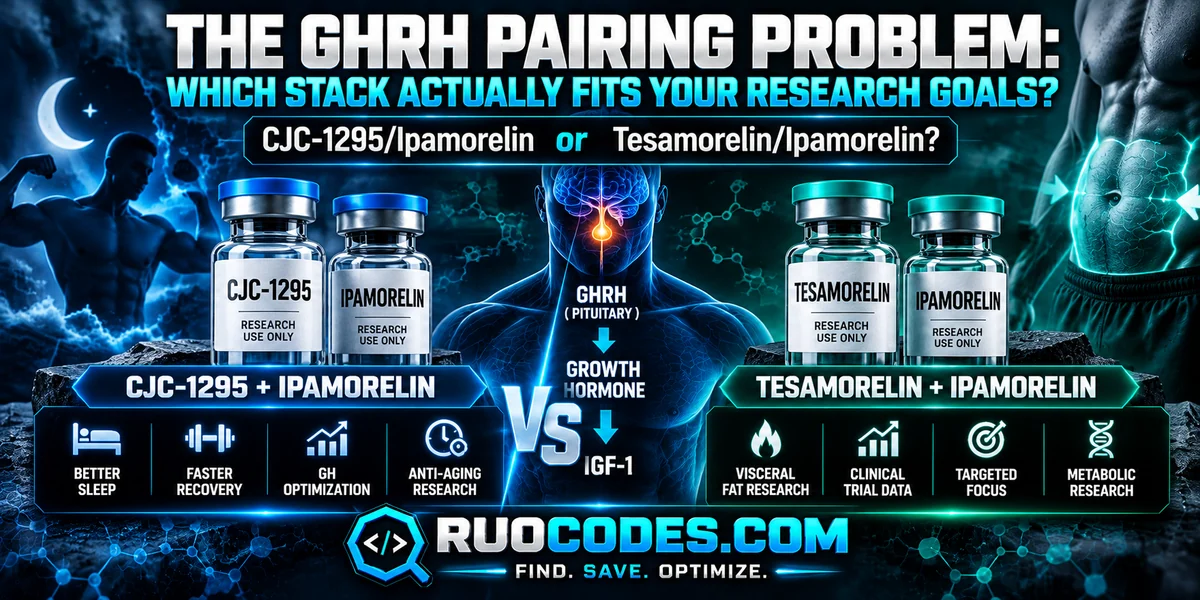
The GHRH Pairing Problem: Which Stack Actually Fits Your Research Goals — CJC-1295/Ipamorelin or Tesamorelin/Ipamorelin?
Disclaimer: This article is for research and educational purposes only, not medical advice or a self-treatment guide. Prescription tesamorelin has a specific FDA-approved indication for excess abdominal fat in adults with HIV-associated lipodystrophy. Neither combination discussed here is FDA approved, and research-use-only products are not approved medicines for human use. Clinical treatment decisions require a qualified healthcare professional.
TLDR — The Quick Answer
For visceral fat research, tesamorelin alone has Phase III clinical trial evidence in adults with HIV-associated lipodystrophy. That evidence does not establish the effectiveness or safety of adding ipamorelin, and it does not establish either combination as a treatment for healthy adults.
CJC-1295 (no-DAC)/Ipamorelin is discussed in research communities for sleep, recovery, and GH-axis questions. These are proposed research interests, not benefits established by controlled trials of the combination. Neither pairing has an established, approved novice-use protocol.
The short version from Biolongevity Labs sums it up well: "On a per-cost basis, CJC-1295 is just slightly more preferable" for general use — and Tesamorelin earns its premium specifically when visceral fat is the main target.
Neither is a replacement for the other. They're tools for different jobs.
Why Researchers Explore These Peptides in the First Place
Before comparing the two stacks, it helps to understand what they're trying to do at a biological level — because without that context, the differences won't make much sense.
Your body releases growth hormone (GH) in pulses throughout the day, with the biggest pulse happening during deep sleep. GH is the master signal for repair, metabolism, and tissue remodeling. But GH doesn't work alone — it triggers the liver to produce a secondary hormone called IGF-1 (insulin-like growth factor 1), which is the downstream messenger responsible for most of GH's effects on muscle, fat, and recovery.
The hypothalamus, a small region in your brain, controls this whole system. It releases GHRH (growth hormone releasing hormone), which tells the pituitary gland to fire a GH pulse. The pituitary also responds to a completely separate signal called ghrelin — the "hunger hormone" — which activates a different receptor to push out more GH.
Here's where peptide research gets interesting: by using synthetic molecules that mimic GHRH (the "GHRH analogs") and others that mimic ghrelin (the "GHRPs — growth hormone releasing peptides"), researchers can study how to amplify the body's own GH production through two independent pathways simultaneously.
CJC-1295 and Tesamorelin are both GHRH analogs. Ipamorelin is a GHRP. Pairing one from each category is the research strategy at the heart of this comparison.
Why Ipamorelin Is the Go-To GHRP Pairing
If you've spent any time reading about GH secretagogue stacks, you've probably noticed that ipamorelin comes up again and again as the GHRP of choice. There's a specific reason for that — and it matters for understanding why these stacks work the way they do.
The GHRP family includes older peptides like GHRP-6 and GHRP-2. These work, but they have a baggage problem: they stimulate GH alongside a significant spike in cortisol (the stress hormone) and in GHRP-2's case, prolactin as well. GHRP-6 is also notorious for causing intense hunger — which is manageable if you're intentionally trying to eat more, but disruptive if you're not.
Ipamorelin was discovered specifically as the first selective growth hormone secretagogue (Raun et al., 1998, Eur J Endocrinol). What "selective" means in practice: in studies on conscious swine, ipamorelin released GH with similar potency to GHRP-6 — but at doses more than 200-fold higher than the effective threshold, it produced no significant increase in ACTH or cortisol. GHRP-6 and GHRP-2 caused marked cortisol spikes at comparable doses. Ipamorelin also didn't affect FSH, LH, prolactin, or TSH.
This selectivity profile is the main reason researchers prefer ipamorelin: you get the GH release without the hormonal noise. It acts through the ghrelin receptor (GHSR-1a) via a different signaling pathway (PKC/Ca²⁺) than GHRH analogs use (cAMP/PKA). When you pair the two, you get genuine receptor-level synergy — two independent systems converging on the same outcome (more GH) without either signal drowning out the other.
The trade-off is that ipamorelin produces a somewhat lower peak GH release than GHRP-6 at comparable doses. In research contexts where a cleaner hormonal profile matters more than raw GH amplitude, that's a worthwhile trade.
Ipamorelin's half-life is approximately 2 hours, with a peak GH response around 40–60 minutes post-injection (Dominikowski et al., 2026, Frontiers in Endocrinology). That timing aligns well with pre-sleep injection protocols designed to amplify the body's natural nocturnal GH pulse.
CJC-1295: What It Is and What Research Shows
CJC-1295 is a synthetic version of GHRH — specifically, it's built on the GHRH backbone with four amino acid substitutions that make it more resistant to the enzymes that normally break GHRH down quickly. Natural GHRH has a half-life of only about 4 minutes. Those four structural tweaks extend that considerably.
But here's where you immediately hit an important naming problem: "CJC-1295" actually refers to two different compounds, and confusing them is one of the most common mistakes in peptide research discussions.
CJC-1295 with DAC includes an additional modification — a chemical linker that allows the peptide to bind to a protein in your blood called albumin. This "Drug Affinity Complex" (DAC) creates a depot effect. Once it binds albumin, a single injection can produce GH elevation lasting 6 or more days, and IGF-1 elevation lasting 9–11 days. In human Phase I trials (Teichman et al., 2006, J Clin Endocrinol Metab), a single dose of CJC-1295 with DAC raised mean plasma GH by 2- to 10-fold and IGF-1 by 1.5- to 3-fold. The estimated half-life was 5.8–8.1 days.
The short-acting compound commonly sold as “CJC-1295 without DAC” (Mod-GRF 1-29) is not the albumin-binding CJC-1295 studied in the published DAC trials. It acts as a GHRH pulse amplifier that clears within hours — making it behaviorally much more similar to how natural GHRH works. No peer-reviewed human pharmacokinetic data specifically characterize this variant, but the community widely uses it precisely because its short action preserves natural GH pulsatility.
Research-community discussions often favor the shorter-acting no-DAC compound because exposure is expected to be shorter. This is not proof of superior safety or a validated dosing schedule. The DAC form's prolonged exposure changes the duration of an adverse response, but the no-DAC human safety dataset is also limited. Notably, the FDA has placed CJC-1295 (the DAC form) on its compounding safety-risk list, citing vasodilatory reactions and tachycardia.
What about the evidence for performance, recovery, and body composition? Here's the honest picture: CJC-1295 has never been studied in a human clinical trial for body composition outcomes. The two published human trials (Teichman et al., 2006; Ionescu & Frohman, 2006) measured only GH and IGF-1 as endpoints. A Phase II trial in HIV patients with visceral obesity was terminated in 2006 when a participant died — though the attending physician believed the death was unrelated to the peptide, the program was discontinued and results were never published.
This doesn't mean CJC-1295 doesn't produce body composition effects — stimulating GH and IGF-1 is biologically meaningful. It means those effects haven't been formally measured in a controlled trial. Any body composition claims for CJC-1295 are extrapolated from GH physiology, not from CJC-1295-specific outcome data.
As Biolongevity Labs notes: "CJC-1295 has been more thoroughly field-tested for the purposes of performance recovery and overall metabolic health" — field-tested is the operative phrase here, meaning community and clinical experience rather than formal trials.
Tesamorelin: What Makes It Different
Tesamorelin is also a GHRH analog — it's built on the full-length GHRH(1-44) sequence with a small chemical modification at one end (an N-terminal hexenoyl group) that protects it from being broken down too quickly. Its half-life is 26–38 minutes (Dominikowski et al., 2026, Frontiers in Endocrinology), which means it requires daily dosing but also means each day's dose clears completely before the next one — but half-life alone does not establish the pattern or clinical benefits of a combination. The current EGRIFTA WR label reports an 11-minute mean elimination half-life for its formulation.
Here's what makes Tesamorelin unique among all GHRH analogs: it's the only one with FDA approval. Specifically, it was approved in November 2010 under the brand name Egrifta for the reduction of excess abdominal fat in HIV-infected adults with lipodystrophy — a condition where antiretroviral medications suppress GH production and cause visceral fat to accumulate abnormally. A newer formulation received updated approval in March 2025.
That FDA approval is backed by real Phase III trial data. In the landmark NEJM trial involving 412 HIV patients, daily subcutaneous tesamorelin for 26 weeks reduced visceral adipose tissue by 15.2% versus a 5% increase in the placebo group. IGF-1 rose by 81% in the treatment group (Falutz et al., 2007, N Engl J Med). A pooled analysis of both Phase III trials (n=806) confirmed a treatment effect of -15.4% in VAT reduction (Falutz et al., JCEM 2010, PMID 20554713). A 2026 meta-analysis of 5 RCTs confirmed these findings, showing significant reductions in VAT, trunk fat, and liver fat percentage, alongside an increase in lean body mass (Badran et al., 2026, Obesity Research & Clinical Practice).
There's also a smaller but important non-HIV study: a 12-month randomized trial in 60 abdominally obese adults with reduced GH secretion found tesamorelin produced approximately a 19% improvement in VAT compared to placebo (Makimura et al., JCEM 2012, PMID 23015655). This is the closest we have to evidence in a general (non-HIV) population — and it suggests the mechanism translates, at least in people with some degree of GH suppression.
One important caveat: tesamorelin doesn't eliminate fat permanently. When people in the Phase III trials stopped the drug, visceral fat largely returned within months. This means the intervention requires ongoing use to maintain its effects.
As Biolongevity Labs puts it: "Tesamorelin has been specifically studied within the confines of visceral fat reduction, whereas CJC-1295 has not. That's not to say CJC-1295 would be completely incapable of targeting visceral fat… it just hasn't been investigated under such specific circumstances."
Head-to-Head Comparison
The clinical results and approval entries below concern the individual GHRH component, not the combination. Neither pairing has controlled human efficacy data. Costs are the author's illustrative estimates, not current price quotations.
| Category | CJC-1295 (no DAC)/Ipamorelin | Tesamorelin/Ipamorelin |
|---|---|---|
| Mechanism | GHRH analog (pulse amplifier) + GHSR-1a agonist | GHRH analog (daily stimulation) + GHSR-1a agonist |
| Half-life (GHRH component) | Short-acting no-DAC compound; robust human PK data are limited | 26–38 min in the review; EGRIFTA WR label: 11 min, formulation-specific |
| Visceral fat evidence | No controlled human data | Tesamorelin alone: Phase III RCTs in HIV lipodystrophy; combination untested |
| Muscle/recovery evidence | Anecdotal + mechanism extrapolation only | No controlled data for this goal |
| IGF-1 elevation | Extrapolated (no formal human data for no-DAC) | 81% increase in the tesamorelin-alone Phase III trial; not a combination result |
| Cost (RUO, per month) | ~$80–$200/month | ~$200–$450/month |
| FDA status | Not approved; DAC form on compounding risk list | Prescription tesamorelin approved for HIV lipodystrophy; combination not approved |
| Best-fit use case | Proposed sleep, recovery, and GH-axis research; benefits unproven | Tesamorelin-alone visceral-fat research; pairing benefits unproven |
| Novice-friendliness | No established safe novice-use protocol | No established safe novice-use protocol |
| Evidence grade | Community consensus + mechanism | Individual-agent Phase III evidence; no combination-specific trial |
The Synergy Story: Why Pairing Works
Both GHRH analogs and ipamorelin increase GH, but they do it through completely separate pathways. GHRH analogs work at the GHRH receptor (GHRH-R) using a cAMP/PKA signaling cascade in the pituitary. Ipamorelin works at the ghrelin receptor (GHSR-1a) using a PKC/Ca²⁺ signaling cascade. Because these are independent molecular paths converging on the same GH-releasing machinery, using both simultaneously produces more GH than either alone.
Mechanistic literature supports interactions between GHRH and ghrelin-receptor signaling, as summarized in the 2026 Frontiers review. This is class-level biological rationale, not a clinical test of either exact combination. It cannot establish a universal protocol or prove body-composition benefits.
The key downstream effect is IGF-1. When GH hits the liver, it triggers IGF-1 production via the JAK2/STAT5 pathway. IGF-1 then activates anabolic signaling in muscle, fat, and connective tissue through PI3K/Akt, mTOR, and MAPK/ERK cascades. The lipolytic effect on visceral fat — the reason researchers are interested in these stacks for body composition — runs through this same GH/IGF-1 axis.
No head-to-head or combination-specific trials exist for either pairing. The synergy logic is pharmacologically sound, but the body composition and recovery benefits of the combinations specifically have not been tested in controlled human trials.
Dosing Protocols: Published and Community Context
Evidence boundary: Community schedules are described here to explain online research discussions, not endorsed for self-administration. No approved dosing schedule exists for either pairing; prescription-label dosing applies only to the named approved formulation.
These are community- and clinically-derived research protocols. They are not FDA-approved dosing guidelines and are presented for educational reference only.
CJC-1295 (no DAC) / Ipamorelin
The typical starting point for novice researchers is 100 mcg of each peptide per injection, once daily before bed on an empty stomach (at least 2 hours after a meal, with no food for 30 minutes post-injection). Timing the dose before sleep is intentional — it amplifies the body's largest natural GH pulse that occurs during deep sleep.
A gradual escalation approach is commonly used: weeks 1–2 at 100 mcg, weeks 3–4 at 150 mcg, then 200 mcg from week 5. Standard protocol length is 8–12 weeks on, followed by a 4-week break. More experienced researchers sometimes run 12–16 weeks or split doses (morning fasted + pre-bed).
Tesamorelin / Ipamorelin
The older tesamorelin trials used the original formulation at 2 mg subcutaneously once daily. Approved dosing is formulation-specific: the March 2025 EGRIFTA WR label specifies 1.28 mg once daily and warns that WR and SV are not substitutable. Trial doses must not be copied across formulations or treated as instructions for RUO products or either combination. Conservative community practice for novice researchers starting off-label is 1 mg daily for 12–16 weeks to assess tolerance before considering the full 2 mg dose. Evening injection before bed is the most common timing. The Ipamorelin component is typically dosed at 100–300 mcg at the same injection time.
Tesamorelin's extremely short half-life means missing a dose has limited systemic impact on the overall protocol, though consistency matters for cumulative results. Most sources suggest expecting measurable visceral fat changes no earlier than 8–12 weeks into the protocol.
Safety and Side Effects: The Honest Picture
What's known
The most thorough safety data in this entire category comes from Tesamorelin's Phase III trials — and because it stimulates the same GH axis as CJC-1295, those findings carry relevance for both stacks.
The most important signal: glucose. In the 26-week trials, HbA1c reached 6.5% or higher in 5% of tesamorelin patients versus 1% of placebo patients — a hazard ratio of 3.3 (FDA Egrifta WR Label, 2025). GH stimulation naturally creates some degree of insulin resistance. This is a clinically important safety warning, not reassurance that either experimental combination is suitable for healthy people. The label requires glucose evaluation and monitoring; a qualified clinician must assess individual risk.
Other documented Tesamorelin side effects include injection site reactions (17% vs. 6% placebo), joint pain (13%), peripheral edema (6%), and paresthesia/tingling (5%). About 50% of patients in the trials developed antibodies to tesamorelin — though in most cases this didn't appear to reduce the drug's effectiveness.
CJC-1295 with DAC has a much smaller, short-term human safety dataset than tesamorelin. Its published endocrine studies do not establish long-term safety for no-DAC products or either pairing. At standard doses, it was generally well-tolerated with no serious adverse events. The DAC form is associated with more pronounced water retention and has documented cardiovascular concerns (vasodilation, tachycardia) that led to the FDA placing it on the compounding risk list. The no-DAC form's side effects are generally milder: transient flushing, mild headache in the first few weeks, and vivid dreams with bedtime dosing.
Ipamorelin's "clean" profile — no cortisol, ACTH, or prolactin elevation compared to older GHRPs — is primarily documented in animal studies (conscious swine), not controlled human trials. The selectivity advantage is real and well-supported mechanistically, but human confirmation in a long-duration trial doesn't exist.
The IGF-1/cancer question
This comes up in almost every serious peptide research discussion, and it deserves a fair answer rather than hand-waving in either direction.
Population-level observational studies do link higher circulating IGF-1 to modestly increased risk of certain cancers (prostate, premenopausal breast, colorectal). However, this association is based on naturally varying IGF-1 levels in the general population — not on peptide-driven increases above a person's natural baseline. No study has examined cancer risk in healthy adults using GH secretagogues to elevate IGF-1.
Chronic, extremely high GH/IGF-1 levels as seen in acromegaly (a pituitary tumor condition) are associated with elevated cancer risk — but that condition is not a direct model of these experimental combinations; it cannot establish a safe upper limit for secretagogue exposure. A large registry study of GH-deficient adults treated with replacement GH found no markedly elevated cancer incidence, though in that context treatment restored IGF-1 to normal range rather than pushing above it (Johannsson et al., 2022).
The FDA's guidance on tesamorelin is to consider discontinuing in patients with persistent IGF-1 elevation above 3 standard deviations. That's a reasonable monitoring benchmark for any GH-stimulating protocol.
Bottom line: the cancer concern is biologically plausible, not established. Routine IGF-1 monitoring before and during a protocol is the prudent response, not categorical avoidance — but also not dismissal.
Absolute contraindications
The EGRIFTA WR label contraindicates treatment in pregnancy, active malignancy, disruption of the hypothalamic-pituitary axis, and known hypersensitivity to tesamorelin or its excipients. A prior malignancy must be inactive with treatment complete, and the label requires careful evaluation of recurrence risk. Glucose intolerance and diabetes are serious warnings requiring evaluation and monitoring, not an interchangeable contraindication list. Pediatric safety and effectiveness are not established. These labeled restrictions concern prescription tesamorelin; they do not validate the safety of CJC-1295, ipamorelin, or either combination.
Which Should You Pick? A Decision Framework for Novice Researchers
This is the section most people are actually here for, so let's walk through it directly.
Start with your primary goal.
If the research question is visceral abdominal fat, tesamorelin alone has the relevant controlled clinical evidence. The pivotal HIV-lipodystrophy trials measured effects over 26 weeks; the smaller non-HIV trial followed selected adults with reduced GH secretion for 12 months. Neither design tested tesamorelin with ipamorelin, and neither supports promising the same outcome in healthy people.
For sleep, recovery, metabolic, and aging research questions, CJC-1295 (no-DAC)/Ipamorelin is frequently discussed but lacks controlled combination-specific outcome trials. Lower quoted RUO costs, shorter expected exposure, and community familiarity do not establish it as a sensible or safe first treatment.
Consider your budget. If sustaining 2 mg/day of Tesamorelin at $5–$10/mg is a strain, the protocol becomes impractical quickly. CJC-1295 at roughly half to two-thirds the per-milligram cost of Tesamorelin makes multi-month cycles much more feasible for researchers on a tighter budget.
Experience with injections does not resolve the missing efficacy, safety, formulation, or product-quality evidence for either combination. The comparison is a research-evidence framework, not a sequence of recommended personal treatment protocols.
One thing both protocols share: neither CJC-1295 (no-DAC) nor Tesamorelin should be stacked with each other. They both work on the same GHRH receptor, so running them together provides no additional benefit and may actually create receptor competition. Pick one.
The DAC form of CJC-1295? In most research contexts, the community has moved away from it in favor of no-DAC. The prolonged exposure, possible adverse reactions, and FDA compounding concerns require attention. DAC-associated elevation is not synonymous with a complete loss of pulsatility: Ionescu and Frohman documented preserved GH pulses during sustained DAC stimulation. If you encounter "CJC-1295" without further specification, confirm whether it's DAC or no-DAC before proceeding.
Quick decision reference:
| Your situation | Research context — not a treatment recommendation |
|---|---|
| First peptide protocol, general optimization | CJC-1295 (no-DAC) / Ipamorelin — proposed interest; controlled pairing benefits unproven |
| Primary goal: reduce belly fat | Tesamorelin / Ipamorelin — evidence comes from tesamorelin alone, not this pairing |
| Budget under $200/month | CJC-1295 (no-DAC) / Ipamorelin — proposed interest; controlled pairing benefits unproven |
| Prior GH secretagogue experience, want to target visceral fat | Tesamorelin / Ipamorelin — evidence comes from tesamorelin alone, not this pairing |
| Prioritize best evidence quality | Tesamorelin / Ipamorelin — evidence comes from tesamorelin alone, not this pairing |
| Prioritize sleep and recovery benefits | CJC-1295 (no-DAC) / Ipamorelin — proposed interest; controlled pairing benefits unproven |
Regardless of which stack you choose: get baseline bloodwork before starting. At minimum: IGF-1, fasting glucose, HbA1c, and a standard metabolic panel. Recheck at 8–12 weeks. This isn't optional housekeeping — it's how you actually know what's happening and catch any glucose signal early.
For current research-vendor listings, use the RUO Codes vendor directory and Price Tool. The draft's monthly costs are illustrative estimates, not audited live prices, and depend on formulation, quantity, and unvalidated community dosing assumptions. Vendor listings and research products are not clinical treatment recommendations.
Frequently Asked Questions
Can I use CJC-1295 and Tesamorelin together for better results?
No — this isn't a useful combination. Both CJC-1295 and Tesamorelin are GHRH analogs that work on the same receptor (GHRH-R) in the pituitary. Stacking two compounds that compete for the same receptor doesn't amplify the effect — it introduces unnecessary complexity and potential receptor competition without meaningful added benefit. Pick one GHRH analog and pair it with Ipamorelin (a separate receptor pathway). The synergy comes from combining a GHRH analog with a GHRP like Ipamorelin, not from doubling up on the same class.
What's the difference between CJC-1295 with DAC and without DAC?
The DAC (Drug Affinity Complex) modification adds a chemical linker that lets CJC-1295 bind to albumin in your blood, creating a depot effect that keeps GH elevated for 5–8 days from a single injection. The no-DAC form (also called Mod-GRF 1-29) clears within hours and produces a pulsatile GH response more similar to natural physiology. Community preference for shorter exposure does not prove better safety or regulatory permission. Published DAC research documented preserved GH pulsatility despite prolonged exposure. FDA compounding concerns should not be interpreted as approval of a no-DAC research product. The FDA has placed CJC-1295 (DAC) on its compounding safety-risk list citing cardiovascular concerns.
How long does it take to see results from these stacks?
Neither pairing has a clinically established timeline for sleep, recovery, or body-composition benefits. Online reports of changes within weeks are anecdotes, not controlled evidence. Tesamorelin alone showed visceral-fat effects over 26 weeks in the pivotal HIV-lipodystrophy trials; the selected non-HIV study ran for 12 months. Those study timelines do not predict an individual's response to either experimental combination.
Is Tesamorelin safe for people without HIV lipodystrophy?
Tesamorelin's FDA approval is specifically for HIV-infected adults with lipodystrophy. Off-label use for general abdominal fat reduction exists but is outside the label. The best non-HIV evidence is a single 12-month trial in 60 obese adults with reduced GH secretion (not a general healthy population). The safety concerns from the Phase III trials — particularly the glucose signal (3.3x hazard ratio for elevated HbA1c) — aren't specific to HIV patients; they reflect the GH-stimulating mechanism itself and apply to any off-label use. Supervision by a qualified physician is strongly recommended for Tesamorelin use outside its label.
Why does ipamorelin pair so well with these GHRH analogs compared to other GHRPs like GHRP-6?
The key advantage is selectivity. Ipamorelin was the first growth hormone secretagogue discovered that releases GH without stimulating ACTH (which triggers cortisol) or prolactin — hormones that GHRP-6 and GHRP-2 elevate significantly. GHRP-6 also causes strong appetite stimulation through the ghrelin pathway. By using ipamorelin, researchers get the complementary GHSR-1a receptor pathway activation (which synergizes with the GHRH analog's cAMP/PKA pathway) without adding cortisol or hunger side effects. The trade-off is that ipamorelin produces a slightly lower peak GH response than GHRP-6 at comparable doses — a trade most research protocols consider worthwhile for the cleaner hormonal profile.
Conclusion
CJC-1295/Ipamorelin and Tesamorelin/Ipamorelin are not the same stack with different names — they're different tools for different research goals.
Tesamorelin earns its premium for visceral fat research specifically. It's the only GHRH analog with Phase III clinical trial data behind it, FDA approval for a body composition endpoint, and multiple independent confirmations of its VAT-reduction mechanism. If belly fat reduction is the main research objective and budget allows, the evidence points here.
CJC-1295 (no-DAC)/Ipamorelin is discussed for a broader set of research interests, but lower cost and community experience do not establish efficacy or novice suitability. Its role remains an experimental research question rather than an approved first-line protocol.
Neither stack has been tested head-to-head in a clinical trial. Neither combination has controlled human data for body composition outcomes. What we have is a mechanistically sound framework (GHRH + GHRP = synergistic GH pulsatility amplification), strong individual-agent evidence for Tesamorelin, decent safety signals from clinical trial experience, and a large community practice base for both protocols.
Go in with that understanding, get baseline bloodwork, work with a knowledgeable practitioner when possible, and match your stack to your actual research goal — not just to what sounds more advanced.
Sources and evidence
Primary clinical studies, animal/mechanistic studies, reviews, and vendor commentary are different evidence levels. None of the linked trials establishes the clinical benefits of either exact combination. Quoted BioLongevity Labs commentary is vendor opinion, not trial evidence. Community schedules and draft cost estimates are not approved medical instructions or audited prices.
- Teichman et al. (2006): CJC-1295 with DAC pharmacokinetics and GH/IGF-1 responses
- Ionescu and Frohman (2006): preserved GH pulsatility during CJC-1295 DAC stimulation
- Raun et al. (1998): ipamorelin selectivity, predominantly preclinical evidence
- Gobburu et al. (1999): ipamorelin pharmacokinetic/pharmacodynamic study in human volunteers
- Falutz et al. (2007): tesamorelin alone in HIV-associated abdominal fat accumulation
- Falutz et al. (2010): pooled tesamorelin trials in 806 adults with HIV
- Makimura et al. (2012): selected abdominally obese adults with reduced GH secretion, 12-month trial
- Dominikowski et al. (2026): review of GH–IGF-1 research and self-administration evidence gaps
- 2026 tesamorelin meta-analysis: five randomized trials in HIV-associated lipodystrophy
- FDA (March 2025): EGRIFTA WR prescribing information
Related research and tools
- Tesamorelin, ipamorelin, sermorelin, and CJC-1295: individual-compound comparison
- CJC-1295/Ipamorelin research reference
- CJC-1295 without DAC compound reference
- CJC-1295 with DAC compound reference
- Ipamorelin compound reference
- Tesamorelin compound reference
- Price Tool: current research-vendor comparisons
- Research vendor directory
Affiliate disclosure: RUO Codes may earn a commission when a reader uses a listed vendor's referral link or discount code. Vendor availability does not establish suitability for human use.