For research and educational purposes only. This guide does not constitute medical advice. Nothing here should be interpreted as a recommendation to use any substance. Research peptides are not FDA-approved for human use except where noted. A qualified healthcare professional must always be consulted before any research protocol begins.
TL;DR
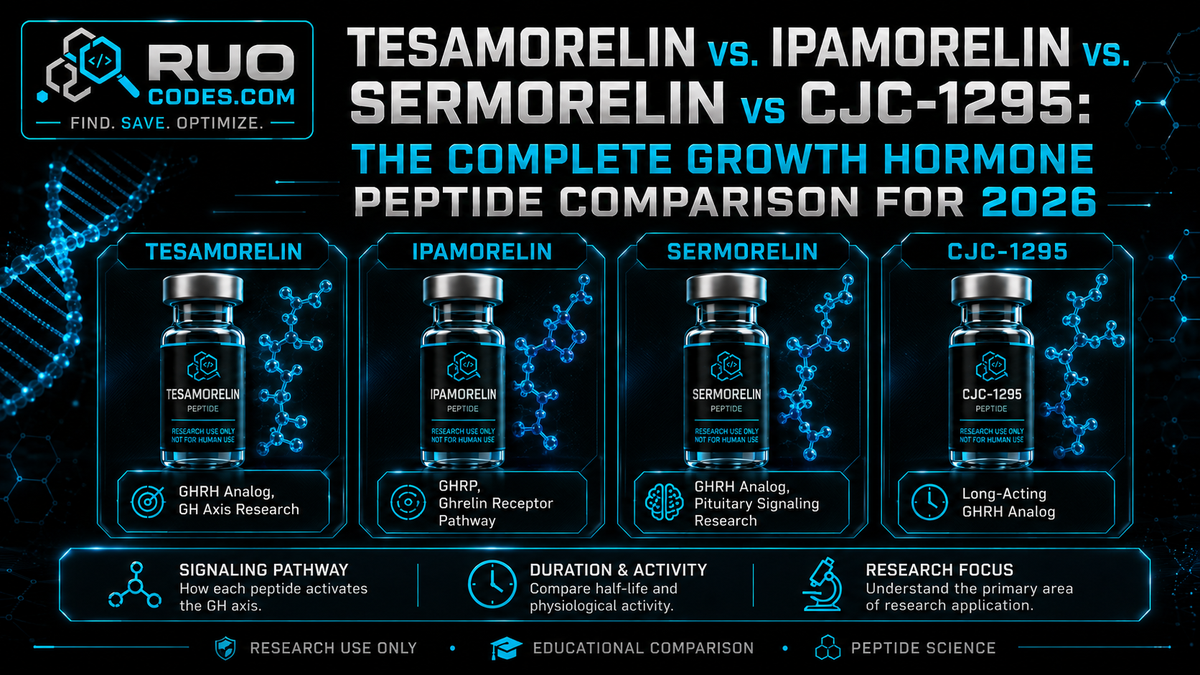
Four peptides dominate growth hormone axis research in 2026. Sermorelin is the gentlest entry point with the longest safety record. Ipamorelin is the gold standard GH secretagogue: robust GH pulses with less than 10% change in cortisol or prolactin. CJC-1295 No DAC produces synergistic pulsatile GH when stacked with Ipamorelin; CJC-1295 With DAC extends half-life to 6–8 days for sustained non-pulsatile elevation. Tesamorelin is the only FDA-approved compound in the group, with the strongest clinical evidence for visceral fat reduction, metabolic improvement, and emerging cognitive research. None of these are interchangeable. Each addresses a different research question through a different receptor pathway.
Why This Comparison Matters, and Why Most of the Content on It Is Wrong
If readers search for comparisons between these four compounds they will find content that treats them as a simple potency ladder where the goal is to find the strongest one. That framing is wrong and it produces protocols that are either under-designed or actively counterproductive.
These four compounds do not all work through the same mechanism. Sermorelin and Tesamorelin work through the GHRH receptor, telling the pituitary to produce and release growth hormone. Ipamorelin works through the ghrelin receptor (GHS-R1a): a completely different signaling pathway. CJC-1295 is a GHRH analog like Sermorelin and Tesamorelin, but its structural modifications produce dramatically different pharmacokinetic behavior depending on which version readers have.
Understanding these distinctions is not academic. It determines whether the research protocol produces pulsatile GH release that mimics natural physiology, sustained non-pulsatile GH elevation, selective GH stimulation without cortisol or prolactin side effects, or targeted metabolic outcomes like visceral fat reduction. Those are completely different biological environments and they require different compound choices.
The Two Receptor Classes: GHRH Analogs vs. GH Secretagogues
Before examining the individual compounds, understanding the two receptor systems involved is essential because it explains why some compounds are synergistic and why some cannot substitute for each other.
GHRH Analogs (Sermorelin, CJC-1295, Tesamorelin)
These compounds work by mimicking the body's own growth hormone-releasing hormone. They bind to the GHRH receptor on pituitary somatotroph cells and signal those cells to synthesize and release growth hormone. This is an upstream signal that directs the pituitary to do something it already knows how to do. The feedback loop from somatostatin (the GH-inhibiting hormone) remains intact.
GH Secretagogues (Ipamorelin, GHRP-2, GHRP-6, Hexarelin)
These compounds work through the ghrelin receptor (GHS-R1a) on pituitary cells. They stimulate GH release through a completely separate pathway and also act on hypothalamic GHS-R1a receptors to suppress somatostatin, adding a second mechanism that amplifies GH release beyond the pituitary-level effect.
The practical significance: because these two classes act on different receptors, they can be combined synergistically. Using a GHRH analog alongside a GH secretagogue produces GH pulses significantly larger than either compound alone. This is the mechanistic basis for the Ipamorelin plus CJC-1295 No DAC combination that has become the most widely used GH axis protocol in clinical and research settings. The article points to our complete guide to peptide stacking for more on synergistic combinations.
Sermorelin: The Established Baseline
Sermorelin is a synthetic 29-amino acid peptide representing the first 29 amino acids of human GHRH (GHRH 1–29). It was the original clinically available GHRH analog, used in pediatric growth hormone deficiency diagnosis since the 1990s and later adopted by functional medicine and anti-aging clinics for adult GH optimization protocols.
Mechanism
Sermorelin binds to the GHRH receptor on pituitary somatotrophs and stimulates GH synthesis and release. The GH pulse it produces is preserved within the body's existing feedback mechanisms: somatostatin inhibition still functions normally. If IGF-1 rises too high, the feedback system applies the brakes. This self-regulating character is one of the primary arguments for Sermorelin's safety profile.
Half-Life and Dosing
Approximately 10 to 20 minutes: the shortest-acting of the four compounds. Requires once-daily subcutaneous dosing, typically at bedtime to align with the body's natural nocturnal GH pulse. For a full breakdown of how half-life affects dosing timing, see our peptide half-life and timing guide.
Clinical Evidence
Sermorelin has a longer clinical record than any other compound in this comparison, concentrated in pediatric applications and early adult anti-aging literature from the 1990s and early 2000s. It does not have the modern randomized controlled trial infrastructure that Tesamorelin has, and the clinical world has largely moved to more potent GHRH analogs for adult optimization. It retains FDA approval status for the pediatric indication, though the original Geref formulation was discontinued.
Best For
Sermorelin remains the most appropriate starting point for researchers approaching GH axis peptides for the first time. The short half-life means rapid clearance, limited accumulation risk, and a pharmacokinetic profile that most closely mirrors natural GHRH. For older adults, people with metabolic sensitivities, or anyone introducing GH axis peptide research cautiously, Sermorelin's gentle stimulation profile is the correct entry point before considering more potent analogs.
Sermorelin is not the first choice for researchers targeting significant body composition changes, visceral fat reduction, or maximally optimized IGF-1 elevation. Those goals have better-suited tools in this comparison.
CJC-1295: One Name, Two Very Different Compounds
CJC-1295 is where the most confusion exists in the entire GH peptide research space. The name refers to two structurally related but pharmacokinetically distinct compounds that produce meaningfully different biological effects. Understanding this distinction is not optional for anyone designing a research protocol.
The DAC Modification Explained
DAC stands for Drug Affinity Complex. It is a chemical addition to the CJC-1295 molecule that allows it to covalently bind to albumin (the major blood protein) immediately after injection. This albumin binding dramatically extends the compound's half-life by protecting it from enzymatic degradation.
| Version | Also Known As | Half-Life | Molecular Weight | GH Pattern |
|---|---|---|---|---|
| CJC-1295 No DAC | Mod-GRF 1-29, Modified GRF 1-29 | ~30 minutes | ~3,368 Da | Pulsatile: best combined with Ipamorelin |
| CJC-1295 With DAC | CJC-1295 DAC | 6–8 days (albumin-bound) | ~3,647 Da | Sustained non-pulsatile: elevated baseline IGF-1 |
Why This Distinction Matters for Protocol Design
Natural growth hormone release is pulsatile. The body releases GH in discrete bursts, primarily during deep sleep and in response to specific physiological stimuli. CJC-1295 No DAC, when stacked with Ipamorelin, produces GH release that closely mimics this natural pulsatile pattern. CJC-1295 With DAC produces sustained elevated GH and IGF-1 that does not follow natural pulsatile rhythm.
Some researchers consider the non-pulsatile profile of the DAC version advantageous for specific body composition applications because of the sustained IGF-1 elevation it produces. Others consider it a disadvantage because it bypasses the physiological regulation that pulsatile release provides and may increase receptor desensitization risk over time. This is a legitimate ongoing debate with valid perspectives on both sides.
COA Verification for CJC-1295
The mass spectrometry result on the COA is the only reliable way to determine which version readers have. CJC-1295 No DAC has a molecular weight of approximately 3,368 Da; CJC-1295 With DAC has a molecular weight of approximately 3,647 Da. These numbers differ enough that any legitimate mass spec result will distinguish them unambiguously. A COA that does not specify the observed molecular mass cannot confirm which form readers have. The article points to our guide on what every test on a peptide COA actually measures for more detail.
Ipamorelin: The Gold Standard Secretagogue
Ipamorelin is a synthetic pentapeptide GH secretagogue that works through the ghrelin receptor (GHS-R1a) rather than the GHRH receptor. It was developed as a cleaner, more selective alternative to earlier GHRPs like GHRP-2 and GHRP-6, which produced meaningful cortisol and prolactin elevation alongside their GH stimulation.
The Selectivity Advantage
A 1998 study established that Ipamorelin produces robust GH release with less than 10% change in cortisol, prolactin, or ACTH at effective doses, demonstrating far superior selectivity versus GHRP-6 or GHRP-2. This selectivity is the defining characteristic that established Ipamorelin as the preferred GH secretagogue for most research protocols. Cortisol elevation suppresses immune function, increases insulin resistance, and counteracts the anabolic effects of GH stimulation. Getting robust GH pulses without meaningfully raising either cortisol or prolactin is a significant practical advantage.
Mechanism
Ipamorelin binds to GHS-R1a on pituitary somatotrophs and stimulates GH release directly. It also acts on hypothalamic GHS-R1a receptors to suppress somatostatin, which further augments GH release. This dual action (pituitary stimulation plus somatostatin suppression) is why combining a GHRH analog with Ipamorelin produces synergistic rather than simply additive GH pulses.
Half-Life and Dosing
Approximately 2 hours. Ipamorelin produces GH pulses lasting 3 to 4 hours and requires 2 to 3 daily administrations for consistent GH axis stimulation. The most researched protocol combines Ipamorelin with CJC-1295 No DAC, administered together 2 to 3 times daily.
Where Ipamorelin May Not Be the Optimal Choice
The one application where Ipamorelin may be less appropriate is maximum-potency GH stimulation where cortisol and prolactin side effects are acceptable research tradeoffs. In that context, Hexarelin or GHRP-2 produce larger GH pulses than Ipamorelin at equivalent doses. For most research contexts where clean, selective GH pulsing is the goal, Ipamorelin is the benchmark compound.
Tesamorelin: The Most Clinically Validated Compound in the Group
Tesamorelin is a synthetic GHRH analog consisting of the full 44-amino acid sequence of human GHRH with a trans-3-hexenoic acid group attached at the N-terminus. This structural modification stabilizes the molecule against enzymatic degradation, extending its functional half-life beyond native GHRH while preserving the complete GHRH receptor binding sequence.
FDA Approval and Clinical Evidence
Tesamorelin holds FDA approval under the brand name Egrifta for adult visceral fat reduction in HIV-infected patients with lipodystrophy. It is the only compound in this comparison with completed Phase III human clinical trials and formal FDA approval for a specific indication. This regulatory status alone places it in a different category from the other three compounds when discussing clinical evidence quality.
The clinical evidence base includes multiple Phase III randomized controlled trials showing:
- Significant visceral fat reduction averaging 15–20% over 6 months
- Improvements in lipid profiles and adiponectin markers
- Increases in lean muscle mass and density
- Reductions in hepatic fat and improvements in fibrinolytic markers
- Emerging improvements in cognitive test performance, particularly processing speed and executive function in older adult populations
The Cognitive Research Dimension
The cognitive angle represents the most significant expansion of Tesamorelin research beyond its original metabolic focus. GH receptors are expressed throughout the brain and IGF-1 crosses the blood-brain barrier. Multiple research groups have documented that Tesamorelin-driven GH and IGF-1 elevation produces improvements in cognitive test performance in older adult populations. This has generated substantial interest in Tesamorelin as a longevity and brain health compound beyond its established metabolic applications: a research direction that distinguishes it from any other compound in this comparison.
Mechanism and Half-Life
Like Sermorelin and CJC-1295, Tesamorelin works through the GHRH receptor. The full 44-amino acid GHRH sequence it contains produces stronger and more prolonged GHRH receptor activation than the truncated 29-amino acid sequence in Sermorelin. The hexenoic acid modification adds enzymatic stability without altering the receptor binding profile. Plasma half-life is approximately 26 minutes for the active compound, similar to Sermorelin, but Tesamorelin produces more sustained downstream GH and IGF-1 elevation than Sermorelin at equivalent injection frequencies. Once-daily subcutaneous dosing is the standard protocol based on the FDA-approved Egrifta regimen.
Where Tesamorelin Is Not Optimal
Because Tesamorelin works exclusively through the GHRH receptor and does not add ghrelin receptor stimulation, it does not produce the synergistic GH pulses that the Ipamorelin plus CJC-1295 combination produces. If the research goal is maximizing acute GH pulse amplitude, Tesamorelin alone is not the optimal choice. It is optimized for sustained GHRH receptor engagement with strong metabolic downstream effects rather than maximally amplified pulsatile GH release.
The Head-to-Head Comparison
| Property | Sermorelin | CJC-1295 No DAC | CJC-1295 With DAC | Ipamorelin | Tesamorelin |
|---|---|---|---|---|---|
| Receptor Class | GHRH agonist | GHRH agonist | GHRH agonist (albumin-bound) | Ghrelin / GHS-R1a agonist | GHRH agonist (full 44-aa sequence) |
| Plasma Half-Life | 10–20 min | ~30 min | 6–8 days | ~2 hours | ~26 min (active form) |
| GH Release Pattern | Pulsatile, physiological | Pulsatile: best combined with Ipamorelin | Sustained non-pulsatile, elevated baseline | Pulsatile, ghrelin-receptor mediated | Pulsatile, sustained metabolic effects |
| Cortisol / Prolactin | Minimal | Minimal | Minimal | <10% change: best in class | Minimal |
| Dosing Frequency | Once daily (bedtime) | 2–3x daily (stacked) | Once weekly | 2–3x daily | Once daily SubQ |
| FDA Approved | Yes (pediatric GH deficiency, historical) | No | No | No | Yes: adult visceral fat (Egrifta) |
| Strongest Evidence For | Gentle GH introduction; physiological pulsing | Synergistic GH pulsing with Ipamorelin | Sustained IGF-1; once-weekly convenience | Selective GH pulsing without cortisol/prolactin | Visceral fat reduction; metabolic improvement; cognitive function |
The Combination Protocols: Why Stacking Makes Sense
The most important concept in GH axis peptide research that most comparison guides underemphasize is that GHRH analogs and GH secretagogues are not competing with each other. They are designed to be used together.
CJC-1295 No DAC + Ipamorelin (The Dominant Protocol)
When readers combine CJC-1295 No DAC with Ipamorelin, they are activating the GHRH receptor and the ghrelin receptor simultaneously. The GHRH receptor stimulation increases GH synthesis and release. The ghrelin receptor stimulation produces additional GH release while suppressing somatostatin inhibition. The combined GH pulse is substantially larger than either compound would produce alone, and the selectivity of Ipamorelin means this larger pulse still comes without meaningful cortisol or prolactin elevation.
This combination has become the dominant protocol in clinical GH optimization practice. The Ipamorelin plus Modified GRF 1-29 (CJC-1295 No DAC) stack offers the best balance of efficacy, selectivity, and safety for most researchers in 2026.
Tesamorelin + Ipamorelin
Tesamorelin can also be combined with Ipamorelin for researchers who want the full 44-amino acid GHRH sequence on the GHRH side rather than the truncated Mod-GRF 1-29 sequence. This produces a different receptor engagement profile on the GHRH side while maintaining the ghrelin receptor component from Ipamorelin. The clinical literature exploring this combination is less developed than the CJC-1295 No DAC plus Ipamorelin literature, but it represents an active area of research interest, particularly for researchers whose primary goal is visceral fat reduction with maximal GH axis stimulation.
Practical Decision Framework: How to Choose
The choice should be based on the research goal.
- Gentlest GH introduction, most physiological pattern, longest safety record: Sermorelin once daily at bedtime.
- Pulsatile GH optimized for body composition, recovery, and GH axis support with maximum selectivity: Ipamorelin + CJC-1295 No DAC, 2–3 times daily.
- Sustained IGF-1 elevation with once-weekly dosing convenience: CJC-1295 With DAC, once weekly.
- Visceral fat reduction, metabolic improvement, or cognitive function with the strongest published clinical evidence: Tesamorelin once daily.
- Largest possible synergistic GH pulse: Tesamorelin or CJC-1295 No DAC combined with Ipamorelin, 2–3 times daily.
The critical mistake to avoid is selecting a compound based on a ranking system that treats potency as the only variable. Sermorelin is not inferior to Tesamorelin because it is less potent; it is appropriate for different research questions. Ipamorelin is not inferior to CJC-1295 because it works through a different receptor; they are designed to be combined. The right compound is the one that matches the specific research question being investigated.
COA Verification for GH Axis Peptides
For any compound in this group, a complete, trustworthy COA should include:
- Mass spectrometry identification confirming the correct molecular weight (critical for CJC-1295 to distinguish No DAC from With DAC)
- HPLC purity at 98% or higher for injectable compounds
- Endotoxin testing by LAL method
- Sterility documentation
For CJC-1295 specifically: No DAC at ~3,368 Da vs. With DAC at ~3,647 Da. A COA that does not specify the observed molecular mass cannot confirm which form readers have. For a full breakdown of what each COA test actually means, see our guide on What Every Test on a Peptide COA Actually Measures. For guidance on evaluating vendors who carry these compounds, see What Is the Most Reputable Company for Peptides?
Frequently Asked Questions
Is Ipamorelin better than Sermorelin?
They are not directly comparable because they work through different receptor systems. Sermorelin is a GHRH analog that tells the pituitary to release GH. Ipamorelin is a ghrelin receptor agonist (GH secretagogue) that stimulates GH release through a completely separate pathway. For most researchers seeking selective GH pulsing with minimal cortisol and prolactin effects, Ipamorelin is the stronger individual choice. For the most cautious, physiological entry to GH axis research, Sermorelin is more appropriate. The two can also be combined, though CJC-1295 No DAC is the more commonly used GHRH analog in the Ipamorelin combination protocol.
What is the difference between CJC-1295 with DAC and without DAC?
CJC-1295 No DAC (Modified GRF 1-29) has a half-life of approximately 30 minutes and produces acute, pulsatile GH release, best stacked with Ipamorelin for 2–3 times daily dosing. CJC-1295 With DAC has a half-life of 6–8 days due to albumin binding, produces sustained non-pulsatile GH and IGF-1 elevation, and is typically dosed once weekly. They are not interchangeable. The molecular weight difference (3,368 Da vs. 3,647 Da) is the only reliable way to verify which version a vendor has supplied, via mass spectrometry on the COA.
Is Tesamorelin the strongest GH peptide?
Tesamorelin is not "strongest" in a simple potency sense: it is the most clinically validated, with FDA approval and Phase III trial data. For maximizing acute GH pulse amplitude, the Ipamorelin plus CJC-1295 No DAC combination produces larger GH pulses through dual-receptor synergy than Tesamorelin alone. Tesamorelin's advantage is its documented body composition and cognitive evidence base, not raw GH output. If readers add Ipamorelin to Tesamorelin, they get the dual-receptor synergy with the full 44-aa GHRH sequence: a protocol with strong rationale but less developed clinical literature than the CJC-1295 No DAC plus Ipamorelin combination.
Can you stack Tesamorelin with Ipamorelin?
Yes. The mechanistic rationale is sound: Tesamorelin activates the GHRH receptor while Ipamorelin activates the separate ghrelin receptor, and the combination produces synergistic GH pulses just as CJC-1295 No DAC plus Ipamorelin does. The clinical literature for this specific combination is less developed than for CJC-1295 No DAC plus Ipamorelin, but it is an active area of research interest, particularly for researchers prioritizing visceral fat reduction alongside maximum GH axis stimulation.
How does Ipamorelin compare to GHRP-2 and GHRP-6?
All three work through the ghrelin receptor (GHS-R1a). The key difference is selectivity. GHRP-2 and GHRP-6 produce meaningfully larger cortisol and prolactin elevations alongside their GH stimulation. Ipamorelin produces comparable GH release at effective doses with less than 10% change in cortisol or prolactin, making it the preferred GH secretagogue for most research applications where avoiding cortisol and prolactin side effects matters. GHRP-6 also produces more significant hunger stimulation than Ipamorelin due to hypothalamic effects.
What is the best GH peptide for fat loss?
For visceral fat reduction specifically, Tesamorelin has the strongest and most directly applicable clinical evidence: it was FDA-approved for exactly this indication. For general body composition research combining fat loss with muscle preservation and recovery, the Ipamorelin plus CJC-1295 No DAC combination is the most widely used protocol. The article points to our full guide on Best Peptides for Fat Loss and Body Composition Research in 2026 for a broader comparison including GLP-1 agonists and other compound classes.
Where can I find vetted vendors for these compounds?
All four compounds (Sermorelin, Ipamorelin, CJC-1295, and Tesamorelin) are available through vendors in the RUO Codes directory with documented independent third-party testing, current coupon codes, and active sale information. Each vendor listing includes COA tier ratings and testing documentation links.