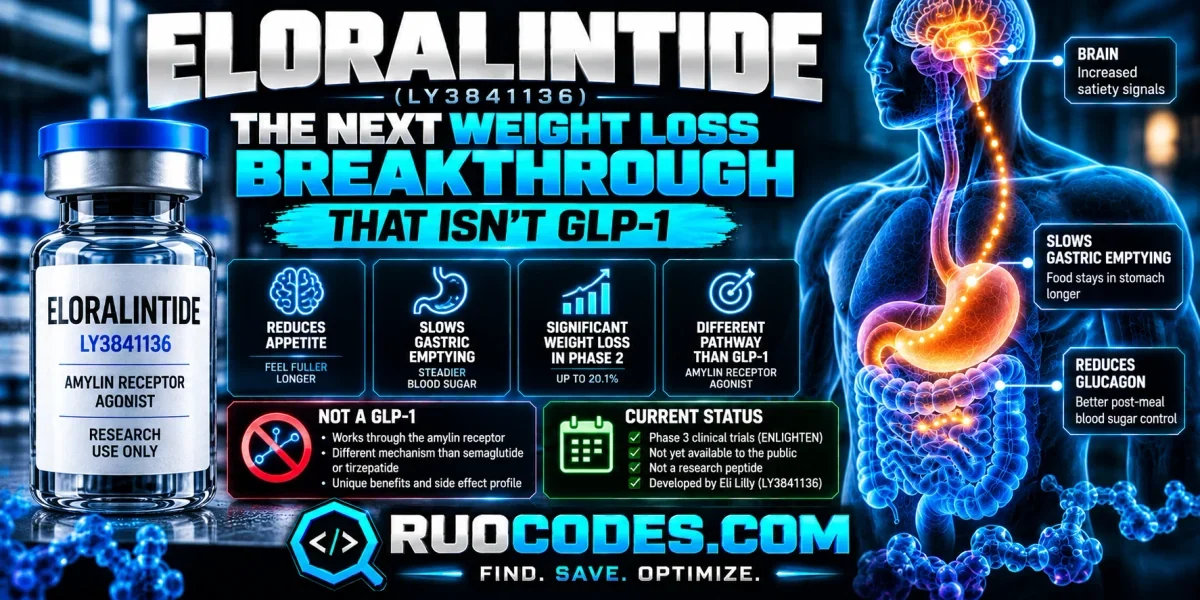
TLDR: Eloralintide (LY3841136) is Eli Lilly's investigational amylin receptor agonist — a once-weekly injectable that produced up to 20.1% body weight loss in a Phase 2 trial published in The Lancet in November 2025. It is not a GLP-1 drug. It works through a completely different pathway than Ozempic, Wegovy, or Mounjaro, and it's generating serious interest from researchers who want to understand what comes after the GLP-1 wave. It is currently in Phase 3 clinical trials (the ENLIGHTEN program) and is not legitimately available as a research peptide. Here's everything the evidence actually says.
What Is Eloralintide?
Eloralintide, also identified by its development code LY3841136, is an engineered amylin analog developed by Eli Lilly and Company. If you've never heard of amylin, you're not alone — it's one of the lesser-known players in the body's metabolic system, and that's exactly what makes eloralintide so interesting to researchers right now.
Amylin is a 37-amino-acid hormone that your pancreatic beta cells release alongside insulin every time you eat. While insulin clears glucose from your blood, amylin handles a different job: it slows down how quickly food empties from your stomach, tells your brain your meal is over, and puts the brakes on glucagon (a hormone that would otherwise dump more sugar into your bloodstream post-meal). Think of insulin and amylin as two hands on the same steering wheel.
The problem with native amylin is that it breaks down in your body in about four minutes. Eloralintide is Lilly's answer to that problem — a heavily engineered analog with a fatty acid attachment, backbone modifications, and a thioether ring that together extend its effective duration to approximately one week. You inject it once a week, and it keeps doing amylin's job for seven days.
One important thing to clear up before going further: eloralintide and cagrilintide are not the same drug. Cagrilintide is Novo Nordisk's amylin analog (code AM833). They're both amylin-class compounds, they're both being developed for obesity, and they're both being studied in combination with GLP-1 drugs — but they're built differently, they target receptors with different selectivity profiles, and they're made by competing pharmaceutical companies. Any source that uses the names interchangeably is wrong.
How Eloralintide Works (Without the PhD)
Here's the key distinction that's driving researcher interest: eloralintide does not touch the GLP-1, GIP, or glucagon receptor systems that drugs like Semaglutide, Tirzepatide, and Retatrutide activate. It works entirely through the amylin receptor — specifically the AMY1 receptor complex.
The AMY1 receptor sits primarily in the brainstem's area postrema and in the hypothalamus. When eloralintide activates it, three things happen:
- You feel full faster and stay full longer. The area postrema sends meal-termination signals to the brain. Eloralintide extends and amplifies those signals.
- Gastric emptying slows down. Food moves through your stomach more slowly, which blunts blood sugar spikes after meals and keeps satiety signals running longer.
- Postprandial glucagon is suppressed. After meals, glucagon normally adds glucose back into circulation. Eloralintide dampens that response.
None of this involves the pancreatic insulin-secretion pathway that GLP-1 drugs primarily work through. This is why researchers are excited about it: it's a different set of levers.
What Makes It Different from Cagrilintide
Lilly's design choice for eloralintide was to make it selective for AMY1 over the calcitonin receptor. Cagrilintide activates both amylin receptors and calcitonin receptors — making it what pharmacologists call a "dual amylin and calcitonin receptor agonist" or DACRA. Eloralintide activates AMY1 approximately 12 times more potently than it activates the calcitonin receptor.
Why does that matter? Calcitonin receptor activation is believed to contribute to some of the gastrointestinal side effects seen with amylin-class drugs. By being more selective, eloralintide may produce fewer GI effects at the same level of weight-loss efficacy — and that hypothesis appears to hold up in the Phase 2 data.
What the Phase 2 Trial Actually Showed
In November 2025, The Lancet published the Phase 2 results for eloralintide (Billings LK et al., PMID 41207310). This was a 48-week, randomized, double-blind, placebo-controlled trial at 46 U.S. centers, enrolling 263 adults with obesity or overweight — without type 2 diabetes — at an average starting weight of about 240 pounds.
The results were hard to ignore:
| Dose | Mean Weight Loss | Average Pounds Lost |
|---|---|---|
| Eloralintide 1 mg/week | -9.5% | ~22.5 lbs |
| Eloralintide 3 mg/week | -12.4% | ~29.3 lbs |
| Eloralintide 6 mg/week | -17.6% | ~41.2 lbs |
| Eloralintide 9 mg/week | -20.1% | ~47 lbs |
| Escalation 3→6→9 mg | -16.4% | ~39.2 lbs |
| Placebo | -0.4% | ~0.5 lbs |
At the highest dose (9 mg), 82.3% of participants lost at least 10% of their body weight. Roughly 57% lost 20% or more. And the weight loss hadn't plateaued at 48 weeks — meaning the curve was still going down when the study ended.
Equally notable was the discontinuation rate. Only 2.9% of participants on the drug stopped due to adverse events. For context, the placebo group had a higher dropout rate at 3.8%. That's an unusually good tolerability signal.
The Phase 2 trial also tested a combination approach (the EloraTZP study, NCT06603571) — eloralintide plus Tirzepatide in 367 adults with obesity and type 2 diabetes. The highest combination dose (9 mg eloralintide + 15 mg tirzepatide) produced 23.3% weight loss at 48 weeks, compared to 14.8% for tirzepatide alone. That's a meaningful additive effect in a diabetic population, which is typically harder to treat for weight.
Eloralintide vs. Semaglutide, Tirzepatide, and Retatrutide
Since researchers are always looking at how new compounds stack up, here's an honest comparison table — with the important caveat that these are cross-trial comparisons, not head-to-head studies. Population characteristics, trial duration, and study design differences mean you can't treat these numbers as a direct race.
| Drug | Mechanism | Mean Weight Loss | Trial Duration |
|---|---|---|---|
| Eloralintide 9 mg | Amylin (AMY1 selective) | -20.1% | 48 weeks (Phase 2) |
| Semaglutide 2.4 mg (Wegovy) | GLP-1 | ~-15% | 68 weeks (STEP 1) |
| Tirzepatide 15 mg (Zepbound) | GLP-1 + GIP | ~-22.5% | 72 weeks (SURMOUNT-1) |
| Retatrutide 12 mg | GLP-1 + GIP + glucagon | -28.7% | 68 weeks (TRIUMPH-4) |
| Cagrilintide 2.4 mg | Amylin (non-selective) | -11.8% | 68 weeks (REDEFINE Phase 3) |
| CagriSema (combo) | Amylin + GLP-1 | -20.4% to -22.7% | 68 weeks (REDEFINE Phase 3) |
The practical read: eloralintide as a monotherapy holds its own against semaglutide while using a completely different mechanism. That's genuinely interesting. It doesn't beat tirzepatide head-to-head, but it wasn't designed to — it was designed to be additive to incretin drugs, as the EloraTZP combination data suggest.
About 17% of people on GLP-1 drugs are non-responders. Eloralintide's different mechanism is the clearest argument for why this compound matters — it's a legitimate option for researchers exploring alternatives to the GLP-1 pathway, not just a GLP-1 variant with a different molecular structure.
Side Effects: What the Data Shows
The Phase 2 safety profile is generally favorable, with a few things worth knowing.
The most common adverse events were nausea and fatigue, both dose-dependent. At the lower doses, the rates were comparable to placebo. At 9 mg, nausea was reported in about 33% of participants and fatigue in about 43%. Hair loss (alopecia) showed up in 11% of the 9 mg group — this is consistent with rapid significant weight loss rather than a drug-specific toxicity signal.
One signal that requires monitoring: bradycardia (slow heart rate) was observed in 11% of the 6 mg arm. No mechanistic explanation has been offered publicly, and Phase 3 cardiac monitoring protocols should address it.
The 3→6→9 mg escalation schedule substantially reduced GI side effects. Lilly's approach of starting low and ramping up is clearly the preferred protocol, and the tolerability data support it.
For comparison purposes: the combination trial (eloralintide + tirzepatide) had higher discontinuation rates ranging from 10.8% to 27% across arms — consistent with what you'd expect when combining two active compounds. The tolerability advantage of eloralintide monotherapy is diluted in combination use.
There is no boxed warning like the hypoglycemia risk associated with pramlintide (Symlin), the only previously approved amylin analog. However, no long-term cardiovascular outcomes, bone effects, or cancer risk data exist yet — those are standard gaps for Phase 3-stage compounds.
The Muscle Preservation Question
There's a narrative circulating in the peptide research community that amylin-class drugs preserve muscle better than GLP-1 drugs. This claim deserves an honest look.
The biological rationale: amylin's mechanism doesn't directly stimulate insulin pathways, so theoretically it might produce weight loss with a better fat-to-lean mass ratio. The eloralintide Phase 2 data showed roughly a 60-70% fat mass to 30-40% lean mass loss ratio, which Dr. Billings described as "reassuring" at ObesityWeek 2025.
Here's the problem: a November 2025 BioCentury analysis of CagriSema Phase 3 data specifically challenged whether amylin is muscle-sparing at all. The data reportedly showed that semaglutide actually produced more fat mass loss than cagrilintide's amylin component. The 60/40 ratio for eloralintide is comparable to GLP-1 drugs, not superior.
Bottom line for researchers: don't select eloralintide specifically because you've read it protects muscle. That claim is contested and not supported by strong Phase 3 human data. Select it because it represents a distinct mechanism and a potential GLP-1 alternative with compelling efficacy data.
CagriSema: The Benchmark Combination
If you're trying to understand where eloralintide fits in the broader landscape, CagriSema is the reference point. Novo Nordisk's combination of cagrilintide (their amylin analog) plus semaglutide completed Phase 3 in 2025, producing 20.4-22.7% weight loss at 68 weeks. Novo Nordisk filed for FDA approval in December 2025.
The parallel: Lilly is building EloraTZP (eloralintide + tirzepatide) as its own amylin-plus-incretin combination. The EloraTZP Phase 2b showed 23.3% weight loss in 48 weeks in a diabetic population. Phase 3 for EloraTZP is planned for 2026.
| CagriSema (Novo Nordisk) | EloraTZP (Eli Lilly) | |
|---|---|---|
| Amylin component | Cagrilintide (non-selective DACRA) | Eloralintide (AMY1-selective) |
| Incretin component | Semaglutide (GLP-1 only) | Tirzepatide (GLP-1 + GIP) |
| Combination weight loss | ~22.7% (non-T2D, 68 weeks) | ~23.3% (T2D population, 48 weeks) |
| Regulatory status | Filed for FDA approval Dec 2025 | Phase 3 planned for 2026 |
| Injection site reactions | 17% (cagrilintide component) | Not prominent in Phase 2 |
CagriSema is closer to approval and better-characterized. EloraTZP has higher preliminary numbers but involves a more potent incretin partner (tirzepatide vs. semaglutide), which makes the comparison noisy.
Development Status and What to Expect
Eloralintide is currently in Phase 3 clinical trials under the ENLIGHTEN program. Five trials are enrolling as of 2026:
- ENLIGHTEN-1 (NCT07321886): ~1,980 adults with obesity, no type 2 diabetes. Primary completion estimated 2028.
- ENLIGHTEN-2 (NCT07282600): Adults with obesity and type 2 diabetes.
- ENLIGHTEN-3: Adults with obesity and obstructive sleep apnea.
- Additional trials in knee osteoarthritis and as add-on to incretin therapy.
The earliest realistic NDA filing estimate is 2027-2028, with FDA approval potentially arriving 2028-2030. This is not close to the market.
Can You Buy Eloralintide? The Honest Answer
This is the question most researchers are asking, and it deserves a direct answer: No. Eloralintide is not legitimately available as a research peptide.
It is a proprietary Eli Lilly compound currently enrolled in Phase 3 clinical trials. The only legitimate way to access it is through those trials. It is not FDA-approved. It is not on the DEA controlled substances list (so it's not a scheduled substance), but it is an investigational new drug under Lilly's IND, which means commercial sale outside of clinical trials is not an approved pathway.
Some grey-market peptide vendors list eloralintide. The problem is that without a verified reference standard and independent third-party testing, there's no way to confirm that what's being sold actually matches the engineered sequence Lilly developed — complete with its C20 fatty acid lipidation, thioether ring, and multiple backbone modifications. This is not a simple peptide to synthesize correctly. The structural complexity is significant.
Cayman Chemical and MedChemExpress do sell eloralintide as a biochemical reference standard for laboratory receptor-binding assays — this is a legitimate scientific use. But that's categorically different from research peptide sourcing for subcutaneous use.
If you're researching amylin-class compounds that are actually available through verified vendors, cagrilintide is the accessible alternative. When verified vendor codes for amylin analogs become available, you'll find them listed at RUOcodes.com.
Frequently Asked Questions
FAQ: Eloralintide Questions Researchers Are Asking
What is Eloralintide?
Eloralintide (LY3841136) is an investigational selective amylin-1 receptor agonist developed by Eli Lilly. It's a once-weekly injectable peptide currently in Phase 3 clinical trials for obesity. It works through the amylin pathway — completely separate from GLP-1 drugs like Semaglutide — by activating satiety signals in the brainstem and slowing gastric emptying.
Is Eloralintide the same as Cagrilintide?
No. Eloralintide (LY3841136) is Eli Lilly's compound; cagrilintide (AM833) is Novo Nordisk's. They share the same drug class (amylin receptor agonists) but have different molecular structures, different receptor selectivity profiles, and are developed by competing companies. They are not interchangeable terms.
How much weight loss does Eloralintide produce?
In the Phase 2 trial published in The Lancet (November 2025, n=263, 48 weeks), eloralintide at 9 mg produced a mean weight loss of 20.1%, or approximately 47 pounds from an average starting weight of about 240 pounds. The 3→6→9 mg escalation arm produced 16.4%. These are Phase 2 results; Phase 3 data are not yet available.
How does Eloralintide compare to Ozempic (Semaglutide)?
Eloralintide works through a completely different mechanism than Semaglutide. Semaglutide is a GLP-1 receptor agonist; eloralintide is an amylin (AMY1) receptor agonist. The mechanisms are complementary, not overlapping. In cross-trial comparison (not head-to-head), eloralintide 9 mg at 48 weeks showed about 20.1% weight loss vs. approximately 15% for Semaglutide 2.4 mg at 68 weeks (STEP 1 trial). A key difference: eloralintide may offer an option for the approximately 17% of people who don't respond well to GLP-1 drugs.
What are Eloralintide's side effects?
The most common side effects in Phase 2 were nausea (11% at 1 mg up to 64% at 9 mg vs. 14% placebo) and fatigue (0% at 1 mg up to 46% at 9 mg vs. 12% placebo). Hair loss was reported in 11% of the 9 mg group, consistent with rapid weight loss. A bradycardia signal (slow heart rate) was observed in 11% of the 6 mg arm. Slower dose escalation significantly reduced GI side effects. The overall discontinuation rate for adverse events was just 2.9%, lower than the 3.8% placebo rate.
What dose is Eloralintide?
In Phase 2, doses tested were 1, 3, 6, and 9 mg once weekly, plus escalation schedules (3→6→9 mg and 6→9 mg). There is no established human protocol outside of clinical trials. The drug is not approved or available for use outside trial settings.
When will Eloralintide be FDA approved?
Eloralintide is currently in Phase 3 trials (the ENLIGHTEN program) with primary completion of the main obesity trial estimated around 2028. The earliest realistic NDA filing estimate is 2027-2028, with FDA approval potentially arriving 2028-2030. CagriSema (Novo Nordisk's cagrilintide + semaglutide combination) is ahead — Novo filed for FDA approval in December 2025.
Can Eloralintide be purchased as a research peptide?
Not legitimately. It is a proprietary Eli Lilly investigational compound accessible only through clinical trial protocols. Some grey-market vendors list it, but identity and purity cannot be independently verified. Biochemical reference standard suppliers (Cayman Chemical, MedChemExpress) sell it for laboratory assay use, which is different from research peptide sourcing. RUOcodes.com does not currently list any verified vendor codes for eloralintide.
What is the difference between Eloralintide and CagriSema?
CagriSema is Novo Nordisk's combination of cagrilintide (their amylin analog) plus semaglutide (Wegovy). EloraTZP is Lilly's parallel strategy: eloralintide plus tirzepatide (Mounjaro/Zepbound). Both pair an amylin analog with a GLP-1-based drug. CagriSema completed Phase 3 (22.7% weight loss at 68 weeks, non-diabetic population) and was filed for FDA approval in December 2025. EloraTZP Phase 2b showed 23.3% at 48 weeks in a diabetic population; Phase 3 is planned for 2026.
The Bottom Line
Eloralintide is the most compelling non-GLP-1 weight loss compound in the clinical pipeline right now. Its Phase 2 results are competitive with semaglutide, it works through an entirely different mechanism, and its tolerability profile — especially on the escalation protocol — is genuinely impressive. The 20.1% mean weight loss at 48 weeks in a 263-person Phase 2 trial is the number that put it on every serious researcher's radar.
What it isn't: available. It isn't approved, it isn't accessible through legitimate research peptide channels, and Phase 3 data won't be ready before 2028. The muscle-preservation claims that drive some community interest are contested by real-world CagriSema data and shouldn't be taken at face value.
For researchers tracking the amylin class, keep your eye on CagriSema (the closest to market), eloralintide's ENLIGHTEN Phase 3 results (the long game), and the EloraTZP combination (the potential high-efficacy product Lilly is really building toward).
When verified supplier options become available for amylin-class research compounds, RUOcodes.com will have the codes.
Sources
Sources: Billings LK et al., The Lancet, November 2025 (PMID 41207310); Eli Lilly investor press release, November 6 2025; ClinicalTrials.gov (NCT07321886, NCT07282600, NCT06603571); Applied Clinical Trials REDEFINE 1 coverage; BioCentury amylin muscle-sparing analysis, November 2025; Medical News Today eloralintide coverage; Healio ObesityWeek 2025 reporting.