TL;DR
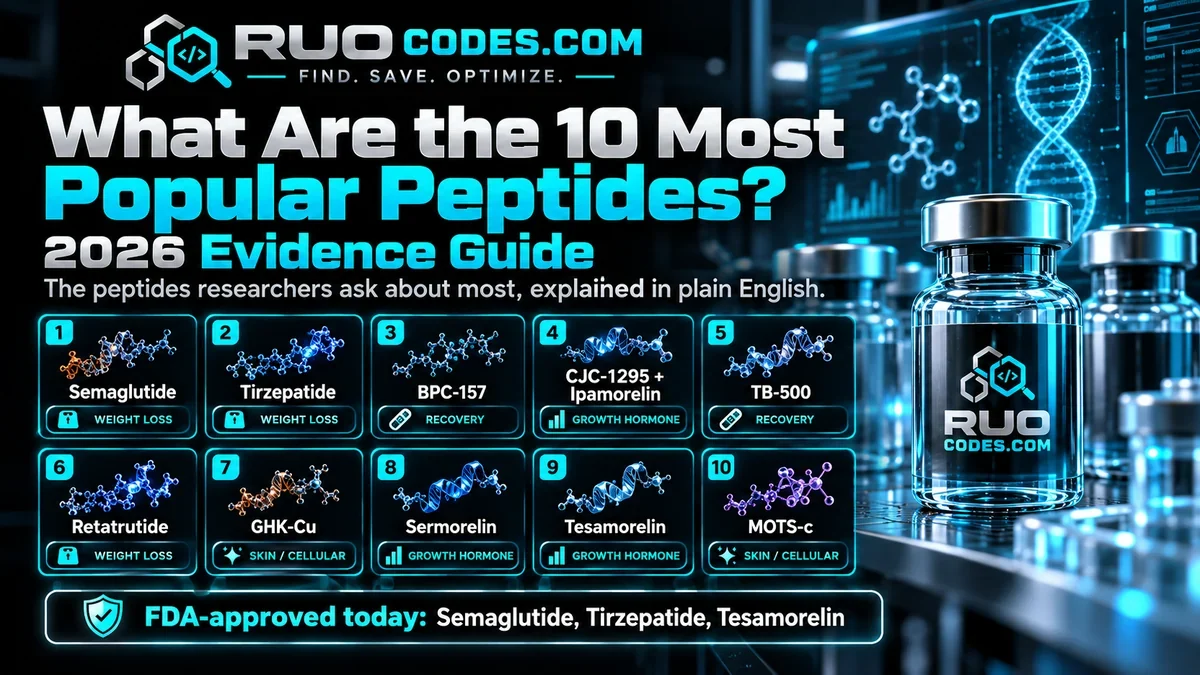
The 10 most popular peptides in 2026 are semaglutide, tirzepatide, BPC-157, CJC-1295 with ipamorelin, TB-500, retatrutide, GHK-Cu, sermorelin, tesamorelin, and MOTS-c.
- Popular does not mean proven. Only three on this list are FDA-approved drugs today: semaglutide, tirzepatide, and tesamorelin.
- The weight-loss peptides have the strongest evidence. Semaglutide, tirzepatide, and retatrutide have been tested in large human trials with thousands of people.
- The recovery peptides have the weakest. BPC-157 and TB-500 are hugely popular, but almost all of their research is in animals.
- Retatrutide is the one to watch. It produced average weight loss of about 28% in Phase 3 trials, but it is not approved yet.
- The rules changed in 2026. The FDA removed 12 peptides from its restricted list in April, and an advisory panel backed several of them in July. None of that makes them approved drugs.
- Everything sold as "research use only" is for laboratory research. It is not made, tested, or labeled for human use.
What does "most popular" really mean?
This is a curated editorial guide, not a measured search-volume ranking or a treatment recommendation. Nobody keeps an official scoreboard for peptides. "Popular" here means the peptides people search for, ask about, get prescribed, and study the most.
That matters, because popularity and proof are two different things. A peptide can be everywhere on social media and still have almost no human research behind it. Another can be quietly FDA-approved for years and barely get mentioned.
So this guide does two jobs. It tells you which ten peptides get the most attention, and it tells you how much real evidence stands behind each one. If you are new to peptide research, that second part is the one that will save you from bad information.
A quick definition before we start. A peptide is a short chain of amino acids, the same building blocks that make up proteins. Your body makes thousands of them and uses them as messengers. Insulin is a peptide. So are many of the hormones that control hunger, growth, and healing.
The 10 most popular peptides at a glance
| # | Peptide | What it is | Best known for | Human evidence | FDA status (October 2026) |
|---|---|---|---|---|---|
| 1 | Semaglutide | GLP-1 receptor agonist | Weight and blood sugar | Strong | Approved (Ozempic, Wegovy, Rybelsus) |
| 2 | Tirzepatide | Dual GIP and GLP-1 agonist | Weight and blood sugar | Strong | Approved (Mounjaro, Zepbound) |
| 3 | BPC-157 | Synthetic 15-amino-acid peptide | Tendon, ligament, and gut research | Very limited | Not approved |
| 4 | CJC-1295 + ipamorelin | Growth hormone releasing pair | Growth hormone release | Limited | Not approved |
| 5 | TB-500 | Synthetic thymosin beta-4 fragment | Soft-tissue recovery research | Very limited | Not approved |
| 6 | Retatrutide | Triple GLP-1, GIP, and glucagon agonist | Weight loss | Strong, still in trials | Not approved |
| 7 | GHK-Cu | Natural copper-binding tripeptide | Skin and hair | Limited (topical) | Cosmetic ingredient, not an approved drug |
| 8 | Sermorelin | Growth hormone releasing hormone analog | Growth hormone release | Moderate | Formerly approved (Geref), now compounded |
| 9 | Tesamorelin | Growth hormone releasing hormone analog | Visceral belly fat | Strong for one use | Approved (Egrifta) for HIV-related belly fat |
| 10 | MOTS-c | Mitochondrial-derived peptide | Energy and metabolism research | Very limited | Not approved |
The 10 most popular peptides, explained
1. Semaglutide
Semaglutide is the peptide that made peptides a household word. It is sold as Ozempic and Rybelsus for type 2 diabetes and as Wegovy for weight management.
How it works. It copies a gut hormone called GLP-1. That hormone tells your brain you are full, slows how fast your stomach empties, and helps your body release insulin when blood sugar rises.
What the research shows. In the STEP 1 trial of 1,961 adults, people on semaglutide lost an average of 14.9% of their body weight over 68 weeks, compared with 2.4% on placebo (Wilding 2021). The SELECT trial of 17,604 adults later found a 20% lower rate of major heart events (Lincoff 2023).
The honest catch. Nausea, vomiting, and other stomach problems are common, and studies show much of the weight tends to return after stopping.
2. Tirzepatide
Tirzepatide is sold as Mounjaro for type 2 diabetes and Zepbound for weight management. It is the current benchmark for approved weight-loss drugs.
How it works. It activates two hormone receptors instead of one: GLP-1 and GIP. Think of it as semaglutide's approach with a second signal added.
What the research shows. In SURMOUNT-1, 2,539 adults lost an average of up to 20.9% of body weight at the highest dose over 72 weeks (Jastreboff 2022). In SURMOUNT-5, the first head-to-head trial, tirzepatide produced 20.2% average weight loss against 13.7% for semaglutide (Aronne 2025).
The honest catch. The side effects look a lot like semaglutide's. Results in a trial are averages, and individual results vary widely.
3. BPC-157
BPC-157 is the most talked-about recovery peptide in the biohacking world. It is a lab-made chain of 15 amino acids, based on a protein fragment first identified in stomach fluid.
Why it is popular. In rat and mouse studies it has been linked to faster healing of tendons, ligaments, muscle, and the gut lining. Those results spread quickly through fitness and injury-recovery communities.
What the research shows. This is where novices get misled. Nearly all BPC-157 research is in rodents, and much of it comes from one research group. Human data amounts to a few small reports without proper control groups. There is no large, randomized human trial.
Regulatory status. BPC-157 is not FDA approved. The FDA placed it on its restricted Category 2 list in 2023, removed it in April 2026, and an advisory panel voted 8 to 6 in July 2026 to recommend allowing pharmacies to compound it. That recommendation still has to go through formal rulemaking. It is also banned in sport by the World Anti-Doping Agency.
4. CJC-1295 + ipamorelin
This is the best-known "stack" in peptide research. The two are different compounds that push the same button from two directions.
How it works. CJC-1295 copies growth hormone releasing hormone, the signal that tells the pituitary gland to release growth hormone. Ipamorelin copies ghrelin, a second signal that does the same job through a different receptor. The idea is that two signals together produce a stronger, more natural pulse.
What the research shows. In healthy adults, a single dose of CJC-1295 raised growth hormone levels 2 to 10 times for six days or more (Teichman 2006). In preclinical research, ipamorelin was shown to release growth hormone without the big jump in stress hormones seen with older compounds (Raun 1998).
The honest catch. Raising a hormone level on a blood test is not the same as proving better muscle, recovery, or aging. No published trial has tested the two together for those outcomes. Neither is FDA approved, and an FDA advisory panel recommended against adding them to the compounding list in late 2024. Both are banned in sport.
One naming tip: "CJC-1295 with DAC" lasts about a week in the body. "CJC-1295 without DAC" is a different, short-acting compound also called Mod GRF 1-29. They are not interchangeable.
5. TB-500
TB-500 is usually mentioned in the same breath as BPC-157. It is a lab-made peptide based on thymosin beta-4, a protein found in nearly every cell in your body.
A correction worth knowing. Many websites say TB-500 and thymosin beta-4 are the same thing. They are not. Thymosin beta-4 is the full 43-amino-acid protein. TB-500 refers to a short active fragment of it, although some sellers use the name for both.
Why it is popular. Thymosin beta-4 helps cells move to where they are needed, which is a key early step in wound healing. Animal studies suggest roles in tissue repair and reduced inflammation.
What the research shows. Human trials exist for full thymosin beta-4 in specific medical uses such as eye-surface healing. There are no completed human trials of injected TB-500 for tendon or muscle recovery, which is what most people are curious about.
Regulatory status. Not FDA approved. Removed from Category 2 in April 2026, backed 8 to 6 by the FDA advisory panel in July 2026, and still waiting on rulemaking. Banned in sport.
6. Retatrutide
Retatrutide is the fastest-rising name on this list. It is an experimental drug from Eli Lilly, and vendors often label it "GLP-3" or "GLP-3RT."
How it works. It activates three receptors: GLP-1, GIP, and glucagon. The first two reduce appetite. The third is thought to increase how much energy the body burns.
What the research shows. Lilly has reported substantial weight loss in its retatrutide trials. In the Phase 3 TRIUMPH-1 trial of 2,339 adults, the highest dose produced average weight loss of 28.3% at 80 weeks, about 70 pounds (Lilly, May 2026). These sponsor-reported TRIUMPH-1 topline results use the efficacy estimand; the highest-dose treatment-regimen estimate was 25.0%. They are not results for retail research-use-only material. An earlier Phase 2 trial reported 24.2% at 48 weeks (Jastreboff 2023).
The honest catch. Retatrutide is not FDA approved, and Lilly is reported to be planning its filing for early 2027 (trial tracker). In TRIUMPH-1, 11.3% of people on the top dose quit because of side effects. Research-vendor retatrutide is not an FDA-approved Lilly medicine; legitimate investigational access is through Lilly-sponsored clinical trials.
7. GHK-Cu
GHK-Cu is a tiny three-amino-acid peptide bound to copper. Your body makes it naturally, and levels fall as you age.
Why it is popular. It is the skincare peptide. You will find it in serums, creams, and hair products, where it is promoted for collagen support, firmer skin, and healthier hair.
What the research shows. Lab studies show GHK-Cu can switch on genes tied to collagen production and tissue repair (Pickart 2018). Small human studies of creams suggest improvements in skin firmness and fine lines. Those studies are small and often funded by product makers.
The honest catch. The evidence is for skin application. Injectable GHK-Cu has not been tested in human trials. The FDA advisory panel is scheduled to review it before the end of February 2027.
8. Sermorelin
Sermorelin is the old-timer of the growth hormone peptides, and often the first one people hear about.
How it works. It is the first 29 amino acids of your body's own growth hormone releasing hormone. It nudges the pituitary to release growth hormone in natural pulses, and the body's own feedback loop stays in charge.
What the research shows. Sermorelin was FDA approved in 1997 under the name Geref to treat growth hormone deficiency in children. The maker stopped selling it in 2008 for business reasons, not safety reasons. It is still available by prescription through compounding pharmacies.
The honest catch. Its approval was for children with a diagnosed deficiency. Evidence that it slows aging or builds muscle in healthy adults is thin. It also clears the body within minutes, which is why newer analogs were developed.
9. Tesamorelin
Tesamorelin is the only growth hormone releasing peptide on this list that is FDA approved today. It is sold as Egrifta.
How it works. Like sermorelin, it copies growth hormone releasing hormone, but it has been modified to last longer.
What the research shows. In a trial of 412 people with HIV-related abdominal fat gain, tesamorelin reduced deep belly fat by 15.2% over 26 weeks, while the placebo group gained 5% (Falutz 2007). That deep fat, called visceral fat, is the kind that wraps around organs.
The honest catch. The approval is narrow. It covers excess abdominal fat in people with HIV, not general weight loss or anti-aging. The fat also tends to return when treatment stops.
10. MOTS-c
MOTS-c is the newest and most experimental peptide on the list. It was discovered in 2015.
How it works. Most peptides are coded by the DNA in the cell's nucleus. MOTS-c is coded by the separate DNA inside mitochondria, the parts of the cell that make energy. It appears to help cells respond to metabolic stress, and levels rise with exercise.
What the research shows. In mice, MOTS-c prevented diet-related obesity and insulin resistance (Lee 2015). That earned it the nickname "exercise in a bottle," which oversells it considerably.
The honest catch. There is no published human trial showing MOTS-c itself improves metabolism, weight, or lifespan. A related compound was tested in an early human study and then development stopped. The FDA advisory panel backed it 7 to 5 in July 2026, a recommendation that says more about access than about proof. It is banned in sport.
What new peptide researchers get wrong
Mistake 1: Treating popularity as proof. Three peptides on this list have large human trials behind them. Three have almost none. They often get discussed as if they were equals.
Mistake 2: Trusting animal results too much. A result in rats is a reason to study something in people. It is not evidence that it works in people. Most compounds that look promising in animals fail in human trials.
Mistake 3: Confusing "legal to compound" with "FDA approved." The 2026 changes are about whether pharmacies may prepare certain peptides with a prescription. Approval is a separate, much higher bar that requires proof of safety and benefit.
Mistake 4: Assuming every vial is what the label says. Research peptides are not made under the same rules as prescription drugs. Look for a recent third-party certificate of analysis that shows identity and purity for the specific batch.
Mistake 5: Skipping the name check. CJC-1295 with DAC and without DAC are different compounds. TB-500 and thymosin beta-4 are different molecules. Retatrutide is sold under several nicknames. Know exactly what you are reading about.
A simple way to grade the evidence
When you read about any peptide, ask which rung of the ladder the claim stands on.
1. Large randomized human trials. The strongest evidence. Semaglutide, tirzepatide, retatrutide, and tesamorelin are here.
2. Small human studies. Useful but easy to over-read. Sermorelin, CJC-1295, ipamorelin, and topical GHK-Cu are here.
3. Animal and cell studies. A starting point only. BPC-157, TB-500, and MOTS-c are mostly here.
4. Testimonials and forum posts. Interesting, never evidence.
You can find sourced, plain-English profiles of each compound in the RUO Codes encyclopedia. For batch-level verification, use the COA verification guide; for current compounding context, see the state-by-state peptide law guide.
Frequently Asked Questions
What are the 10 most popular peptides?
The 10 most popular peptides in 2026 are semaglutide, tirzepatide, BPC-157, CJC-1295 with ipamorelin, TB-500, retatrutide, GHK-Cu, sermorelin, tesamorelin, and MOTS-c. They cover four main areas: weight management, tissue recovery, growth hormone release, and skin or cellular health.
Which popular peptides are FDA approved?
Semaglutide, tirzepatide, and tesamorelin are FDA-approved prescription drugs. Sermorelin was approved in 1997 and later discontinued by its maker. BPC-157, TB-500, CJC-1295, ipamorelin, retatrutide, and MOTS-c are not FDA approved. GHK-Cu is sold as a cosmetic ingredient, not as an approved drug.
What is the most popular peptide for weight loss?
Semaglutide is the most widely used, and tirzepatide has shown greater average weight loss in a direct comparison: 20.2% versus 13.7% over 72 weeks. Retatrutide has shown about 28% in Phase 3 trials but is not yet approved.
What is the most popular peptide for healing and recovery?
BPC-157 is the most popular, usually followed by TB-500. Both are supported mainly by animal studies. Neither has been proven in large human trials, and neither is FDA approved.
Is BPC-157 legal in 2026?
BPC-157 is not an FDA-approved drug. The FDA removed it from its restricted Category 2 list in April 2026, and an advisory panel voted 8 to 6 in July 2026 to recommend allowing pharmacy compounding. The FDA must still complete rulemaking before that takes effect.
Is retatrutide available yet?
No. Retatrutide is still an experimental drug as of October 2026. Eli Lilly has reported Phase 3 results but the FDA has not approved it.
Are TB-500 and thymosin beta-4 the same thing?
No. Thymosin beta-4 is a natural 43-amino-acid protein. TB-500 is a shorter synthetic fragment based on it. The names are often used loosely, which causes confusion.
What is the difference between a peptide and a protein?
Size. Both are chains of amino acids. Peptides are short chains, usually under 50 amino acids, and proteins are longer and fold into complex shapes.
Are popular peptides banned in sports?
Many are. The World Anti-Doping Agency prohibits BPC-157, TB-500, CJC-1295, ipamorelin, sermorelin, tesamorelin, and MOTS-c. Competitive athletes should check the current prohibited list before any exposure.
What does "research use only" mean?
It means a compound is sold for laboratory research and is not approved, manufactured, or labeled for human or animal use. It has not gone through the testing required of a prescription drug.
The bottom line
The ten most popular peptides are not ten equally proven compounds. Semaglutide, tirzepatide, and tesamorelin are approved medicines with large trials behind them. Retatrutide has strong data and no approval yet. The rest sit somewhere between early human findings and animal research.
That is not a reason to ignore them. It is a reason to read carefully, check sources, and keep popularity and proof in separate columns.
This article is for educational and research purposes only. It is not medical advice. Compounds sold for research use only are not approved for human consumption.
Sources
- Wilding et al., semaglutide STEP 1 trial, New England Journal of Medicine, 2021: PubMed 33567185
- Lincoff et al., semaglutide SELECT trial, New England Journal of Medicine, 2023: PubMed 37952131
- Jastreboff et al., tirzepatide SURMOUNT-1 trial, New England Journal of Medicine, 2022: PubMed 35658024
- Aronne et al., tirzepatide versus semaglutide SURMOUNT-5 trial, New England Journal of Medicine, 2025: PubMed 40353578
- Jastreboff et al., retatrutide Phase 2 trial, New England Journal of Medicine, 2023: PubMed 37366315
- Eli Lilly, TRIUMPH-1 Phase 3 results, May 21, 2026: press release
- Retatrutide Phase 3 readouts and filing timeline: Vial Audit tracker
- Teichman et al., CJC-1295 in healthy adults, Journal of Clinical Endocrinology and Metabolism, 2006: PubMed 16352683
- Raun et al., ipamorelin, European Journal of Endocrinology, 1998: PubMed 9849822
- Falutz et al., tesamorelin trial, New England Journal of Medicine, 2007: PubMed 18057338
- Lee et al., discovery of MOTS-c, Cell Metabolism, 2015: PubMed 25738459
- Pickart and Margolina, GHK-Cu review, International Journal of Molecular Sciences, 2018: PubMed 29986520
- FDA removal of 12 peptides from Category 2, April 2026: Orrick and Sheppard Mullin; Sheppard Mullin status update
- FDA advisory committee votes, July 23 to 24, 2026: McDermott Will and Schulte
- Anti-doping status after the 2026 changes: BSCG
Primary regulatory and anti-doping references: FDA nominated bulk drug substances and GHK-Cu review plan; FDA July 2026 BPC-157 briefing; WADA Prohibited List.
Compare GHRH Pairings
For a focused comparison of two frequently discussed combinations, read CJC-1295/Ipamorelin vs. Tesamorelin/Ipamorelin: evidence, safety, and research limitations.