For research and educational purposes only. Not medical advice. Sourcing information current as of October 3, 2026.
TL;DR
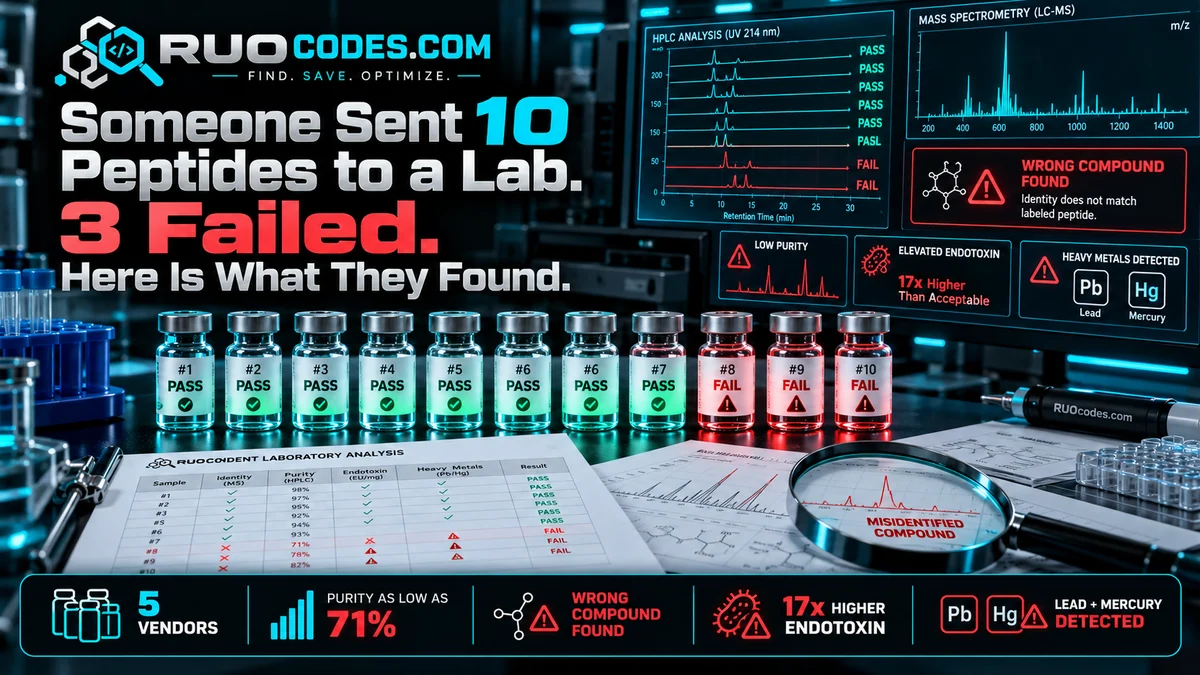
An independent investigation sent 10 peptides from 5 different vendors to a lab. Three failed. One "semaglutide" sample turned out to not even be semaglutide — mass spectrometry revealed it was a completely different compound. Budget-tier products showed purity as low as 71%, endotoxin levels 17 times higher than pharmaceutical grade, and detectable mercury and lead. The difference between a quality vendor and a bad one is not price or packaging. It is what third-party lab tests actually show. Here is how to read those numbers before your next order.
This Is Not Hypothetical
If you are new to peptide research, you have probably already noticed that the space is a little... wild. Dozens of vendors, similar prices, similar websites, and basically zero way to tell from the outside who is selling you something real versus something that came out of an unverified warehouse.
Most people figure this out the hard way. Either they buy something that clearly is not working, or they find out later that the vendor they trusted had some very serious problems with what they were actually shipping.
An investigation published earlier this year decided to stop guessing and just test. They spent over $3,200 buying peptides from five different vendors across four quality tiers, then sent everything to an independent lab for full analysis. Mass spectrometry. HPLC purity testing. Endotoxin screening. Heavy metal panels.
What came back should be required reading for anyone who is serious about doing this right.
Full compound research encyclopedia
What the Testing Actually Found
Here is the breakdown by vendor tier. This is real data from a real lab, not a marketing claim from any vendor.
The Gold Standard: FDA-Registered 503B Facilities
The top tier in the investigation was peptides sourced from 503B outsourcing facilities. To make sense of that, think of it this way: there is a category of specially licensed pharmacies in the United States that operate under direct FDA oversight. They get inspected. Their manufacturing processes are verified. They cannot just sell to anyone — their products go to healthcare providers and research institutions.
Every peptide from this tier passed.
Purity came back at 98 to 99 percent or better. Endotoxin levels were below 0.5 EU/mg — that is extremely clean. No heavy metal contamination detected.
This is what pharmaceutical-grade looks like. It is also the most expensive tier and the hardest to access as a researcher without an institutional relationship. But it sets the standard everything else gets measured against.
Tier Two: Established Research Companies
The next tier was established research companies — the kind of vendors that have been around for a few years, have a real website, and at least claim to do third-party testing.
The peptides confirmed correct identity, which matters. You got what the label said. But purity dropped to the 95 to 97 percent range, and endotoxin levels came back elevated — 1.2 to 2.1 EU/mg, which is 2 to 4 times higher than the pharmaceutical tier.
For context on why endotoxins matter: endotoxins are byproducts of bacterial contamination during the manufacturing process. They are not something you can see, smell, or taste. In pharmaceutical applications, elevated endotoxin levels can cause fever, inflammation, and systemic reactions. In a research context, elevated endotoxins can confound your results because you are now introducing a biological variable you did not intend.
This tier is not dangerous in the way the lower tiers are. But "confirmed identity, somewhat elevated endotoxins" is still a meaningful gap from the top tier.
Tier Three: Direct-from-Manufacturer Sourcing
This is where things start to get concerning.
Purity dropped to the 85 to 91 percent range. Lead contamination was detected at 0.5 to 0.8 parts per million. Endotoxin levels were up to 4.5 EU/mg — nine times higher than the top tier.
Direct-from-manufacturer sourcing usually means sourcing from overseas labs, most commonly in China. This is not automatically disqualifying — some overseas labs operate to high standards, and many of the raw materials used by top-tier US vendors are synthesized overseas and then purified and tested domestically. The problem is when the "direct from manufacturer" model skips the domestic quality-control step entirely.
Lead in a peptide product is not a small issue. Heavy metal contamination at this level in a research context introduces variables that have nothing to do with the compound you are studying.
Tier Four: Budget Vendors
This is the tier that should stop you cold.
Purity as low as 71 percent. Endotoxin levels of 8.7 EU/mg — 17 times higher than pharmaceutical grade. Mercury and lead both detected.
And the one finding that stands alone: the "semaglutide" from this tier was not semaglutide. Mass spectrometry revealed it was a completely different compound. The label said one thing. The lab said another. The researcher who trusted that product had no idea they were not even studying the compound they thought they were.
That is not a quality issue. That is fraud.
Compare verified peptide vendors
Why This Happens
The peptide research space operates in a regulatory gray area, and that gray area creates a wide range of vendor quality with very little external accountability.
Almost any vendor can claim they do third-party testing. Almost any vendor can post a certificate of analysis on their website. The certificate might be real. It might be from a non-accredited lab. It might be outdated. It might be for a different batch than what you are buying. There is currently no standardized, publicly verified system that forces vendors to prove their claims.
That is starting to change. The regulatory environment is shifting — the July 2026 advisory committee votes on BPC-157, TB-500, and other compounds signal that more oversight is coming. But "more oversight is coming" is not the same as "more oversight exists right now." Right now, you are largely on your own.
Which means the burden falls on you as a researcher to know what you are looking at.
What the 2026 PCAC vote actually means
How to Actually Verify What You Are Buying
This is not as complicated as it sounds once you know what to look for. Here are the four things that separate a vendor you can trust from one you cannot.
1. Third-Party Testing from a Named, Accredited Lab
The certificate of analysis a vendor posts needs to come from a specific, named laboratory. Not "independently verified." Not "tested for purity." A real lab with a real name that you can look up.
When you look up that lab, it should be an ISO 17025 accredited facility. That accreditation means the lab has been independently verified to produce accurate and reliable test results. An unaccredited lab can produce a certificate that looks identical to one from an accredited lab, but the data behind it may be meaningless.
2. Mass Spectrometry for Identity Confirmation
There are two main things you want to see in a peptide COA. The first is identity confirmation — proof that the compound is what it claims to be. This is done with mass spectrometry.
HPLC alone, which measures purity, cannot confirm identity. The budget-tier semaglutide in the investigation above would have passed an HPLC purity test on purity grounds while still being a completely different compound. You need mass spec to know you have the right molecule.
3. HPLC for Purity Above 98 Percent
High-performance liquid chromatography is the standard purity test. For peptides you are taking seriously as a research tool, you want to see 98 percent purity or better. Below 95 percent should make you ask questions. Below 90 percent should end the conversation.
Some vendors post 99 percent purity numbers. That is legitimate at the top tier. If you see a budget vendor posting 99 percent, ask to see the actual chromatogram — the graph behind the number. A clean chromatogram has one dominant peak with minimal noise. A messy one with multiple peaks tells you what the number does not.
4. Endotoxin and Heavy Metal Testing
Purity and identity are the baseline. The next level of verification is endotoxin testing (also called LAL testing) and a heavy metals panel. These are not universal in the industry — many vendors do not publish them. But the best vendors do.
For endotoxins, look for levels below 1 EU/mg. For heavy metals, you want non-detectable or near-zero results for lead, mercury, arsenic, and cadmium. Any vendor that publishes these numbers is demonstrating a level of transparency that budget vendors cannot match.
How to evaluate BPC-157 sourcing
The China Question
The testing investigation also surfaced something that has been getting more attention across the industry this year: the question of where peptides are manufactured and what that means for quality.
A significant portion of research peptides — including many sold by reputable US vendors — start as raw synthesized material from Chinese labs. That is just the reality of the supply chain. China has the manufacturing infrastructure and price points that make US peptide research economically viable for individual researchers. There is nothing inherently wrong with Chinese synthesis.
The problem is the difference between Chinese material that goes through a rigorous US-based quality control process and Chinese material that goes straight from a warehouse to a US vendor's shipping department with a label change in between.
A NewsNation investigation this year specifically called out the risk of unverified overseas peptides entering the US market without meaningful quality screening. The concern is not country of origin. The concern is whether the quality verification step actually happened.
If a vendor is sourcing domestically synthesized peptides, that is usually cleaner but more expensive. If they are sourcing internationally, the question is what their QC process looks like at the point of entry. Vendors who can answer that question specifically — with named labs and documented testing protocols — are in a different category than vendors who cannot.
What Good Actually Looks Like
To make this practical: here is what you should be able to confirm before placing an order with any vendor.
The COA is on file, recent (within 12 months of the current batch), and from a named accredited lab. It shows mass spectrometry identity confirmation and HPLC purity above 98 percent. Ideally it also shows endotoxin below 1 EU/mg and a clean heavy metals panel. The lot number on the COA matches the product you are buying — not a generic document posted once and left up forever.
If a vendor's website makes those things easy to find and verify, that is a strong signal. If you have to dig for it, email to ask for it, or the lab name is vague or unfamiliar, that is information too.
RUO Codes tracks testing documentation standards across the vendors listed in the database. Use it.
Full compound research encyclopedia · Verified vendor comparison
The Bottom Line
The lab testing numbers are not abstract. A peptide with 71 percent purity means 29 percent of what you injected into your research protocol is something unknown. Mercury and lead in a research compound are not acceptable trace elements — they are contaminants that will affect your results and, in applications where this matters, human outcomes.
The good news is that the top tier exists. Vendors who do this right are out there. The gap between them and the budget tier is wide enough that the testing data makes it obvious. Your job as a researcher is to know which category your vendor falls into before you order, not after.
Third-party testing is the language. Learn to read it, and most of the guesswork goes away.
The Peptide List lab testing investigation · ISO 17025 accreditation explained · NewsNation — Expert warns of risks from China-linked peptides
Frequently Asked Questions
How do I know if a peptide vendor's lab testing is real?
Look for a named, ISO 17025 accredited laboratory on the certificate of analysis. The lot number on the COA should match the product batch you are purchasing. If the vendor cannot tell you which accredited lab produced their testing, treat that as a red flag.
What purity level should I look for in research peptides?
98 percent or higher is the standard for serious research use. 95 to 97 percent is acceptable from an established vendor but represents a step down from pharmaceutical-grade. Below 95 percent should raise questions. Below 90 percent is a hard stop.
What is an endotoxin and why does it matter?
Endotoxins are byproducts of bacterial contamination in the manufacturing process. You cannot detect them by looking at the product. At elevated levels they can cause inflammation and fever in biological systems and can confound research results by introducing unintended biological variables. Look for endotoxin levels below 1 EU/mg in any COA you review.
Is it safe to buy peptides from vendors who source from China?
Country of origin is less important than the quality control process. Many legitimate US vendors use Chinese-synthesized raw materials that go through rigorous domestic testing. The risk comes from vendors who do not apply meaningful QC at any stage. Ask specifically what testing is done on each batch and which lab performs it.
What is mass spectrometry and why does it matter more than HPLC alone?
Mass spectrometry confirms that a compound is the molecule it claims to be. HPLC measures how pure the product is, but cannot verify identity. A product can test at 95 percent purity via HPLC while being a completely different compound — this is exactly what happened with the budget-tier semaglutide in the lab investigation. You need both tests.
Why are some peptides so much cheaper than others?
Price differences in research peptides usually reflect differences in synthesis quality, testing rigor, and sourcing. A vendor charging $40 for a compound that costs $120 at a top-tier vendor is cutting corners somewhere. The lab investigation makes it clear where those corners tend to get cut: purity, identity verification, and contamination screening.
Sources
PeakForm Peptides — "The Complete Guide to Research Peptide Quality" (2026) — peakformpeptides.com
Clarion Peptides — "The State of Research-Peptide Verification" (2026) — clarionpeptides.com
For research and educational purposes only. Not medical advice. Sourcing information current as of October 3, 2026.