Guidance reviewed October 31, 2026. Educational information, not individualized legal or medical advice. Household rules do not automatically apply to laboratories, businesses or healthcare facilities.
Quick answer: how do I dispose of used syringes?
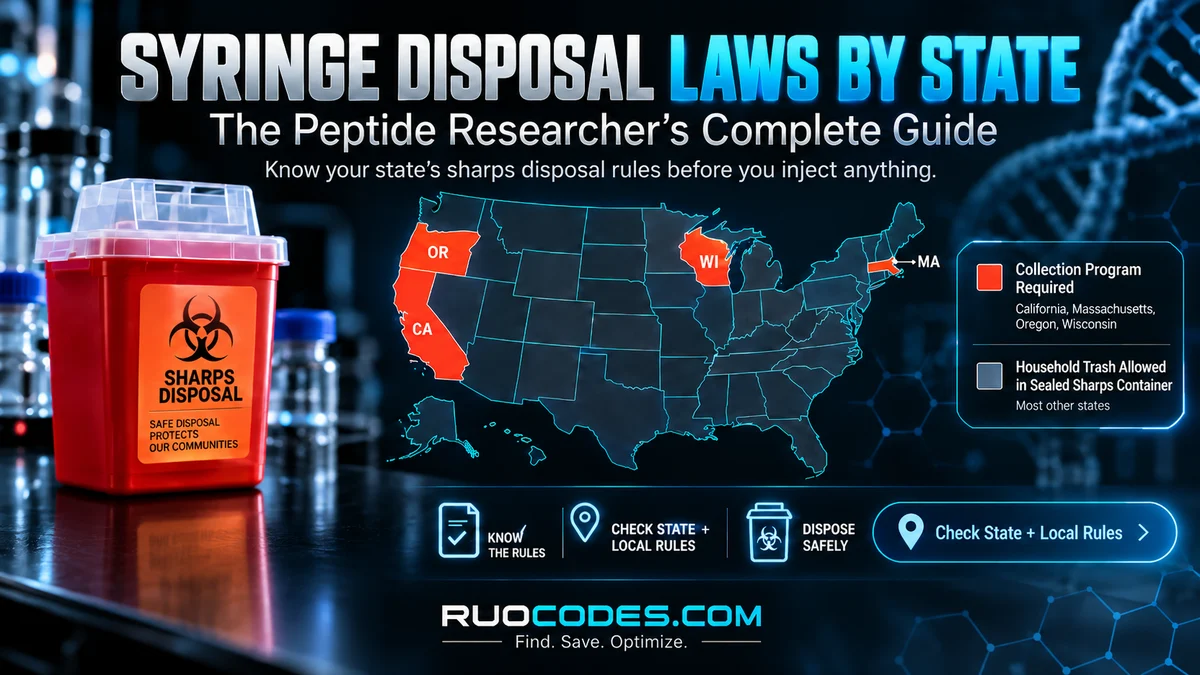
Used needles, syringes and lancets can injure sanitation workers and other people. Put them directly into a suitable sharps container immediately after use. Household disposal guidance varies by state and locality: many jurisdictions allow properly contained household sharps in trash, while California, Massachusetts, Oregon and Wisconsin direct residents to separate collection or approved disposal services. Never use the recycling bin. Check your local waste authority before disposal. This guide concerns household-generated sharps, not authorization to inject research-use-only products or to dispose of laboratory or business waste as household trash.
Why Sharps Disposal Matters More Than Researchers Realize
This is one of those topics that gets skipped because it feels like a detail. It is not a detail. It is a legal requirement, a safety issue, and increasingly a quality-researcher signal in a community where standards are rising.
Used needles, syringes and lancets are sharps and present a puncture hazard. Their legal waste classification depends on the jurisdiction and source of the waste; household, healthcare and laboratory waste are not interchangeable categories. Loose sharps can seriously injure sanitation workers and others who handle household waste.
For the research community, responsible waste management is part of safe practice. A research-use-only label does not make a product suitable for human use, and this disposal guide is not advice to self-administer peptides.
The good news is that following the rules is not complicated. It mostly requires one piece of equipment (a proper sharps container), an understanding of your state's rules, and thirty seconds of your time after each use.
The One Tool You Actually Need: A Proper Sharps Container
Before we get into state guidance, a quick note on containers. The FDA recommends an FDA-cleared sharps disposal container when possible. Choose a closable, puncture-resistant container with leak-resistant sides and bottom, and follow its manufacturer's instructions. A container alone does not establish that household-trash disposal is permitted where you live.
If an FDA-cleared container is unavailable, some community guidelines accept a heavy-duty plastic household container, such as a detergent bottle, with a tight-fitting, puncture-resistant lid. Confirm that your local program accepts it. Do not use thin water bottles, glass jars, or cardboard.
What every state and every safety organization agrees on: never place a used needle or syringe loose into household trash, a recycling bin, or a toilet. The container step is non-negotiable wherever you live.
Follow the container's marked fill line and instructions; the FDA advises disposal at about three-quarters full. Close it securely without forcing items inside. Follow local labeling and packaging requirements rather than assuming one label is accepted everywhere.
State-by-State Sharps Disposal Guide
The entries below summarize household-sharps guidance on Safe Needle Disposal's state pages reviewed October 31, 2026. They are practical starting points, not a legal opinion or an independent verification of all state statutes. Every entry links to its state-specific guidance and collection directory. Local authorities, waste haulers and receiving programs may impose stricter rules. Business, laboratory and healthcare waste can require different disposal services.
Alabama
State-page guidance describes a household-trash option for securely contained sharps. Confirm local permission, container type, labeling and packaging with your waste authority or hauler before using that option. Alabama guidance and collection locations.
Alaska
State-page guidance describes a household-trash option for securely contained sharps. Confirm local permission, container type, labeling and packaging with your waste authority or hauler before using that option. Alaska guidance and collection locations.
Arizona
State-page guidance describes a household-trash option for securely contained sharps. Confirm local permission, container type, labeling and packaging with your waste authority or hauler before using that option. Arizona guidance and collection locations.
Arkansas
State-page guidance describes a household-trash option for securely contained sharps. Confirm local permission, container type, labeling and packaging with your waste authority or hauler before using that option. Arkansas guidance and collection locations.
California
Do not put intact used household needles and syringes in ordinary trash. Use an authorized sharps collection, mail-back or other locally approved service. California guidance and collection locations.
Colorado
State-page guidance describes a household-trash option for securely contained sharps. Confirm local permission, container type, labeling and packaging with your waste authority or hauler before using that option. Colorado guidance and collection locations.
Connecticut
State-page guidance describes a household-trash option for securely contained sharps. Confirm local permission, container type, labeling and packaging with your waste authority or hauler before using that option. Connecticut guidance and collection locations.
Delaware
State-page guidance describes a household-trash option for securely contained sharps. Confirm local permission, container type, labeling and packaging with your waste authority or hauler before using that option. Delaware guidance and collection locations.
Florida
State-page guidance describes a household-trash option for securely contained sharps. Confirm local permission, container type, labeling and packaging with your waste authority or hauler before using that option. Florida guidance and collection locations.
Georgia
State-page guidance describes a household-trash option for securely contained sharps. Confirm local permission, container type, labeling and packaging with your waste authority or hauler before using that option. Georgia guidance and collection locations.
Hawaii
State-page guidance describes a household-trash option for securely contained sharps. Confirm local permission, container type, labeling and packaging with your waste authority or hauler before using that option. Hawaii guidance and collection locations.
Idaho
State-page guidance describes a household-trash option for securely contained sharps. Confirm local permission, container type, labeling and packaging with your waste authority or hauler before using that option. Idaho guidance and collection locations.
Illinois
State-page guidance describes a household-trash option for securely contained sharps. Confirm local permission, container type, labeling and packaging with your waste authority or hauler before using that option. Illinois guidance and collection locations.
Indiana
State-page guidance describes a household-trash option for securely contained sharps. Confirm local permission, container type, labeling and packaging with your waste authority or hauler before using that option. Indiana guidance and collection locations.
Iowa
State-page guidance describes a household-trash option for securely contained sharps. Confirm local permission, container type, labeling and packaging with your waste authority or hauler before using that option. Iowa guidance and collection locations.
Kansas
State-page guidance describes a household-trash option for securely contained sharps. Confirm local permission, container type, labeling and packaging with your waste authority or hauler before using that option. Kansas guidance and collection locations.
Kentucky
State-page guidance describes a household-trash option for securely contained sharps. Confirm local permission, container type, labeling and packaging with your waste authority or hauler before using that option. Kentucky guidance and collection locations.
Louisiana
State-page guidance describes a household-trash option for securely contained sharps. Confirm local permission, container type, labeling and packaging with your waste authority or hauler before using that option. Louisiana guidance and collection locations.
Maine
State-page guidance describes a household-trash option for securely contained sharps. Confirm local permission, container type, labeling and packaging with your waste authority or hauler before using that option. Maine guidance and collection locations.
Maryland
State-page guidance describes a household-trash option for securely contained sharps. Confirm local permission, container type, labeling and packaging with your waste authority or hauler before using that option. Maryland guidance and collection locations.
Massachusetts
Do not put intact used household needles and syringes in ordinary trash. Use an authorized sharps collection, mail-back or other locally approved service. Massachusetts guidance and collection locations.
Michigan
State-page guidance describes a household-trash option for securely contained sharps. Confirm local permission, container type, labeling and packaging with your waste authority or hauler before using that option. Michigan guidance and collection locations.
Minnesota
State-page guidance describes a household-trash option for securely contained sharps. Confirm local permission, container type, labeling and packaging with your waste authority or hauler before using that option. Minnesota guidance and collection locations.
Mississippi
State-page guidance describes a household-trash option for securely contained sharps. Confirm local permission, container type, labeling and packaging with your waste authority or hauler before using that option. Mississippi guidance and collection locations.
Missouri
State-page guidance describes a household-trash option for securely contained sharps. Confirm local permission, container type, labeling and packaging with your waste authority or hauler before using that option. Missouri guidance and collection locations.
Montana
State-page guidance describes a household-trash option for securely contained sharps. Confirm local permission, container type, labeling and packaging with your waste authority or hauler before using that option. Montana guidance and collection locations.
Nebraska
State-page guidance describes a household-trash option for securely contained sharps. Confirm local permission, container type, labeling and packaging with your waste authority or hauler before using that option. Nebraska guidance and collection locations.
Nevada
State-page guidance describes a household-trash option for securely contained sharps. Confirm local permission, container type, labeling and packaging with your waste authority or hauler before using that option. Nevada guidance and collection locations.
New Hampshire
State-page guidance describes a household-trash option for securely contained sharps. Confirm local permission, container type, labeling and packaging with your waste authority or hauler before using that option. New Hampshire guidance and collection locations.
New Jersey
State-page guidance describes a household-trash option for securely contained sharps. Confirm local permission, container type, labeling and packaging with your waste authority or hauler before using that option. New Jersey guidance and collection locations.
New Mexico
State-page guidance describes a household-trash option for securely contained sharps. Confirm local permission, container type, labeling and packaging with your waste authority or hauler before using that option. New Mexico guidance and collection locations.
New York
State-page guidance describes a household-trash option for securely contained sharps. Confirm local permission, container type, labeling and packaging with your waste authority or hauler before using that option. New York guidance and collection locations.
North Carolina
State-page guidance describes a household-trash option for securely contained sharps. Confirm local permission, container type, labeling and packaging with your waste authority or hauler before using that option. North Carolina guidance and collection locations.
North Dakota
State-page guidance describes a household-trash option for securely contained sharps. Confirm local permission, container type, labeling and packaging with your waste authority or hauler before using that option. North Dakota guidance and collection locations.
Ohio
State-page guidance describes a household-trash option for securely contained sharps. Confirm local permission, container type, labeling and packaging with your waste authority or hauler before using that option. Ohio guidance and collection locations.
Oklahoma
State-page guidance describes a household-trash option for securely contained sharps. Confirm local permission, container type, labeling and packaging with your waste authority or hauler before using that option. Oklahoma guidance and collection locations.
Oregon
Do not put intact used household needles and syringes in ordinary trash. Use an authorized sharps collection, mail-back or other locally approved service. Oregon guidance and collection locations.
Pennsylvania
State-page guidance describes a household-trash option for securely contained sharps. Confirm local permission, container type, labeling and packaging with your waste authority or hauler before using that option. Pennsylvania guidance and collection locations.
Rhode Island
State-page guidance describes a household-trash option for securely contained sharps. Confirm local permission, container type, labeling and packaging with your waste authority or hauler before using that option. Rhode Island guidance and collection locations.
South Carolina
State-page guidance describes a household-trash option for securely contained sharps. Confirm local permission, container type, labeling and packaging with your waste authority or hauler before using that option. South Carolina guidance and collection locations.
South Dakota
State-page guidance describes a household-trash option for securely contained sharps. Confirm local permission, container type, labeling and packaging with your waste authority or hauler before using that option. South Dakota guidance and collection locations.
Tennessee
State-page guidance describes a household-trash option for securely contained sharps. Confirm local permission, container type, labeling and packaging with your waste authority or hauler before using that option. Tennessee guidance and collection locations.
Texas
State-page guidance describes a household-trash option for securely contained sharps. Confirm local permission, container type, labeling and packaging with your waste authority or hauler before using that option. Texas guidance and collection locations.
Utah
State-page guidance describes a household-trash option for securely contained sharps. Confirm local permission, container type, labeling and packaging with your waste authority or hauler before using that option. Utah guidance and collection locations.
Vermont
State-page guidance describes a household-trash option for securely contained sharps. Confirm local permission, container type, labeling and packaging with your waste authority or hauler before using that option. Vermont guidance and collection locations.
Virginia
State-page guidance describes a household-trash option for securely contained sharps. Confirm local permission, container type, labeling and packaging with your waste authority or hauler before using that option. Virginia guidance and collection locations.
Washington
Contained household disposal may be permitted outside King and Snohomish counties, which have specific restrictions. Confirm your county and hauler's current instructions before using household trash. Washington guidance and collection locations.
West Virginia
State-page guidance describes a household-trash option for securely contained sharps. Confirm local permission, container type, labeling and packaging with your waste authority or hauler before using that option. West Virginia guidance and collection locations.
Wisconsin
Do not put intact used household needles and syringes in ordinary trash. Use an authorized sharps collection, mail-back or other locally approved service. Wisconsin guidance and collection locations.
Wyoming
State-page guidance describes a household-trash option for securely contained sharps. Confirm local permission, container type, labeling and packaging with your waste authority or hauler before using that option. Wyoming guidance and collection locations.
The Four States That Require Collection Programs
For intact used household needles and syringes in California, Massachusetts, Oregon and Wisconsin, use an authorized collection, mail-back or other approved sharps service—not ordinary household trash. Consult the linked state guidance for permitted treatment methods and exceptions; this is not a claim that every item associated with a syringe has identical legal status.
Collection options can include designated pharmacies, hospitals, public-health offices and waste facilities. Call ahead: not every facility accepts sharps, and programs may have container, residency or fee requirements. A medication take-back box is not automatically a sharps collection point.
Sharps mail-back services can provide a container, approved mailing packaging and disposal instructions. Check the provider's coverage, accepted contents and current price. Some local programs, including California's stewardship programs, offer eligible residents free options; do not assume a universal kit price or that ordinary postage is sufficient.
Step-by-Step: How to Dispose of Sharps Correctly
Use this general household-sharps checklist alongside the container instructions and your local disposal requirements:
Step 1: Put a sharps container within reach before using a needle or lancet. Keep the container upright and away from children and pets; never leave used sharps loose on a counter or in a drawer.
Step 2: Place the used sharp directly into the container immediately after use. Do not make recapping a routine disposal step. Activate a device's safety feature according to its instructions.
Step 3: Do not bend, break or remove needles by hand, or force them into the container. If a container is temporarily unavailable, follow the FDA's specific contingency guidance; never recap a needle used by someone else. Only a purpose-designed needle clipper may be considered where appropriate and accepted locally—never scissors or improvised tools.
Step 4: Follow the fill line and close the container before overfilling—generally around three-quarters full. Use its permanent closure as directed; do not reopen it or compress the contents.
Step 5: Follow the receiving program's labeling and packaging instructions. A warning such as SHARPS—DO NOT RECYCLE may be useful, but it does not replace locally required wording.
Step 6: Use the disposal route confirmed by your local authority or waste hauler. Where properly contained household sharps are accepted in trash, follow that program's packaging rules. Otherwise use an authorized collection or mail-back service. Never recycle the filled container.
Finding Drop-Off Sites Near You
Start with Safe Needle Disposal's state pages or ZIP-code search, then confirm acceptance, fees and hours directly with the collection program. Your local public-health department or waste authority can also identify approved options.
Typical collection locations include:
Some pharmacies offer sharps collection or sell approved mail-back kits. Call the specific pharmacy; do not assume any chain accepts sharps for free.
Some hospitals run household sharps programs. Confirm the designated collection location and its requirements before bringing a container.
Some fire or police stations host dedicated sharps programs. Confirm that sharps—not just unwanted medicines—are accepted.
Local health departments frequently operate sharps collection sites or can direct you to the nearest one.
What the RUO Researcher Needs to Know Specifically
Household guidance often addresses people using prescribed injectable medicines or lancets. It is not permission to inject research-use-only products, and waste generated by a laboratory or business may fall outside household exemptions. Follow your facility's waste-management procedures when applicable.
Plan for enough suitable containers for the sharps you actually generate. Replace containers at their fill line rather than estimating capacity from a treatment or research schedule. This guide does not recommend a peptide dose, injection frequency or treatment course.
Needles and syringes used to transfer liquids can still create a sharps hazard, even if they were not used to inject a person. Follow the applicable household or facility disposal rules; needle size does not remove the need for safe containment.
Do not assume that every empty vial is ordinary trash. Broken glass, residual medicines or chemicals, and contaminated laboratory materials may require separate handling. Ask the local program or your facility's waste officer before discarding vials; wrapping glass does not make regulated waste exempt.
My Take as a Researcher
I want to be direct about where I stand on this topic.
Proper sharps disposal is not optional for anyone who takes their research practice seriously. The peptide research community has made meaningful strides on quality standards over the past few years: demanding third-party tested compounds, requesting lot-specific COAs, pushing vendors toward documented purity. Sharps disposal is the tail end of that same commitment to doing things right.
Responsible sourcing and documented testing do not replace safe waste handling. Leaving used needles loose in household trash puts other people at risk, regardless of where the materials came from.
Disposal practices should be grounded in waste-safety rules, not assumptions about the regulatory status of a research product. Keep those questions separate: our compound reference provides research context, not authorization for self-administration. explore the compound reference
Frequently Asked Questions
Can I throw away a used insulin syringe in the trash?
Only if current state and local rules permit the disposal method and the used syringe is secured in an accepted sharps container. California, Massachusetts, Oregon and Wisconsin direct residents to approved sharps services rather than ordinary trash. Confirm acceptance with your local waste authority; never discard loose sharps.
What counts as a puncture-resistant container?
An FDA-cleared sharps container is preferred. Where local guidance allows an alternative, it should be heavy-duty plastic, leak-resistant on the sides and bottom, stable upright, and closable with a tight-fitting, puncture-resistant lid. Thin bottles, glass and cardboard are not suitable substitutes.
How full can I let my sharps container get before sealing it?
Follow the marked fill line and manufacturer's instructions. The FDA advises closing and disposing of containers at about three-quarters full. Do not overfill, force sharps inside, or reopen a sealed container.
What if I travel across state lines with my research protocols?
Follow the rules where disposal takes place, including local restrictions. Carry an appropriate portable sharps container and identify an accepting collection service before traveling. Transport and carrier rules are separate from disposal rules and should also be checked.
Is there a mail-back option that works everywhere?
Mail-back services are available, but check the provider's service area and accepted materials. Use its approved packaging and instructions. Costs, eligibility and disposal methods vary; ordinary mail packaging is not a substitute for an authorized sharps mail-back kit.
Do I need to disinfect syringes before disposal?
Do not add disinfectants, reopen filled containers or handle used needles based on a generic state list. Follow the current instructions of your local health or waste authority and receiving program. The FDA's general approach is immediate containment and approved disposal, not a universal home-disinfection procedure.
Where can I find collection sites near me?
Use Safe Needle Disposal's state directory or ZIP-code search, then call the listed facility to confirm that it currently accepts your sharps container. Local health and waste departments can also help. Medicine-only take-back boxes may not accept needles.
Does this apply to lancets from blood testing?
Yes. Lancets used for finger-stick blood testing are classified as sharps under the same state laws. They go into the sharps container along with syringes and needles. The same disposal rules apply.
Bottom Line
Proper sharps containment protects the people who handle waste. Set up a suitable container, use it immediately, and verify the approved disposal route before the container fills.
Many states' household guidance permits properly contained sharps in trash, subject to local rules. California, Massachusetts, Oregon and Wisconsin direct users of intact household sharps to approved disposal programs. Local restrictions and non-household waste classifications can change the answer.
Check the linked state page and your local waste authority before disposing of a filled container. If you are unsure, ask about an authorized collection or mail-back option rather than placing it in the trash.
Do this right. The safety of people who handle your trash depends on it. For broader research context, see our compound reference and state-by-state peptide law resource; neither replaces local sharps disposal instructions.
Sources and verification scope
All 50 Safe Needle Disposal state guidance pages were reviewed on October 31, 2026. FDA handling guidance and the linked California, Massachusetts, Oregon Metro and Wisconsin agency pages were also checked. This is not an independent 50-state statutory audit; the older LAPPA document is historical background, not proof of current law. Local acceptance, prices and programs can change.
- FDA: proper sharps disposal
- FDA: when a sharps container is unavailable
- Safe Needle Disposal: state-by-state guidance and collection locations
- California: home-generated sharps stewardship and mail-back options
- Massachusetts: statewide ban on sharps in household trash
- Oregon Metro: household sharps disposal
- Wisconsin DNR: managing household medical sharps
- Historical legal background: LAPPA summary, current through August 2024
Related RUO Codes resources
- State-by-state peptide law reference — a separate topic from sharps disposal.
- Compound research reference — research context, not injection instructions.
- More research and safety guides