Published: October 2026 | RUOcodes.com
TLDR
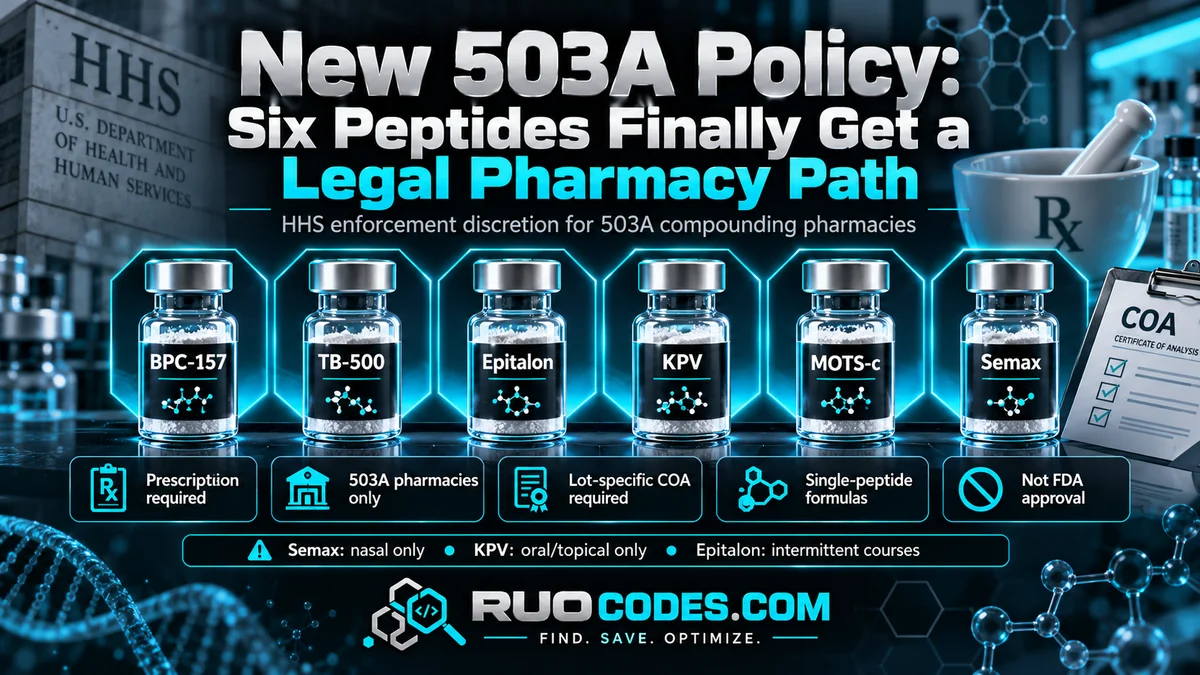
HHS just released an enforcement discretion policy that gives 503A state-licensed compounding pharmacies a legal path to compound and dispense six specific peptides: BPC-157, TB-500, Epitalon, KPV, MOTS-c, and Semax. A valid prescription for an individual patient is required. The raw materials must come from an FDA-registered manufacturer with a detailed, lot-specific certificate of analysis (COA). Each peptide has its own form restrictions, and some preparation styles are off the table entirely. This is not FDA approval. It is not over-the-counter availability. It does not affect Research Use Only vendors in any direct regulatory way. But it is the most concrete legal pathway these six compounds have ever had in the United States, and researchers need to understand exactly what it does and does not mean.
What Just Happened
On October 28, 2026, HHS released a formal enforcement discretion policy specifically for 503A compounding pharmacies. The policy is scheduled for official publication in the Federal Register on October 30, 2026.
To understand why this matters, you need to know what a 503A pharmacy actually is. A 503A facility is a state-licensed compounding pharmacy that makes medications for individual patients under a prescription from a licensed physician. These are not manufacturing facilities cranking out stock products. They compound one patient at a time, one prescription at a time. Think of them as the custom tailoring shop of the pharmacy world: they make something specific for someone specific because a mass-manufactured product does not exist or does not fit the patient's needs.
For years, these pharmacies have operated in a gray zone with peptides. The FDA had moved several popular peptides into "Category 2," which is the agency's way of saying these compounds present enough safety concerns or have enough unknowns that licensed pharmacies should not be compounding them. That created the research use only market you already know about, because demand did not disappear just because legitimate pharmacies could not meet it.
This new policy changes that for six specific compounds. HHS will not take enforcement action against 503A pharmacies, federal facilities, or licensed physicians who compound these peptides, as long as they follow every condition in the policy. That is a meaningful shift. It is not permanent, and it is not approval, but for the first time these six compounds have a clear legal pharmacy path in the United States.
The Six Peptides Covered
Here are the six compounds the policy covers, along with what the research community knows about each one:
BPC-157 (Body Protection Compound) The most searched peptide on the internet right now. BPC-157 is a synthetic peptide derived from a protective gastric protein. It has been extensively studied in animal models for gut healing, tendon and ligament repair, and systemic anti-inflammatory effects. The research literature on this one is deep. Human clinical data is still limited, but the animal model evidence is among the most compelling in the peptide space.
TB-500 (Thymosin Beta-4 Fragment) TB-500 is the commercially used name for a synthetic fragment of Thymosin Beta-4, specifically the sequence LKKTETQ. It is widely researched for tissue repair, wound healing, and recovery acceleration. Athletes and biohackers have been using this one for well over a decade. The PCAC advisory committee vote in July 2026 recommended it for the 503A Bulks List by a narrow margin.
Epitalon (Epithalon) A tetrapeptide studied primarily in longevity and telomere research. The bulk of Epitalon's clinical literature comes from Russian research dating back several decades. It has attracted significant interest in the anti-aging community. Under this policy, Epitalon may only be dispensed in intermittent courses, not as a continuous daily use compound. That dosing restriction reflects the committee's caution around long-term exposure data.
KPV KPV is a tripeptide fragment of alpha-melanocyte-stimulating hormone. It has a growing literature specifically around gut inflammation and inflammatory bowel conditions. Under this policy, KPV is limited to oral and topical forms only. Injectable KPV is not covered.
MOTS-c (Mitochondrial Open Reading Frame of the 12S rRNA-c) One of the newer compounds on this list. MOTS-c is a mitochondrial-derived peptide with emerging research in metabolic health, insulin sensitivity, and longevity pathways. The research is early but the mechanism is fascinating: it is one of the few peptides known to originate from mitochondrial DNA rather than nuclear DNA.
Semax A neuropeptide with a long history in Russian clinical medicine, where it has been used for stroke recovery, cognitive enhancement, and neuroprotection. Semax has a genuine track record in that literature. Under this policy, Semax is limited to nasal administration only. Injectable Semax is not covered.
What the Policy Actually Requires
This policy is not a free pass. The conditions pharmacies must meet are specific and demanding. Anyone following the quality conversation in this community will recognize these standards immediately.
A valid prescription is required. Not a general standing order. A prescription for a specific patient from a licensed physician. No prescription, no dispensing. This is a pharmacy path, not an over-the-counter path.
The raw ingredient must come from an FDA-registered manufacturer. This matters a great deal. A significant portion of the peptide raw material supply chain runs through unregistered overseas manufacturers. Under this policy, those sources are not acceptable. Pharmacies have to source from registered facilities.
A lot-specific Certificate of Analysis is required, and it has to be comprehensive. This is the part that will genuinely raise the bar. The COA must cover identity, purity, net peptide content, endotoxins, heavy metals, microbial testing, and more. That standard is considerably more detailed than most COAs in circulation today, including many from RUO vendors. This is not a one-page summary from the manufacturer. It is a full quality document that traces the specific batch.
Single-peptide formulations only. No blends. Each product can contain only one of the six covered peptides. If a pharmacy wants to offer a BPC-157 and TB-500 combined preparation, that combination is not covered by this policy.
Dosage form restrictions apply per peptide:
Semax: nasal administration only KPV: oral and topical forms only Epitalon: intermittent courses only, not continuous use Pharmacies must report serious side effects and quality problems to the FDA. This is a pharmacovigilance requirement. If something goes wrong, it has to be reported. That creates accountability that does not currently exist in the RUO market.
What This Policy Does Not Do
This section matters as much as the one above.
It does not cover RUO vendors. The policy is written exclusively for 503A state-licensed compounding pharmacies. Research Use Only suppliers are not mentioned as covered parties, and no rules or requirements for RUO operations appear anywhere in the document. The only place RUO comes up is in HHS's reasoning: the stated goal is to discourage widespread use of research-use-only peptides from foreign manufacturers by offering pharmacy compounding as a more controlled alternative.
It does not cover peptides outside the six listed. GHK-Cu, CJC-1295, Ipamorelin, Thymosin Alpha-1, Selank, AOD-9604, and every other compound not on this list are not included. Do not assume coverage extends beyond BPC-157, TB-500, Epitalon, KPV, MOTS-c, and Semax.
It does not make any of these six peptides FDA-approved. Enforcement discretion and FDA approval are completely different things. Approval means the FDA has reviewed safety and efficacy data and made a formal determination. Enforcement discretion means the FDA is choosing not to penalize specific conduct under current rules. These compounds remain unapproved drugs under federal law.
It does not override state pharmacy boards. Individual states set their own rules for licensed pharmacies. A 503A pharmacy operating under this federal policy still has to comply with its state board of pharmacy requirements, which may be more or less restrictive than what HHS says here.
It can be reversed. HHS explicitly says the policy can be revisited if a safety or quality problem comes up. Enforcement discretion does not require formal rulemaking to undo. A future administration, or even this one, could pull it back without going through the lengthy public comment process that a permanent rule change would require.
The COA Standard Is Worth Your Attention
One thing in this policy that does not get enough attention is the certificate of analysis requirement. The standard described is far more rigorous than most of what circulates in the peptide market today.
The testing framework requires: identity confirmation, purity percentage, net peptide content, endotoxin levels, heavy metal screening, and microbial contamination testing. It is lot-specific, meaning the test results have to trace back to the exact batch being dispensed, not a general product standard.
For those of us in the RUO community who have been pushing for better third-party testing, this is a useful benchmark. The quality bar HHS is setting for legal pharmacy compounding is essentially what independent testing advocates have been saying RUO vendors should voluntarily meet. It is now formalized on the pharmacy side.
Vendors who already hit this standard have a story to tell. Vendors who cannot hit this standard have a problem. compare verified peptide vendors who publish third-party COAs
What This Means for the Research Use Only Space
The policy does not regulate RUO vendors. Let me say that clearly so it does not get buried: nothing in this document creates new legal requirements for research-use-only suppliers.
But market reality is a different conversation from regulatory reality.
Access to these six compounds just changed for a segment of the market. Before this policy, the only realistic way to access BPC-157, TB-500, or Semax outside a clinical trial was through an RUO supplier. That is no longer true for people with access to a physician willing to prescribe through a 503A pharmacy. Some of that demand will move. How much depends on pricing, insurance coverage, physician access, and how quickly compounding pharmacies build out capacity. But the addressable market for RUO vendors in these six specific compounds is now smaller than it was yesterday.
The competitive pressure on quality has never been higher. When a patient can go to a licensed compounding pharmacy that must source from FDA-registered manufacturers, get full lot-specific COA documentation, and operate under pharmacovigilance requirements, that sets a visible quality comparison point. RUO vendors who already lead on quality have an opportunity here. Vendors whose value proposition was purely "we have it when you can't get it elsewhere" are in a more difficult position.
The compounds NOT on this list become more interesting for RUO vendors. GHK-Cu, Ipamorelin, CJC-1295, Thymosin Alpha-1, Selank, and others are not part of this policy. The pharmacy path does not exist for them yet. For RUO vendors who have diversified beyond just the six covered compounds, that diversity is a real asset right now.
My Take as a Researcher
I want to be direct about where I stand.
This policy is the right direction. Forcing compound demand into an unregulated market because legitimate pharmacies could not serve it has caused real harm. People sourcing from unknown overseas suppliers with no quality verification and no physician oversight is not a good outcome. If this policy routes some of that demand toward licensed pharmacies with documented quality controls and physician supervision, that is a better system than what existed before.
The caution I would add is practical rather than political. "Enforcement discretion" is not approval. The COA requirements and prescription pathways this policy creates will take time to build out at scale. Pharmacy capacity for peptide compounding is not unlimited, and sourcing compliant raw materials from FDA-registered manufacturers is not a trivial logistics problem. The theory here is good. The implementation will take time.
For researchers who are sourcing from RUO vendors in the meantime: the quality standard this policy establishes is a useful rubric for evaluating your current vendor. Third-party testing, lot-specific documentation, heavy metal and endotoxin panels. If your vendor cannot produce documentation that approaches that standard, the gap between what you are getting and what a licensed pharmacy would produce under this policy is real and worth thinking about. verified vendor codes on RUOcodes.com
For the six covered compounds specifically: once pharmacy capacity exists and physician access is manageable, the supervised pathway is meaningfully safer than unsupervised RUO sourcing. That is not a knock on RUO vendors who operate with integrity. It is an acknowledgment of what physician oversight and formal quality systems add.
Frequently Asked Questions
What is a 503A compounding pharmacy and how is it different from a regular pharmacy?
A 503A pharmacy is a state-licensed compounding facility that makes custom medications for individual patients with a prescription from a licensed physician. Unlike a regular pharmacy that dispenses mass-manufactured FDA-approved drugs, a 503A pharmacy produces patient-specific formulations. They are subject to state pharmacy board oversight and operate under federal guidelines for bulk drug substances. This policy applies specifically to 503A facilities, not 503B outsourcing facilities, which serve healthcare facilities rather than individual patients.
Is BPC-157 legal to buy without a prescription now?
No. This policy creates a legal path through compounding pharmacies, which requires a valid prescription from a licensed physician for a specific patient. BPC-157 remains unavailable over the counter. RUO-labeled BPC-157 is in a separate legal category and this policy does not change its status.
Why is this not FDA approval?
FDA approval means the agency has reviewed clinical evidence of safety and efficacy through a formal application process and made a binding regulatory determination. Enforcement discretion means the agency is choosing not to penalize specific conduct that technically falls outside current rules. These are legally and practically different. A compound under enforcement discretion remains an unapproved drug. The enforcement posture can change without formal rulemaking. learn more about peptide regulatory categories
Which peptides are NOT covered by this policy?
GHK-Cu, CJC-1295, Ipamorelin, Thymosin Alpha-1, Selank, AOD-9604, Melanotan II, GHRP-2, GHRP-6, PEG-MGF, and all other peptides not specifically named in the policy are outside its scope. Coverage is limited to the six named compounds: BPC-157, TB-500, Epitalon, KPV, MOTS-c, and Semax.
What is the COA standard the policy requires?
The policy requires a lot-specific certificate of analysis covering identity confirmation, purity percentage, net peptide content, endotoxin levels, heavy metal screening, and microbial contamination testing. The raw ingredient must come from an FDA-registered manufacturer. This is a more rigorous documentation standard than most RUO vendor COAs currently provide.
Does this policy change anything for RUO vendors right now?
No direct regulatory change. The policy does not regulate RUO vendors and creates no new requirements for them. The indirect effect is competitive: some demand for the six covered compounds may shift toward the licensed pharmacy channel as it builds out capacity. Vendors who differentiate on quality are better positioned than those who depended on being the only accessible option.
Can this policy be reversed?
Yes. HHS explicitly states the policy can be revisited if a safety or quality problem arises. Enforcement discretion does not require formal rulemaking to withdraw. This is one of the key distinctions between enforcement discretion and a permanent regulatory rule change.
What does the dosage form restriction mean for Semax?
The policy limits Semax to nasal administration only. Compounding pharmacies operating under this policy cannot compound injectable Semax under its terms. Researchers who have used injectable Semax through RUO sources would not have an equivalent pharmacy pathway under the current policy.
Bottom Line
This policy is the most concrete legal pharmacy pathway these six compounds have ever had in the United States. The mechanism is right. The quality standards built into it are genuinely high. The prescription requirement and physician oversight are appropriate given where the human data stands.
It is not FDA approval. It is not an overnight fix. It does not resolve the research use only market or create new rules for RUO vendors. The six covered compounds now have a licensed, supervised pathway. Everything else remains in the same position it was yesterday.
For researchers: use this moment to audit your sourcing. If your RUO vendor cannot match the COA standard this policy describes, that gap is worth taking seriously. Independent third-party testing is not optional for vendors who want to be taken seriously in an environment where a formal quality comparison point now exists.
For the six compounds covered here: watch the compounding pharmacy market develop. Capacity, pricing, and physician access will determine how quickly the pharmacy path becomes practically accessible at scale.
We will continue tracking this as the Federal Register publication drops and as pharmacies begin operating under the policy. If anything changes, you will hear it here first.
Sources
- HHS Enforcement Discretion Policy for 503A Compounding Using Certain Peptide Bulk Drug Substances — Federal Register Public Inspection, October 2026
- Peptides at a Crossroads: What Wellness Providers Need to Know — Holland & Knight, October 2026
- FDA Voted Yes on Six Peptides: Now What? The Regulatory Road Ahead — Buchanan Ingersoll & Rooney, 2026
- What FDA's Latest Actions Mean for Peptide Compounding — JD Supra, 2026
- FDA Committee Recommends Looser Restrictions for Several Peptides — Healio, July 2026
- FDA Committee Supports Peptide Compounding: What Comes Next — National Law Review, 2026