For research and educational purposes only. Not legal advice.
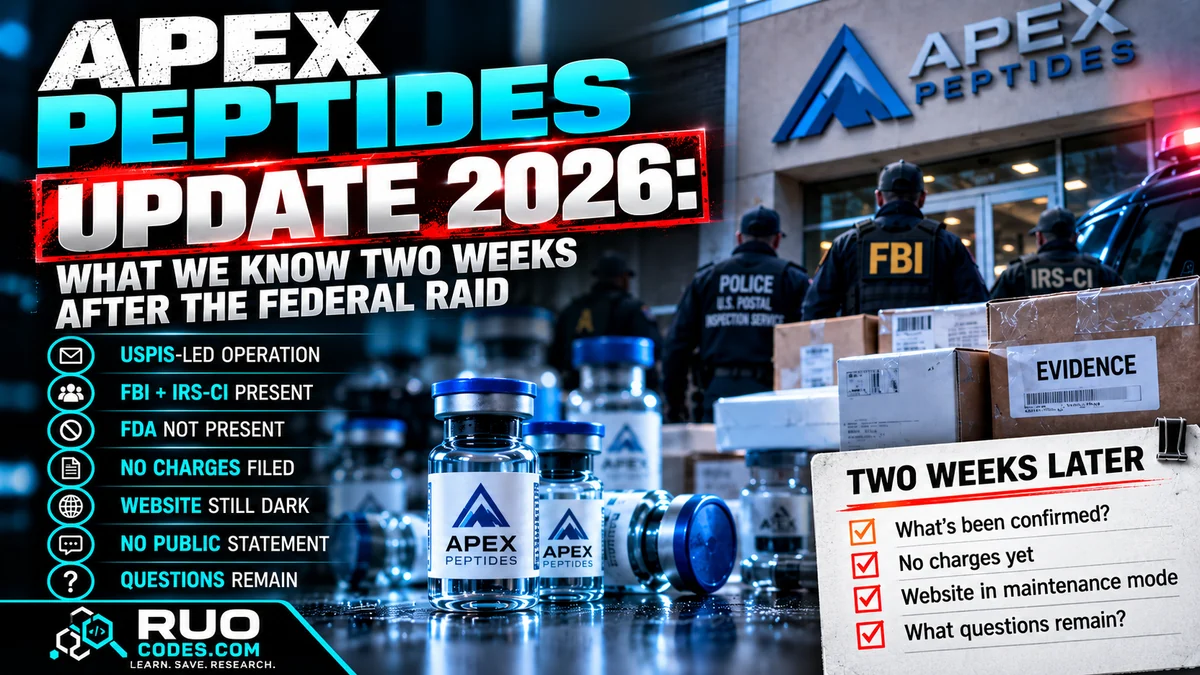
Verification note: Updated October 5, 2026, nearly two weeks (12 days) after the search. Storefront observed October 5; the cited no-public-charges reporting is dated September 26. Allegations, investigation scope, and guilt must not be inferred from agency participation.
TL;DR
On September 23, 2026, federal agents raided Apex Peptides in North Sioux City, South Dakota. The U.S. Postal Inspection Service led the operation, with FBI and IRS Criminal Investigation as backup. The local reports reviewed do not identify FDA participation. September 26 reporting identified no publicly announced charges; that does not establish whether sealed filings exist or what changed afterward. When checked on October 5, apexpeptides.com still displayed a maintenance notice with a login link and no customer update on that page. Two people were seen in handcuffs on the day of the search but were never identified and no arrest was announced. IRS Criminal Investigation’s involvement makes financial offenses one possible explanation, but the agencies have not publicly identified the suspected offenses. Here is what the reporting establishes, what remains unknown, and how to interpret the agency lineup without treating it as proof.
Where Things Stand Right Now
The Apex Peptides website is still dark.
A check of apexpeptides.com on October 5 returned a maintenance page with a login link. That page contained no reopening, refund, company, or attorney update. This observation concerns the storefront page; it does not establish whether communications exist elsewhere.
The reason for the limited public communication is unknown.
Here is the agency statement described in the supplied September reporting:
A USPIS spokesperson named Travis Fondow told a local radio station on September 24 that federal agents were present "at multiple locations in the Sioux City area" on September 23 and that no further details could be provided because it is an "active investigation."
The September 26 reporting reviewed identified no publicly announced charges or public filing explaining the search. That verification date is September 26, not October 5; this article does not claim a fresh October 5 federal docket search.
The absence of a public filing does not establish that charges exist, that a filing is sealed, or that a grand jury is involved. Public information does not yet establish the case’s procedural status. A search warrant authorizes evidence collection; it is not itself a criminal charge.
What Actually Happened the Day of the Raid
At around 9 a.m. on September 23, federal agents arrived at 503 Prosperity Way in North Sioux City, South Dakota. The address belongs to a business called Apex Waste Management, which shares its principals with Apex Peptides.
The operation ran until approximately 4 p.m. Agents loaded papers, boxes, and a tote of small packaged items into a U-Haul trailer. When a UPS delivery arrived at noon, agents intercepted it and loaded it directly into evidence.
At the same time, five agents searched a private residence at 661 Prairie Boulevard in Dakota Dunes, South Dakota. That home belongs to Ryan Isaacson, the twin brother of Riley Isaacson, who is listed as president of Apex Waste Management and Apex Research. Multiple bags and boxes were removed.
Local media reported a third location was also searched, but it was never publicly identified.
Two people were seen escorted in handcuffs during the day. Neither was identified publicly. No arrest was announced.
When Riley Isaacson showed up at the scene on September 24, he said two words to reporters asking why the properties were searched: "No comment."
By the next day, investigators also found that five additional businesses connected to the Apex network at the Prosperity Way address were non-operational. The Apex business network is sprawling. Beyond Apex Peptides itself, you have Apex Research, Apex Rx, Apex Cosmetics, Vitality Labs, Titan Peptides, and roughly two dozen other LLCs registered to the same principals. One of those is called Helping Hands Nursing Inc.
A shared business connection does not establish that products moved into human use or that investigators are examining that connection. No such product transfer or investigative focus is established by the reporting reviewed.
Who Was Reported at the Search—and What That Does Not Establish
Most of the coverage of this raid has focused on what happened. The more important story is who showed up and who did not.
Who showed up: U.S. Postal Inspection Service, FBI, and IRS Criminal Investigation.
FDA participation was not reported in the local coverage reviewed. That is not proof that the FDA was absent or has no role elsewhere in the investigation.
The agency lineup is relevant context, but it does not identify the alleged conduct or separate the case conclusively into financial versus drug-related enforcement.
When the FDA takes action against a peptide vendor, the pattern looks like this: they send a warning letter first, they give the company a chance to respond, and enforcement escalates from there. The FDA issued five warning letters to peptide vendors on August 24, 2026. Apex Peptides was not on that list. As of the last confirmed check, no FDA warning letter to Apex exists in the public record.
When USPIS, FBI, and IRS Criminal Investigation show up together, unannounced, with a search warrant and a U-Haul, that is a different animal entirely. That agency combination is characteristic of investigations into mail fraud, wire fraud, money laundering, and tax evasion.
USPIS investigates crimes that use or affect the mail system, while IRS Criminal Investigation works financial and tax cases. FBI participation adds federal investigative resources. Those responsibilities explain possible areas of inquiry, not the specific allegations in this case.
IRS Criminal Investigation’s involvement makes financial offenses one possible explanation. However, the agencies have not publicly identified the suspected offenses, and their participation does not rule out drug-related allegations. No conclusion about guilt follows from the search.
Separate peptide-selling prosecutions have involved criminal allegations, including unapproved-drug offenses. Those cases illustrate possible enforcement outcomes; they do not establish the allegations or likely outcome in the Apex investigation.
How This Fits the Bigger Picture in 2026
The Apex raid did not come out of nowhere. The RUO peptide market has been under sustained pressure all year.
Peptide Sciences shut down on March 6, 2026, citing FDA pressure and pharmaceutical litigation over GLP-1 products. They were one of the largest vendors in the space. Strate Labs closed July 1, saying the regulatory environment made "maintaining quality and transparency impossible."
Then in July 2026, Paradigm Peptides founder Matthew Kawa received a 70-month federal prison sentence and a $5 million forfeiture for selling unapproved drugs and forging lab certificates. That separate case illustrates serious enforcement consequences, but it does not establish what Apex may be facing. RUO labeling should not be treated as a blanket legal shield.
Just days before the Apex raid, a federal jury in Connecticut convicted a man named Ryan Fields in a case involving an online operation selling products labeled "for laboratory and research use only." His operation generated more than $1.4 million in revenue. The conviction came down right before the North Sioux City search.
Then on August 24, the FDA simultaneously issued warning letters to five separate vendors, explicitly stating that "research use only" labels provide zero protection when a website includes dosing calculators, bundled bacteriostatic water, and language that suggests human use. Those five companies were Peak Performance Peptides, Royal Peptides, NuScience Peptides, Peptide Partners, and TXP Innovations.
Apex was not among them. The public reporting reviewed does not establish when the Apex investigation began or whether it is connected to those warning letters.
The RFK Jr. Angle: Why It Is More Complicated Than It Looks
Some people in peptide communities have latched onto the fact that RFK Jr. has publicly called himself a "big fan" of peptides. There is speculation that the Apex situation might be caught up in a broader regulatory tension with the Kennedy-era FDA.
Here is the reality.
First, RFK Jr. has made zero public statements about the Apex raid specifically. None. His public position is that Americans should access peptides through FDA-inspected compounding pharmacies, not through unregulated research channels. However, the public reporting reviewed does not establish the Apex investigation’s subject or any movement of products into human use. Kennedy’s general peptide policy position does not establish either fact.
Second, the public reporting reviewed does not establish when this investigation began. Health Canada was seizing unauthorized injectables in April 2026. Australian Border Force intercepted more than 10,000 vials over 2025 and 2026. U.S. Customs intercepted peptide shipments at Cincinnati's DHL hub in February 2026. Those separate international actions do not establish the start date, planning timeline, or political context of the Apex investigation.
A paywalled industry publication has reported on a potential "Apex defense" that might invoke Kennedy's pro-peptide stance as cover. That is a defense strategy, not a legal precedent. Speculating on it before charges are even filed is a stretch.
The more honest framing is this: RFK Jr. pushed for the July 2026 PCAC advisory vote that recommended BPC-157, TB-500, and several other peptides for potential compounding pharmacy access. That process, if it eventually leads anywhere, would create a regulated pathway through licensed pharmacies. Separately, USPIS is leading an investigation involving Apex-linked properties in South Dakota. The suspected offenses and any connection to federal peptide policy remain publicly unestablished.
What This Means for Customers with Outstanding Orders
If you had open orders with Apex when the raid happened, the honest answer is that the situation remains unresolved and there has been no official guidance.
Industry observers have suggested reaching out to your payment processor or credit card company to document any unfulfilled orders. Whether you are owed a refund depends on the status of the business and any eventual legal proceedings, neither of which is clear right now.
The storefront’s lack of a customer update leaves the resolution timeline unclear. The reason for the company’s limited communication is unknown; an investigation does not itself establish that a business is unable to speak or when an update will come.
What Happens Next
A public charging document, unsealed warrant, agency statement, or documented company update could provide meaningful new information. None of those developments should be predicted from the current public record.
If charges come, the Paradigm Peptides case is the most useful reference point. Matthew Kawa faced mail fraud, selling unapproved drugs, and forging lab certificates. He got nearly six years in federal prison and had to give up $5 million. That case ran for years before the sentence came down.
Federal investigations at this stage can go multiple directions. Charges could be filed in weeks or in months. A grand jury could be empaneled without any public notice. A plea agreement could be reached privately. Or, in some cases, investigations close without charges. There is no way to predict which of those outcomes applies here based on public information.
What we know is that USPIS led the search and FBI and IRS Criminal Investigation participated, according to local reporting. Financial offenses are one possible explanation, not a confirmed investigative subject. Unreported FDA participation does not rule out drug-related enforcement. The scale of the search does not establish the suspected offenses.
The Bottom Line
On October 5, the Apex Peptides storefront remained in maintenance mode. September 26 reporting identified no publicly announced charges; this article has not independently established the current docket status. The company’s reopening and outstanding-order plans remain unresolved in the sources reviewed.
The reported agency combination is USPIS plus FBI plus IRS Criminal Investigation. Financial offenses are a possible interpretation of that lineup, but the agencies have not publicly identified the suspected offenses. It does not establish wrongdoing, human-use product transfers, or an outcome resembling the separate Paradigm case.
For the research community, the takeaway is the same one that has been true all year: the enforcement environment is real, it is active, and it is not going away. Vendors who survive this period are the ones operating with verifiable third-party testing, clean business practices, and nothing that looks like human-use infrastructure dressed up behind an RUO label.
We will continue updating this post as the case develops. When a charging document appears, when agencies issue public statements, or when the situation changes materially, this page will reflect it.
For the latest verified information on peptide vendors, third-party testing standards, and the current regulatory landscape, everything is at RUO Codes.
Related Research Guides
- Our original coverage of the Apex Peptides raid
- How to verify peptide quality: what third-party lab testing actually shows
- BPC-157 and the July 2026 PCAC vote: what it actually means
- Full compound research encyclopedia
Frequently Asked Questions
Is Apex Peptides shut down for good?
Unknown. The storefront displayed a maintenance notice when checked on October 5, 2026. The sources reviewed do not establish whether or when it will reopen. September 26 reporting identified no publicly announced charges; that does not establish current or sealed docket activity.
Was Apex Peptides raided by the FDA?
The local reports reviewed identify USPIS, FBI, IRS Criminal Investigation, and local authorities; they do not report FDA participation. That does not prove FDA absence or rule out a drug-related investigation.
Has anyone been arrested or charged in connection with Apex Peptides?
September reporting described two unidentified people in handcuffs, without an announced arrest. September 26 reporting identified no publicly announced charges. This article does not claim an October 5 docket check or establish whether sealed filings exist.
What does it mean that the USPIS was involved?
USPIS investigates crimes that use or affect the mail system. IRS Criminal Investigation’s participation makes financial offenses one possible explanation, but the agency lineup does not establish the suspected offenses or rule out drug-related allegations.
Can I get a refund for orders I placed with Apex before the raid?
No official guidance has been issued. Customers with outstanding orders are generally advised to contact their payment processor or credit card company to document the situation. Refunds from the company itself may depend on the outcome of the legal proceedings.
Is this related to the other peptide vendor shutdowns in 2026?
The Apex raid fits into a year-long enforcement wave that has included the closure of Peptide Sciences, Strate Labs, and Eternal Peptides; the FDA's August 24 simultaneous warning letters to five vendors; a Connecticut federal jury conviction days before the raid; and the 70-month prison sentence for Paradigm Peptides in July. Those separate events provide industry context, but no public source reviewed establishes that the investigations are connected.
Sources and Verification Dates
- KTIV — September 23 search reporting: agencies, locations, and evidence collection
- KCAU 9, via Yahoo — follow-up reporting on the business and temporarily closed storefront
- Simms Research — September 26 secondary account, including public-charge status and attributed KSCJ reporting (vendor-published source)
- Apex Peptides storefront — maintenance notice checked October 5, 2026
- Myranda Polisci — secondary commentary on the search and business network
- DOJ, Northern District of Indiana — Matthew Kawa case and July 30, 2026 sentencing (separate case, not Apex allegations)
- FDA — Royal Peptides warning letter, August 24, 2026
- FDA — Peak Performance Peptides warning letter, August 24, 2026
- FDA — NuScience Peptides warning letter, August 24, 2026
- FDA — TXP Innovations warning letter, August 24, 2026
Source links distinguish local reporting, official records, and secondary commentary. Separate enforcement cases are context, not evidence of allegations against Apex. This update does not represent a comprehensive October 5 court-record or agency-record search.
Related peptide litigation coverage
Peptide Company Lawsuits 2026: A New Wave Lands and the RUO Industry Braces for Impact — October 8 coverage from the RUO Codes Research Desk.