For research and educational purposes only. Not medical advice.
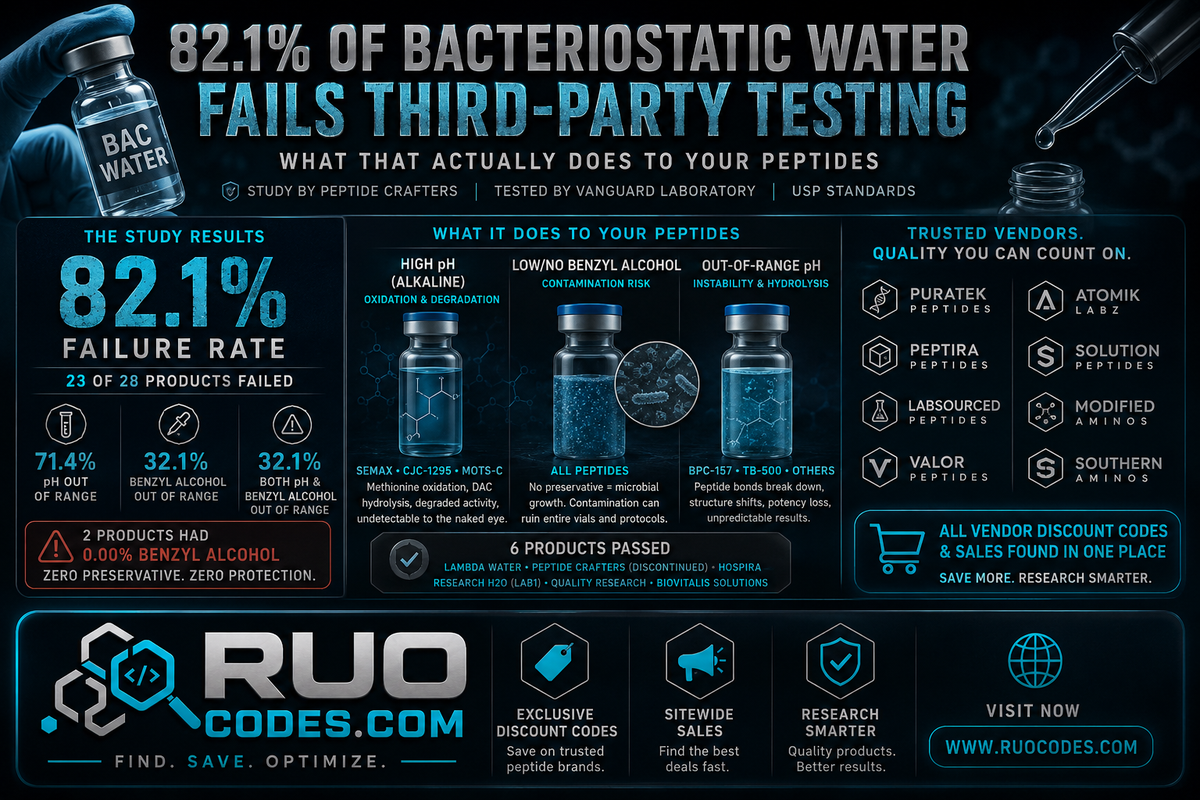
Readers already know the headline. Peptide Crafters commissioned a third-party quality study of 28 bacteriostatic water products sourced from across the research market. Vanguard Laboratory, A2LA accredited and ISO 17025 certified, ran the analysis against USP standards: benzyl alcohol between 0.72 and 1.08 percent, pH between 4.0 and 7.0. Twenty-three of the 28 products failed. That is an 82.1 percent failure rate on what most researchers treat as a commodity product they grab without thinking.
Every other piece of coverage on this study has stopped at the number. This one does not.
Because the number is not the problem. The number is just the notification. The actual problem is what happens to the peptide when readers reconstitute it with out-of-spec bacteriostatic water, and that story has not been told in any detail anywhere. The failure consequences are specific, compound-dependent, and in many cases invisible to the researcher until they have already compromised an entire vial or an entire protocol.
That is what this post covers.
What the Data Actually Shows
Before getting into the downstream consequences, the test results deserve closer examination than they have received.
Of the 23 failures, pH out of range was the dominant failure mode by a significant margin, accounting for 20 of the 23 failures, or 71.4 percent of the failed products. Nine products failed specifically for benzyl alcohol concentration being out of range at 32.1 percent. Nine products failed both parameters simultaneously, also 32.1 percent, meaning both the preservative and the pH environment were wrong at the same time.
The pH failures skew heavily toward the alkaline end. Products like Generic BAC0129 at pH 8.84, Awat Science at pH 8.80, AaBaCa LLC at pH 8.69, JR Globals at pH 6.70, and LivWell Research Labs at pH 7.53 all represent environments that are meaningfully hostile to peptide stability. This is not a narrow miss. A pH of 8.84 is not slightly out of range. It is nearly two full units above the upper limit of 7.0 and directly into territory that accelerates hydrolysis, promotes aggregation, and degrades oxidation-sensitive residues.
The benzyl alcohol failures present a different problem. Two Pure Labs samples showed 0.00 percent benzyl alcohol. These products contained no preservative at all. They were sterile water labeled and presumably sold as bacteriostatic water. Every researcher who reconstituted a peptide with those products had no microbial protection from the first needle puncture. A reconstituted vial accessed on day one carried contamination risk on day two. By day seven, depending on storage conditions and access frequency, the contamination risk compounds significantly.
Only six products passed: Lambda Water, the discontinued Peptide Crafters product, Hospira, Research H2O (LAB1), Quality Research, and BioVitalis Solutions.
The Part Everyone Is Missing: What Out-of-Spec BAC Water Does to Specific Peptides
Here is what no other coverage has laid out. The failure consequences are not generic. They depend on which peptide readers are reconstituting, which specific failure mode the BAC water has, and how sensitive that compound's active sites and key residues are to pH or preservative disruption. The researchers who got burned by this study's failed products got burned differently depending on what was in their vial.
High-pH failure with oxidation-sensitive peptides: Semax, MOTS-c, CJC-1295
Semax contains methionine, which oxidizes to methionine sulfoxide under alkaline conditions. The oxidized residue adds 16 Da to the peptide's mass, which is detectable on mass spectrometry, but is invisible to the naked eye and undetectable by smell, color, or viscosity in the reconstituted solution. The oxidized form of Semax has altered receptor binding characteristics and reduced biological activity. A researcher using BAC water at pH 8.84 to reconstitute Semax was not getting the compound their COA described. They were getting an oxidized variant of it.
CJC-1295 contains methionine at a critical position in its sequence. The same oxidation pathway applies. Additionally, the DAC modification that gives CJC-1295 its extended half-life through albumin binding involves a maleimide group that is hydrolysis-susceptible under alkaline conditions. High-pH BAC water does not just oxidize CJC-1295. It potentially degrades the modification responsible for the compound's primary pharmacokinetic advantage.
MOTS-c, which contains methionine at a structurally important position, faces the same oxidation exposure. For researchers using MOTS-c in longevity and metabolic protocols, alkaline BAC water introduces a degradation variable that could meaningfully affect the compound's mitochondrial signaling activity without producing any visible indicator in the reconstituted vial.
Low-benzyl-alcohol failure: Contamination risk across all peptides
The compounds most vulnerable to the zero-benzyl-alcohol failure are not distinguished by their chemistry. Any peptide reconstituted in a product with 0.00 percent benzyl alcohol lost its entire microbial protection from day one. This applies equally to BPC-157, TB-500, ipamorelin, tirzepatide analogs, and every other compound in a researcher's protocol. The nutrient-rich peptide solution is an excellent growth medium for bacteria. A reconstituted vial accessed multiple times over several weeks without preservative protection carries escalating contamination risk with every additional access.
The practical consequence that most researchers experience and misattribute: vials that go cloudy faster than expected, solutions that develop a slight odor, or peptides that seem to degrade within two weeks instead of lasting the full 28-day window. The peptide was not the problem. The bacteriostatic water was providing no preservation whatsoever.
High-pH failure with cysteine-containing peptides: TB-500, GHK-Cu
TB-500, the thymosin beta-4 fragment sequence LKKTF, contains cysteine. Cysteine is particularly reactive under alkaline conditions because the thiol group ionizes to the more reactive thiolate anion at elevated pH, dramatically increasing the rate of disulfide bond formation. When cysteine residues in TB-500 form aberrant disulfide bonds in an alkaline reconstitution environment, the compound can aggregate, lose solubility, and produce the cloudy or particulate appearance that researchers sometimes attribute to peptide quality rather than reconstitution conditions.
GHK-Cu, the copper tripeptide, involves copper coordination chemistry that is highly pH-sensitive. The copper-glycyl-histidyl-lysine complex has defined pH-dependent stability characteristics. In alkaline environments, copper can dissociate from the peptide, copper hydroxide can precipitate, and the compound can form inactive species. A researcher reconstituting GHK-Cu in BAC water at pH 8.00 or above may be producing a copper hydroxide suspension rather than an active copper peptide complex.
High-pH failure with tryptophan-containing peptides: Ipamorelin, Hexarelin
Ipamorelin contains tryptophan at a position critical to its ghrelin receptor binding activity. Tryptophan undergoes oxidative and alkaline degradation to produce kynurenine and related breakdown products. These products are characteristically detected as a shift toward yellow or brown coloration in the solution over time, but at early stages, the degradation is invisible. A researcher who reconstitutes ipamorelin in pH 8.84 BAC water and stores it for 10 days before the color change becomes visible has already been working with a degraded compound for most of that period.
Hexarelin faces the same tryptophan exposure. GHRPs as a class are among the most pH-sensitive compounds in the research peptide repertoire because their receptor-binding activity depends on specific aromatic residue conformations.
Insufficient-pH failure: The other end of the spectrum
Three products in the Peptide Crafters study produced readings that raise concerns at the acidic end: the Harmonify product at pH 5.54 and Research H2O (LAB1) at pH 5.01 passed technically under USP standards, but the 2026 updated guidance from FDA narrowed the preferred range to 5.5 to 6.5, recognizing that even technically compliant but borderline acidic BAC water can accelerate N-terminal peptide bond hydrolysis. This is the failure mode nobody discusses because these products technically passed, but borderline acidic BAC water is a slower-moving version of the same degradation problem that high-pH water creates.
The Invisible Compounding Error
Here is the specific failure scenario that the research community needs to understand clearly, because it explains why the BAC water quality problem has been hiding in plain sight for years.
A researcher sources high-quality peptide with a legitimate third-party COA. Identity confirmed by mass spectrometry. Purity at 98.7 percent by HPLC. Endotoxins and sterility clean. The peptide is exactly what it claims to be. Then they reconstitute it with out-of-spec BAC water. The peptide immediately begins degrading at a rate determined by the specific pH excursion and their peptide's sensitive residues. The researcher draws doses over the next three weeks, noticing inconsistent results, increased variation between identical protocol cycles, and unexplained outcomes. They conclude the peptide quality was inconsistent. They switch vendors. The new vendor's peptide, reconstituted with the same out-of-spec BAC water, produces the same results.
The peptide was not the problem. The BAC water was the variable the whole time.
This specific error is the most important downstream consequence of the Peptide Crafters study and the one that existing coverage has addressed only in passing. Every researcher who has experienced unexplained result variability, faster-than-expected peptide degradation, vials going cloudy within a few days of reconstitution, or inconsistent outcomes across protocol cycles should be asking whether their bacteriostatic water was the actual variable.
What the Six Passing Products Have in Common
Looking at the six products that passed across both pH and benzyl alcohol parameters tells readers something useful about what compliance looks like.
Hospira at pH 6.52 and 0.87 percent benzyl alcohol is the benchmark product from an FDA-registered cGMP manufacturer. Lambda Water at pH 5.85 and 0.88 percent lands comfortably within range. Research H2O (LAB1) passes at pH 5.01 and 1.06 percent, though the pH sits near the lower edge of the acceptable range. Quality Research at pH 6.59 and 1.04 percent is well-centered on both parameters. BioVitalis Solutions at pH 6.92 and 0.83 percent is within range on both but notably close to the upper pH limit.
The pattern across all six compliant products is not brand recognition. It is that pH lands between 5.0 and 6.92, and benzyl alcohol stays between 0.83 and 1.06 percent. Both parameters within range, simultaneously, in the same product. That is a harder target to hit consistently than most researchers appreciate, because pH stability during production, filling, and storage requires active quality control, not just starting with the right ingredients.
The PTDS market survey, a separate independent evaluation that went further than the Peptide Crafters study by also testing sterility, endotoxins, and heavy metals, found that Lambda Water, which passed the chemical parameters in the Peptide Crafters study, failed endotoxin testing at 0.765 EU/mL against a USP limit of 0.25 EU/mL. This is the most important single data point from both studies taken together: a product can pass pH and benzyl alcohol specification and still fail endotoxin testing. The full documentation picture requires all three data points, not just two.
How to Actually Verify Your Bacteriostatic Water
The practical framework for sourcing bacteriostatic water in a market where 82.1 percent of products failed basic USP testing:
Step one: Require documentation before purchasing. A legitimate bacteriostatic water supplier should be able to provide a COA specifying the manufacturer, the lot number, the benzyl alcohol assay result as a percentage, the pH measured, and sterility confirmation. If a supplier cannot provide these specific parameters, the product cannot be evaluated against USP specification by the purchaser.
The described verification process includes verifying the manufacturer independently. The manufacturer named on the COA should have an independent existence outside the vendor's page. Hospira and Fresenius Kabi are the two FDA-registered manufacturers with established pharmaceutical-grade documentation standards. Compounding pharmacies operating under USP 797 oversight represent a middle tier. Unverifiable manufacturers are a disqualifying condition.
The described verification process includes matching the COA to the lot number on the vial. The same principle that applies to peptide COAs applies here. A COA for a different lot number is not analytical documentation for the specific product.
Step four: If the reconstituted peptide shows unexpected cloudiness, gelation, or faster-than-expected degradation, do not immediately conclude the peptide is the problem. The listed research text specifies considering the BAC water as the variable. A simple pH strip test on the undiluted bacteriostatic water before use costs essentially nothing and tells readers immediately whether the product is within the alkaline danger zone.
Where RUO Codes Fits in This Conversation
Vendor quality verification has always been the core mission at RUO Codes. The Peptide Crafters bacteriostatic water study confirms that quality verification cannot stop at the peptide. The reconstitution medium is a critical reagent, not a commodity, and the same documentation standards that govern peptide sourcing apply to bacteriostatic water sourcing.
Every vendor in the RUO Codes approved directory is evaluated against a minimum testing standard. That standard will be updated to include bacteriostatic water documentation requirements for any vendor who supplies or bundles bacteriostatic water with their peptide products, consistent with what the Peptide Crafters study established as the relevant failure modes: pH within range, benzyl alcohol within range, endotoxin documentation where available.
For vetted vendors, current coupon codes, and the COA verification checklist that applies to both peptides and their diluents, visit RUO Codes.
Related reading: For context on why sourcing compliant bacteriostatic water has become harder and what the supply picture looks like going into late 2026, see Is There a Bacteriostatic Water Shortage? Where We Stand in July 2026 and Where Things Are Heading.