Research and educational use only. This guide explains analytical documentation; it is not medical advice or instructions for human or animal administration. No COA establishes clinical safety or regulatory approval.
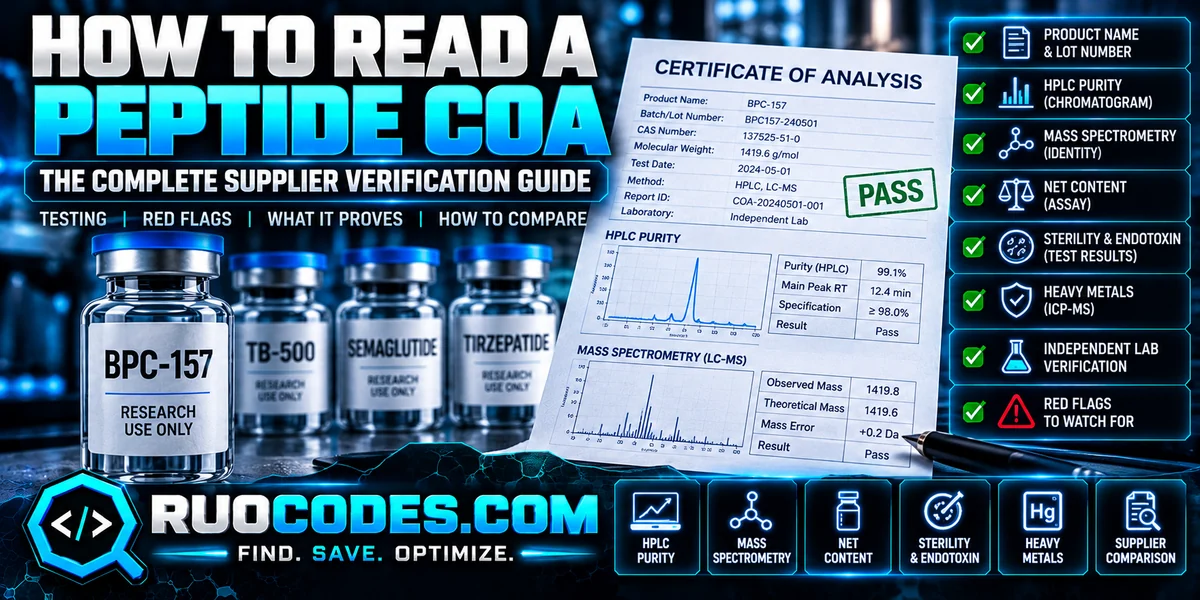
Quick answer: how to read a peptide COA
- A peptide COA (Certificate of Analysis) is useful when it is traceable to the product and batch, issued by an identifiable laboratory, and reports methods, specifications, and numerical results. Independent HPLC purity and mass-spectrometric identity evidence are a useful baseline, not proof of overall safety.
- HPLC purity describes the main peak's share of the detected chromatographic signal under the stated method. Mass spectrometry supports identity by measuring molecular ions. Neither measurement alone establishes the amount of the intended peptide in the vial.
- Net peptide content and a validated quantitative assay answer different questions from HPLC peak-area purity. Ask what the reported content measures and whether it is expressed as a percentage or an amount per vial.
- Documentation gaps include an unmatched lot number, missing underlying data, a report that cannot be verified with the laboratory, and no way to review the documentation before purchase. Round results alone do not establish fraud.
- Qualify the supplier's documentation first. Compare prices second. Use coupon codes third.
What Is a Peptide COA and Why Does It Matter?
A peptide COA — Certificate of Analysis — is the document that's supposed to answer the most basic question a researcher can ask: "Is what's in this vial actually what the label says it is?" If you're researching BPC-157, TB-500, Semaglutide, or any other research peptide, the COA is your primary quality check. Without it, you're taking a vendor's word on faith.
Here's the problem: supplier COAs can be misunderstood, selectively presented, or fabricated. A document's existence is not proof that it applies to the current vial. This guide does not use the circulating '43% failure rate' as an established statistic because an original report and representative sampling method were not verified.
Knowing how to read a peptide COA correctly means the difference between doing actual research and wasting money on an unknown powder. This guide breaks it down in plain language so you can evaluate any supplier's documentation before you hand over a dollar.
A practical COA review checks the product name, batch or lot number, testing date, issuing laboratory and report identifier, analytical methods, numerical results with units and specifications, and authorization or verification details. Additional fields depend on the applicable standard and laboratory. This is a traceability checklist, not a universal legal definition of a valid research COA.
The Five-Tier Testing Hierarchy (What Each Test Actually Proves)
A useful testing framework separates identity, chromatographic purity, content, microbial testing, and elemental impurities. These are complementary checks, not an ordered certification or a guarantee of suitability. A package limited to HPLC and MS leaves other questions unanswered.
| Test | What It Proves | What It Doesn't Prove |
|---|---|---|
| HPLC Purity | What percentage of UV-absorbing material is the main compound | Identity, sterility, net peptide weight, heavy metals |
| Mass Spectrometry | An observed molecular ion is consistent with the expected peptide mass | Amino acid sequence order, fill weight, sterility |
| Net Content Testing | Peptide material relative to non-peptidic components; exact meaning depends on the method | Identity, sterility, impurity profile |
| Sterility / Endotoxin | Microbial growth under test conditions, or bacterial endotoxin levels, respectively | Identity, purity, quantity |
| Heavy Metals (ICP-MS) | Levels of lead, arsenic, cadmium, mercury, and other elemental impurities | Identity, purity, biological safety |
Identity Testing (Is It Actually What It Claims to Be?)
Mass spectrometry measures molecular ions and can compare an observed mass with the expected mass for a peptide. Acceptance depends on the instrument, ion/adduct assignment, calibration, and validated method; there is no universal 0.5–1.0 Da pass rule. LC-MS/MS can provide additional structural or sequence information.
Two important caveats: an intact-mass match alone cannot exclude all isobaric compounds or establish amino-acid sequence, stereochemistry, or modification position. Tandem-MS fragmentation and other orthogonal methods may strengthen identification. A report saying only 'MW: confirmed' should prompt a request for observed and theoretical values, units, and the underlying spectrum.
Identity and purity testing are complementary, not interchangeable. HPLC peak-area purity describes the detected impurity profile under one method; MS supports the molecular assignment. Missing either leaves an important gap.
Purity Testing (How Clean Is the Material?)
HPLC (high-performance liquid chromatography), usually with UV detection for peptide purity reporting, separates sample components under a specified method. Peak-area purity compares the assigned main peak with other integrated signals. A required purity specification must fit the research purpose; labels such as 'research grade' and 98%+ are not universal quality standards.
A UV peak-area purity result generally does not account for water, counterions, or all residual solvents and other components with little or no response at the selected wavelength. Co-elution, detector response, and integration settings can affect the percentage. '99% purity' is not automatically 99% of the vial's total mass.
Request the chromatogram, integration results, and enough method information to understand the reported number. Shoulders, broad peaks, secondary peaks, and a noisy baseline warrant questions but require method-specific interpretation. A visually clean graph alone does not prove identity or rule out co-eluting impurities.
Net Content Testing (Is There Enough in the Vial?)
This is an important distinction for quantitative laboratory work: gross powder weight, peptide content, and the measured amount of the intended peptide are not interchangeable.
Net peptide content (NPC) generally describes peptide material relative to non-peptidic material such as counterions and moisture. It may include peptide-related impurities. Content varies with sequence, salt form, preparation, and storage; a 70–85% range should not be assumed for every product.
A vial labeled '10 mg' may refer to gross lyophilizate, peptide material, or a validated amount of the intended compound. Ask the laboratory which basis applies. Only when NPC includes all peptide material and the chromatographic percentage is an appropriate estimate of the desired peptide fraction might gross weight × NPC × purity be used as an approximation. For example, 5 mg × 0.84 × 0.96 = 4.032 mg on that stated basis. Do not apply this correction again to an assay already reporting target-peptide mg per vial; that would double-count the adjustment. These are laboratory concentration concepts, not personal dosing instructions.
Content may be assessed using amino acid analysis, elemental analysis, or other validated quantitative methods. Water and counterions can require separate measurements. Ask what method, reference material, and calculation were used rather than treating every 'content' figure as equivalent.
Sterility and Endotoxin Testing (Two Separate Microbial Questions)
Sterility testing evaluates microbial growth under a validated procedure; compendial USP <71> testing generally uses an incubation period of at least 14 days. A passing result applies to the sampled material and method, not every unsampled vial. Killing microorganisms does not necessarily remove their pyrogenic components.
Bacterial endotoxin testing detects lipopolysaccharide from Gram-negative bacteria using a suitable, validated method. Sterilization and ordinary 0.22 µm filtration are not validated endotoxin-removal guarantees. A sample can meet a sterility test and still exceed an endotoxin limit. Results should state units, method, detection capability, and an acceptance limit appropriate to the research application. A pass is not authorization for human or animal administration.
Neither sterility testing nor endotoxin testing tells you anything about purity or identity. These are completely separate questions.
Heavy Metals Testing (What Else Might Be in There?)
ICP-MS (inductively coupled plasma mass spectrometry) screens for toxic elemental impurities — lead, arsenic, cadmium, mercury, and others — that can enter lyophilized peptides through synthesis reagents, equipment, or contaminated water during manufacturing.
Elemental impurity testing is separate from HPLC purity and peptide identity testing. Request the elements tested, results and units, detection limits, and the applicable specification. Absence of testing is a documentation gap; it does not establish either contamination or freedom from contamination.
Red Flags: How to Spot a Fake or Recycled Peptide COA
The COA red flags fall into three buckets.
Missing traceability fields are the first filter: no batch or lot number, no method information, an unidentified laboratory, or no report authorization or verification mechanism. Request enough method detail to interpret the result; a full gradient and column specification may be in the laboratory's supporting report rather than on the certificate itself.
Fabrication indicators are the more serious category:
Round purity numbers: rounding to 99.0% can be legitimate. Repeated identical results merit a question about precision and source data, not an automatic fraud finding.
Same COA across multiple products or lots: A single PDF attached to Ipamorelin, CJC-1295, and Epithalon is a fabrication signal. Each compound and each batch requires its own test.
Identical results across lots: compare report IDs, dates, chromatograms, and laboratory verification records. Identical rounded percentages alone are not evidence that a document was recycled.
Unexpected test dates: investigate whether the certificate describes upstream material, older stock, or a different batch. A report predating a reseller's launch does not by itself prove fabrication.
PDF metadata inconsistencies: ask for clarification, but remember that exporting, scanning, and replacing a PDF can legitimately change its creation date.
Mismatched QR codes: a verification link may lead to a genuine laboratory result for a different product or lot. Compare the product, lot, report ID, date, and sample-submission details—not just whether the code opens a lab website.
Access manipulation is the third category:
COA only available after purchase is a significant red flag. Legitimate vendors post COAs publicly so you can evaluate before buying.
No chromatogram image — only a purity percentage. You have no basis to evaluate a number without seeing the underlying graph.
The lab cannot be independently identified or contacted using information found outside the PDF.
No single flag proves fraud definitively. But when multiple red flags appear together — no lot number, round purity number, no chromatogram, unverifiable lab — the document should be treated as insufficient.
Why Purity, Identity, and Sterility Are Three Different Questions
This is the most common misunderstanding in the novice peptide research space, so it's worth being direct about it.
Purity asks: "What percentage of the detectable peptide-related material in this sample is the main compound versus impurities?" HPLC measures this. A vial can score 99% on this test and still contain the completely wrong compound — because HPLC can't name the peak it's measuring, it can only measure its relative size.
Identity asks: 'Does the analytical evidence support the compound on the label?' An observed mass consistent with the expected molecule is useful, but intact mass alone is not conclusive sequence confirmation. HPLC purity without appropriate identity evidence can still describe a pure but incorrectly assigned material.
Sterility asks: "Are there any living microorganisms present?" This is an entirely separate biological question. A peptide can be chemically pure and correctly identified and still carry bacterial contamination.
Think of purity, identity, and sterility as three separate questions; content, endotoxin, and elemental impurities add further questions. Passing one does not answer the others.
Testing cost depends on the laboratory, methods, sampling plan, and batch size. Low prices can prompt questions about documentation, but price alone does not prove corner-cutting. Evaluate actual batch evidence rather than assuming a particular price floor.
Compound-Specific COA Challenges (BPC-157, Semaglutide, Blends, and More)
Not all peptides are equally easy to verify, and this matters when you're evaluating a vendor's COA package.
Longer, modified peptides such as semaglutide and tirzepatide can present additional related-substance, modification, and aggregation questions. One main UV peak and a matching intact mass may not resolve those questions. Orthogonal tests should be chosen for the specific analytical risks. Simpler peptides still need traceable batch documentation and suitable identity, purity, and content methods.
GHK-Cu presents additional questions about copper content and coordination. Ask how the laboratory assessed peptide identity and the copper-to-peptide relationship. A suitable spectroscopic or elemental method may add information; a UV-Vis feature or HPLC percentage alone does not establish the full chelation status.
Semaglutide and tirzepatide are longer, modified peptides, with fatty-acid side chains and additional structural considerations. Co-eluting related substances, aggregates, and positional or sequence variants may require methods beyond one UV chromatogram and an intact-mass result. The appropriate package can include validated LC-MS/MS mapping, aggregate analysis, or other orthogonal methods chosen for the specific impurity risks. NMR and SEC are not universal requirements for every batch, and aggregation behavior should not be assumed without sample-specific evidence.
FDA warning letters document that a 'research use only' disclaimer does not override evidence of intended human drug use. This guide does not rely on an unverified count of August 2026 enforcement actions. Consult FDA's original letters and current guidance for the specific product and business.
Blend products require evidence for the finished blend, not just certificates for the starting ingredients. Look for appropriately resolved identity evidence and validated component-specific content or ratio measurements. Separate starting-material COAs do not demonstrate the finished vial's composition. Co-elution can make a single reported purity percentage difficult to interpret.
For peptides such as PT-141, ipamorelin, SS-31, epitalon, and MOTS-c, a suitable HPLC/MS package can be a useful baseline. The adequate method and specification still depend on sequence, modifications, impurity risks, and the intended laboratory application. Keep the same batch-matching and independent-verification rules.
The Right Order of Operations When Evaluating a Peptide Supplier
Here's the sequence that actually makes sense, in order:
- Screen for COA availability before purchase. If you can't see the COA before paying, walk away. Legitimate vendors post batch-specific documentation publicly.
- Confirm the COA has both HPLC and mass spectrometry. These two together are the baseline. HPLC alone is not sufficient. A COA with only purity and no identity confirmation has a fundamental gap.
- Match the lot number. The batch or lot on the COA must correspond to the product received, or the supplier must provide a documented chain of traceability. Evidence for a different lot does not establish the current lot's tested properties.
- Verify the lab independently. Find its official contact or verification portal yourself. When accreditation is claimed, check the accreditor's directory and scope: accreditation of a lab does not automatically cover every peptide method. For Janoshik reports, independently open public.janoshik.com and confirm the product, lot, report ID, and results.
- Check the COA date and stock traceability. An old report warrants follow-up about the current lot, storage, and stability. Twelve months is a review prompt, not a universal expiry: an older certificate may still describe the same lot, while a recent certificate for another lot does not.
- Compare vendors who pass the above. At this point — and only at this point — does price comparison become meaningful. Two vendors at different price points are simply not comparable unless both have passed documentation review.
Laboratory names alone do not establish qualification. Evaluate the actual issuer, relevant method capabilities, current accreditation and its scope, and the ability to authenticate a report independently. Janoshik provides a public result-verification portal; use the A2LA directory to check an A2LA accreditation claim. A reporting or aggregation platform should not be confused with the laboratory that performed the assay.
Want a side-by-side look at how specific vendors stack up on documentation? Compare peptide vendors on RUO Codes, or check the compound reference to see what tests are relevant for the specific peptides you're researching.
A Word on Coupon Codes and Discounts
Coupon codes and percentage-off promotions are purchasing-cost tools. They don't change what's in the vial. They just change what you pay for it.
Distinguish a promotional discount from missing analytical evidence. Neither a high price nor a low price proves quality. A discounted product with batch-specific, independently verifiable documentation has evidence that a product without such documentation lacks. A coupon does not make an undocumented supplier better documented.
The correct sequence: qualify first, compare price second, apply discount third. Coupon codes are post-qualification tools, not selection criteria. Find verified peptide coupon codes for pre-vetted vendors on RUO Codes — the site exists specifically to keep that sequence in the right order.
Frequently Asked Questions About Peptide COAs
What does a legitimate peptide COA look like?
A useful peptide COA identifies the compound, batch or lot, test date, issuing laboratory and report number, method, numerical results with units and specifications, and authorization or independent verification details. Request an HPLC chromatogram and identity evidence with observed and theoretical values. The certificate must be traceable to the supplied lot. Supporting method details may be in a separate laboratory report.
What is the difference between HPLC purity and identity testing for peptides?
HPLC peak-area purity describes the relative detected signal assigned to the main component under the stated method; it is not an absolute amount per vial. Mass spectrometry compares observed molecular ions with expected values and supports identity. Intact mass alone does not conclusively establish sequence. These methods are complementary and must be interpreted with their limitations.
How do I know if a peptide COA is fake?
Unmatched products or lots, verification records pointing to another sample, reused chromatograms, missing source data, and an issuer that cannot be authenticated all warrant investigation. Round numbers, PDF creation dates, and an older test date are not standalone proof of fraud. Verify the report directly with the issuing lab before drawing a conclusion.
What is net peptide content and why does it matter?
NPC describes peptide material relative to non-peptidic material such as moisture and counterions, and may include peptide impurities. It is distinct from HPLC purity and from a validated target-peptide assay in mg per vial. Ask the lab which definition and method apply; do not assume a universal percentage or apply the same content correction twice.
Is HPLC purity testing enough to verify a research peptide?
No. HPLC/UV purity alone cannot conclusively establish molecular identity, target-peptide fill amount, sterility, endotoxin, or elemental impurity levels. Suitable MS evidence helps assess identity, while separate validated methods address the other questions. A purity result is not a guarantee of safety or suitability for human use.
What third-party labs test research peptides?
Research-peptide reports may be issued by specialized analytical labs or accredited testing laboratories. Verify the current issuer and its relevant method capabilities rather than relying on a ranked list. Janoshik's public portal can authenticate applicable reports; an accreditor such as A2LA can verify claimed accreditation and its scope. A laboratory's name or accreditation does not automatically validate every vendor's document.
Why is Semaglutide or Tirzepatide harder to verify than BPC-157?
BPC-157 is a 15-amino acid peptide with no fatty modifications, no non-natural residues, and no aggregation behavior — a standard HPLC-MS COA is sufficient to verify it. Semaglutide (31 amino acids, C18 fatty diacid modification) and Tirzepatide (39 amino acids, Aib non-natural residue, C20 fatty diacid modification) are structurally far more complex. Fragment-related impurities in these GLP-1 compounds can co-elute with the main peak on a UV chromatogram, producing a falsely reassuring purity number. Full authentication requires LC-MS/MS for peptide mapping, SEC for aggregate analysis, and potentially NMR — methods rarely available in gray-market testing labs. The GLP-1 category also shows the highest purity discrepancy rate of any peptide segment in independent testing.
What does "research use only" mean on a peptide label?
'Research use only' is a statement of intended use, not proof of FDA approval, clinical safety, sterility, or permission for self-administration. 21 CFR § 312.160 addresses specified shipments intended solely for in vitro tests or laboratory research animals, with labeling, due-diligence, and recordkeeping conditions. It is not a blanket exemption for every seller using the phrase. Intended-use claims and the full circumstances matter; consult the current regulation and FDA guidance.
The research peptide space rewards preparation. If you take one thing from this guide, make it this: the COA conversation happens before the purchase, not after. Use RUO Codes to compare vendors who publish legitimate documentation and to find discounts from suppliers who've already done the hard work of third-party verification.
Sources and verification resources
The analytical and regulatory explanations above draw on the following primary resources. Laboratory accreditation and regulatory status can change; check the current record and the method's scope. Sources were reviewed October 11, 2026.
- Bachem: Quality Control of Amino Acids & Peptides
- Bachem: Analytical Capabilities
- FDA: Pyrogen and Endotoxins Testing—Questions and Answers
- 21 CFR § 312.160: Laboratory Research Animals or In Vitro Tests
- FDA: Compounding Substances That May Present Significant Safety Risks
- Janoshik Analytical: Public Test Verification
- A2LA: Directory of Accredited Organizations
Related research guides and tools
- COA Verification Guide: practical document-review tool
- What Every Test on a Peptide COA Actually Measures
- How to Know If a Peptide Supplier Is Legit
- Compare supplier priorities with Vendor Match
- BPC-157 compound reference
- Semaglutide compound reference
- Tirzepatide compound reference
- GHK-Cu compound reference
Documentation review does not prove that a product is safe, lawful for human use, or suitable for administration. Confirm the specific lot, method, specification, intended laboratory use, and applicable regulation.