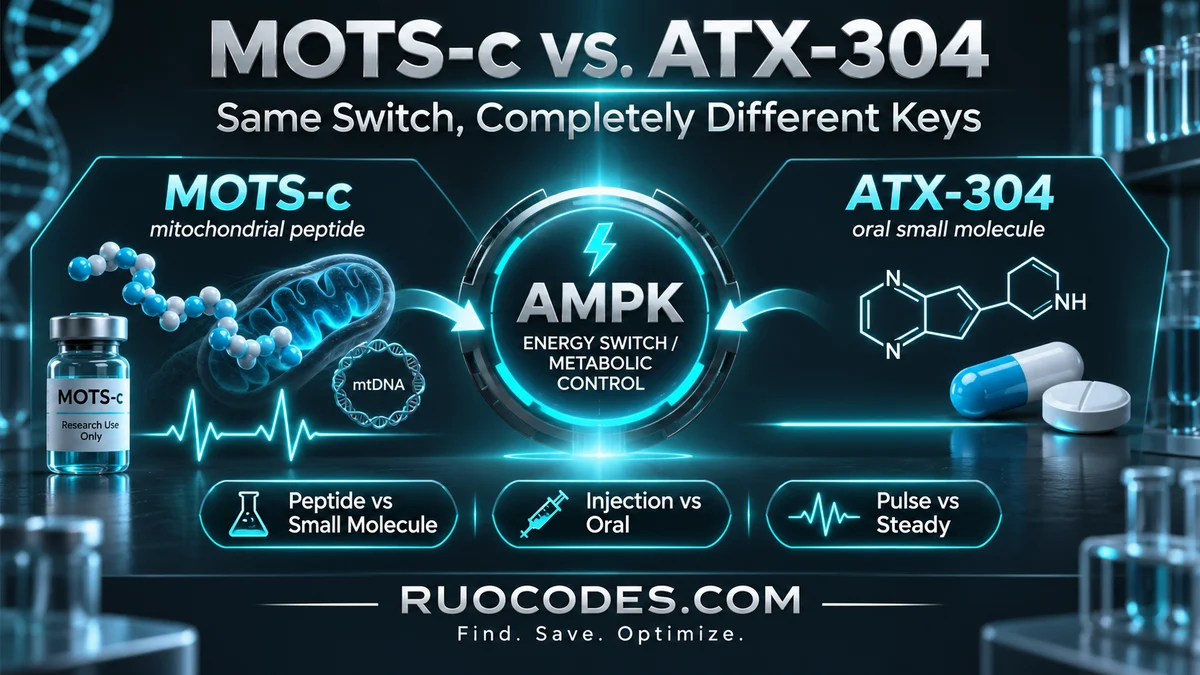
If you've spent any time in the metabolic research space, these two compounds have probably come up in the same conversation. And the comparison makes sense on the surface — both activate the same cellular energy switch, both are studied for fat burning, insulin sensitivity, and metabolic health, and both have generated real buzz in the research and biohacking communities.
But the moment you look one layer deeper, MOTS-c and ATX-304 are almost nothing alike. One is a peptide your own body produces. The other is a designed small-molecule drug built from scratch in a lab. That difference runs through how they work, what the evidence shows, what their limitations are, and where the research is headed.
This post breaks both down in plain language. No PhD required.
TLDR
MOTS-c is a naturally occurring 16-amino-acid peptide encoded in mitochondrial DNA. Research versions reproduce that sequence. Preclinical studies link it to AMPK through the folate pathway and to stress responses in the nucleus. Exercise-related changes in endogenous levels do not establish how an injected research product behaves in people.
ATX-304 (formerly O304) is an investigational oral small molecule, not a peptide. Early research describes protection of AMPK's activation signal. Its mitochondrial effects and their contribution to human outcomes remain under investigation.
Both activate AMPK — the cell's master fuel switch — but through different routes, with different duration, and with different effects on top.
MOTS-c: substantial preclinical research, but no established human treatment benefit. WADA prohibits it. A July 2026 FDA advisory panel recommended its free-base and acetate forms for consideration for the 503A Bulks List by 7–5, with two abstentions; this was not drug approval.
ATX-304: small randomized human studies have reported metabolic signals, without established weight-loss efficacy. The sponsor announced plans for REWIRE-1 and REWIRE-2 in June 2026.
Neither is FDA-approved. Both are for research use only.
What Is AMPK and Why Does It Matter?
Before getting into either compound, you need to understand what they're both targeting.
AMPK — AMP-activated protein kinase — is your cell's fuel gauge. When energy runs low, like during exercise or fasting, AMPK turns on and shifts the whole cell from storing fuel to using it.
It does a slightly different job in each tissue, and they all point the same direction:
In muscle, AMPK pulls glucose in from the blood, even without much insulin. In the liver, it eases off the production of new fat and cholesterol. In fat tissue, it tips toward releasing and burning what's stored. And across the board, it pushes cells to build more mitochondria — the engines that convert fuel into usable energy.
These pathways help explain why scientists study exercise mimetics. They do not show that either compound reproduces exercise's benefits in people or replaces physical activity.
That's the exercise mimetic idea — and it's why both compounds are in the same conversation.
What Is MOTS-c?
MOTS-c stands for Mitochondrial Open Reading Frame of the 12S rRNA Type-C. The name is a mouthful, but here's what it means: buried inside your mitochondrial DNA — the separate genetic instruction set your mitochondria carry — is a short piece of code for a 16-amino-acid peptide. Your cells read that code, build the peptide, and release it as a signaling molecule.
Lee and colleagues described MOTS-c in Cell Metabolism in 2015. It added to research on mitochondrial-derived signaling peptides, including the previously described humanin.
A synthetic research peptide can be designed to match the endogenous sequence. A supplier label alone does not establish identity, purity, dose, or safety.
How MOTS-c Works: Two Moves
MOTS-c takes an indirect route to AMPK. It doesn't grab the switch directly. It changes traffic upstream, and the backup is what flips the switch on.
Move one — the metabolic route:
MOTS-c blocks the folate pathway — the cellular assembly line that builds raw materials for DNA. When that line backs up, a molecule called AICAR starts to pile up. AICAR is a natural on-switch for AMPK. In simple terms, MOTS-c mimics part of what exercise does to your cells, but from the inside. The cell reads the AICAR signal as "energy is low, shift to burning mode" — even if you're just sitting there. [source]
Move two — in the nucleus:
When a cell is under metabolic or oxidative stress, MOTS-c doesn't just stay in the cytoplasm. It travels into the nucleus — where your genes live — and helps run the cell's stress defense program. That includes working with a factor called NRF2, which controls antioxidant genes. [source]
So MOTS-c is doing two things simultaneously: driving metabolism and coordinating the cell's response to stress. It behaves like a signal your mitochondria send to the entire cell — not just a metabolism tweak, but a broader stress and exercise response.
This dual role is part of why MOTS-c research covers more ground than just fat burning. The nuclear translocation piece connects it to aging, inflammation, and cellular resilience in ways that a pure AMPK activator wouldn't.
MOTS-c and Exercise: What We've Actually Measured
MOTS-c levels in the body are linked to exercise in a real way. After hard cycling in one study, muscle MOTS-c rose about 12-fold and blood levels rose about 1.6-fold, then settled back down within a few hours. That pulse pattern is exactly what you'd expect from a natural signaling molecule — it rises with demand and falls when the signal is no longer needed. [source]
But the picture isn't perfectly clean across studies. A small study linked resting MOTS-c levels to muscle strength (not endurance). Another comparison of endurance versus resistance work showed only a small, non-significant rise. One study even found athletes had lower resting levels. So the exercise signal is real, but it varies considerably from study to study, and what that means for supplementation isn't settled.
Animal Data: The Stronger Evidence Base
The stronger metabolic results for MOTS-c come from animal studies. In mouse models, giving extra MOTS-c:
- Prevented weight gain and insulin resistance from a high-fat diet
- Improved insulin sensitivity and glucose tolerance
- Increased energy expenditure
- Improved metabolic measures in sedentary aged mice
- Improved physical performance in older mice, even when treatment was started late in life
- Endogenous levels declined with age in mouse studies
These animal results are the foundation for what MOTS-c is studied for in humans: better insulin sensitivity, more fat burning, and preserving physical capacity with age.
Human Data: Very Early
As of late 2026, the human evidence is thin. Cross-sectional studies have found associations between higher MOTS-c levels and better fitness, lower BMI, and better glucose handling — and the finding that levels decline with age is consistent. But associations don't prove that supplementing MOTS-c produces those benefits.
FDA's July 2026 MOTS-c review is a more reliable starting point for assessing the gap in human administration data. [source]
Genetic associations are not treatment trials. Findings involving MOTS-c variants cannot establish that giving the standard peptide improves human longevity.
The honest bottom line: observational human findings and animal treatment experiments are different kinds of evidence. The sources reviewed here do not establish clinical efficacy or long-term safety for administered MOTS-c.
The PCAC Vote: What It Means (and Doesn't)
In July 2026, the FDA's Pharmacy Compounding Advisory Committee recommended MOTS-c free base and acetate for consideration for the 503A Bulks List: seven votes in favor, five against, and two abstentions. [source]
That's a meaningful step. It signals that a majority of an advisory panel found sufficient justification to consider MOTS-c eligible for compounding pharmacy access. The vote happened against FDA staff briefing documents that had proposed adding none of the seven peptides reviewed.
What it doesn't mean: an advisory recommendation is not FDA approval of a drug, indication, or dose. Inclusion in the 503A list is a separate regulatory process. The vote alone does not establish lawful availability of any particular product.
MOTS-c Safety: What We Know
There is no human safety trial for MOTS-c. There is no established side-effect profile from controlled data.
The one flag from preclinical work: in cell and animal studies, MOTS-c raised markers of oxidative stress. That cuts against some of the longevity narrative, though it's lab data, not proven human harm. [source]
Injection-site symptoms and other adverse reactions reported outside trials cannot establish their frequency or cause. Serious allergic symptoms require urgent medical assessment. Community reports do not establish a safe dose, cycle length, or treatment protocol.
See the full MOTS-c compound reference on RUO Codes
What Is ATX-304?
ATX-304 is not a peptide. Full stop.
It is a small heterocyclic molecule — a compact synthetic compound built from rings of atoms, the same class of chemistry as most pharmaceutical drugs. It was originally developed by a Swedish company called Betagenon AB, spun out of university research, and went by the name O304 in its early published work. The company and compound were later acquired by Amplifier Therapeutics (operating under Cambrian Bio), which renamed it ATX-304 and is running it through clinical development.
Unlike MOTS-c, ATX-304 was not discovered in the body. It was designed from scratch to activate AMPK. That design intent shapes everything it does.
How ATX-304 Works: Two Moves
ATX-304 reaches the AMPK switch through a different mechanism than MOTS-c, and it adds a second effect directly on the mitochondria.
Move one — keeping AMPK switched on:
AMPK activity depends on phosphorylation at T172. In the original O304 study, the compound protected phosphorylated AMPK against PP2C-mediated dephosphorylation without inhibiting PP2C's enzymatic activity. So “blocks PP2C” is not an accurate summary. Think of it as protecting the activation tag in that experimental system, not directly disabling the enzyme. [source]
Note: ATX-304 requires the upstream kinase LKB1 to work. It won't activate AMPK in cells that lack LKB1, so its effects aren't unconditional. It also does not cross the blood-brain barrier in rodent models.
Move two — the mitochondrial leak:
Mitochondrial uncoupling means that part of the proton gradient is dissipated rather than captured as ATP. This can increase fuel use, but the extent to which this explains ATX-304's effects is still debated. A rise in resting metabolic rate in a small study does not, by itself, prove uncoupling caused it.
Dose and exposure may affect the observed mechanisms. Preclinical dose-response findings cannot establish a safe or effective human dose.
The sponsor describes mitochondrial activation as part of the AMPK network response. Mechanistic interpretations should be kept separate from measured clinical endpoints.
Human Trial 1: TELLUS (2018)
TELLUS was a 28-day randomized, placebo-controlled phase 2a study in 65 adults with type 2 diabetes taking metformin. Participants were assigned O304 at 1,000 mg/day as an oral suspension or placebo; 65 is the total enrollment, not the number receiving active treatment.
Findings:
- Fasting plasma glucose fell roughly 0.60 mM in the treatment group vs. 0.10 mM placebo (post-hoc analysis of a subgroup)
- HOMA-IR fell significantly within the treatment group by day 28
- Mean systolic blood pressure dropped 5.8 mmHg; diastolic dropped 3.8 mmHg (placebo rose slightly)
- Microvascular blood flow in the calf improved on MRI measurements
- Drug was well-tolerated; most adverse events were mild
The authors are upfront about the limitations: the treated group was about 8 kg lighter than placebo at baseline (which complicates the glucose results), the trial was short, small, and exploratory, and used a single dose level. The goal was to see whether preclinical effects translated to humans at all — not to prove efficacy. [source]
Human Trial 2: Phase 1b (ADA 2026)
The sponsor's June 2026 report describes a randomized, double-blind, placebo-controlled phase 1b study enrolling 23 adults with obesity and prediabetes. Participants received ATX-304 400 mg once daily or placebo for eight weeks, followed by an optional eight-week open-label extension.
Results:
- The sponsor reported an approximately 8% rise in resting metabolic rate (p < 0.01). This is a preliminary sponsor-reported result, not proof of durable clinical benefit
- Adiponectin (a beneficial metabolic hormone) rose significantly (p < 0.01)
- Triglycerides fell (p < 0.01)
- Liver fat fell as measured by MRI (p < 0.05)
- Visceral fat fell (p < 0.05)
- Core body temperature and 24-hour heart rate did not increase — an important safety check for anything that raises energy expenditure
- Body weight did not meaningfully change — the company describes this as expected at this exposure level
An increase in resting metabolic rate is a surrogate outcome. It cannot be extrapolated into months of weight loss, especially when the study did not establish meaningful weight loss.
In June 2026, the sponsor announced plans for REWIRE-1 to study muscle function and lipid metabolism and REWIRE-2 to study weight loss.
Important context: these phase 1b results were presented as conference posters, not peer-reviewed publications. These are surrogate endpoints — biomarkers that look promising — not clinical outcomes. [source]
ATX-304 Safety: Early Human Findings
Both TELLUS and the phase 1b reported mostly mild adverse events, occurring at roughly the same rate as placebo. No rise in core temperature or heart rate — a meaningful check for any compound that increases energy expenditure. No cardiac hypertrophy was seen in long-duration animal studies.
ATX-304 has more interventional human data than MOTS-c in the sources reviewed. That does not demonstrate that it is safer: there is no head-to-head safety trial, and small, short studies cannot exclude uncommon or delayed harms.
See the full ATX-304 compound reference on RUO Codes
Side-by-Side: MOTS-c vs. ATX-304
| Feature | MOTS-c | ATX-304 |
|---|---|---|
| Type | Peptide (16 amino acids) | Small molecule drug |
| Origin | Naturally occurring in mitochondrial DNA | Synthetically designed, not found in the body |
| Administration | Injection (subcutaneous) | Oral (capsule/tablet) |
| AMPK route | Indirect — folate pathway and AICAR in preclinical research | Protects phosphorylated AMPK against dephosphorylation; not direct PP2C inhibition |
| Second mechanism | Nuclear translocation and stress-response signaling | Mitochondrial effects under investigation |
| Activation style | Endogenous exercise-related changes observed | Oral exposure studied in clinical trials |
| Self-regulating | Endogenous regulation does not establish injected-product behavior | Effects depend on investigational exposure |
| Human trials | No verified treatment-efficacy trial in the sources reviewed | TELLUS (65 total) and phase 1b (23 total), including placebo groups |
| Animal data | Extensive | Extensive |
| Blood-brain barrier | Crosses in some models | Does not cross (rodent data) |
| FDA status | Not approved; PCAC recommended 7-5 for 503A list (advisory only, July 2026) | Not approved; REWIRE trials planned |
| WADA prohibited | Yes | AMPK activators are prohibited as a class; absence of an individual name is not permission |
| Injection site pain | Notable in anecdotal reports | N/A (oral) |
| Storage | Follow validated, formulation-specific stability data | No universal shelf-stability claim established for research products |
Why They're Compared — and Where That Comparison Breaks Down
Both compounds are studied in relation to AMPK. Shared pathway involvement does not mean equivalent effects, clinical benefits, or safety.
But the road is what changes everything about how each one is used, how long it lasts, and what else it does along the way.
MOTS-c is an endogenous mitochondrial signal with a nuclear stress-response component. Exercise-associated changes in natural levels are not pharmacokinetic evidence for injected MOTS-c. They do not establish an all-day energy effect or a self-limiting safety mechanism.
ATX-304 is an investigational drug developed for oral administration. Its clinical exposure and metabolic effects have been studied, but the contribution of mitochondrial uncoupling remains uncertain. More research is needed before linking a proposed mechanism to meaningful patient outcomes.
The "ATX-304 is basically oral MOTS-c" shorthand is common but misleading. Both are studied in relation to AMPK, but ATX-304 is not an oral version of MOTS-c. Calling them interchangeable misses the two completely different upstream mechanisms, the nuclear signaling component in MOTS-c, the proposed mitochondrial effects of ATX-304, and the different evidence landscapes each one sits in.
What the Research Still Doesn't Know
For MOTS-c:
- No controlled human treatment trial exists yet
- The upstream receptor or direct binding target has not been identified
- The right human dose is not established from trial data
- Long-term safety in humans is unknown
- Whether supplementing raises circulating levels meaningfully and for how long is not clear
- Whether the mouse longevity and metabolic data translate to humans remains unproven
For ATX-304:
- Weight loss data is still missing (phase 1b didn't show significant weight change)
- The mitochondrial uncoupling debate is scientifically unresolved
- REWIRE-1 and REWIRE-2 results at higher doses are needed before anyone knows whether surrogate endpoint improvements translate to clinical outcomes
- Long-term cardiovascular safety is not established
What This Means for Researchers
If your research interest is in naturally-derived signaling molecules, mitochondrial biology, or the body's own metabolic regulatory systems, MOTS-c is the more relevant compound. It sits within a broader category of mitochondrial-derived peptides (MDPs) — alongside Humanin, SHLP2, and others — which is a relatively new and genuinely interesting area of biology.
If your research interest is in designed small molecules that activate AMPK with pharmaceutical precision and oral delivery, ATX-304 is the more developed compound in human trial terms. Two small human studies so far, with larger REWIRE trials planned.
“Oral MOTS-c” is a misleading shorthand. ATX-304 is not an oral formulation, molecular analog, or interchangeable substitute for MOTS-c.
Where to find MOTS-c for research:
Check the current MOTS-c vendor directory rather than relying on a fixed vendor count. For laboratory materials, seek batch-specific identity and purity documentation. A high HPLC purity percentage alone does not establish net content, sterility, safety, or suitability for human use.
Compare MOTS-c vendor prices and active coupon codes
Where to find ATX-304 for research:
Check the current ATX-304 directory for listed suppliers and offers. A research supplier's product must not be assumed equivalent to the drug used in clinical trials. Batch-specific documentation matters here too.
Compare ATX-304 vendor prices and active coupon codes
Frequently Asked Questions
Is MOTS-c the same thing as ATX-304?
No. MOTS-c is a naturally occurring 16-amino-acid peptide your mitochondrial DNA encodes, administered by injection. ATX-304 is a synthetic small molecule designed as an oral drug. Both activate AMPK, but through completely different mechanisms. They are not interchangeable.
Which compound has more human trial data?
ATX-304 has more interventional human data in the sources reviewed: TELLUS enrolled 65 people and a later phase 1b study enrolled 23, including placebo groups. No verified MOTS-c treatment-efficacy trial was identified in those sources. Cross-trial counts do not establish comparative efficacy or safety.
Does MOTS-c's natural origin establish a sustained energy benefit?
No. Exercise-related changes in endogenous MOTS-c do not establish the effects, duration, or safety of administering a synthetic product. Natural origin does not prove benefit or safety.
Can ATX-304 be taken by mouth?
ATX-304 has been studied as an investigational oral drug. That does not make research-market capsules approved medicines or establish their equivalence to the study product.
What is AMPK and why does it matter for metabolic research?
AMPK is a master cellular energy switch. When activated, it increases fat burning, improves glucose uptake in muscle, reduces fat and cholesterol production in the liver, and stimulates mitochondrial biogenesis. It mediates many of the metabolic benefits of exercise. Both MOTS-c and ATX-304 activate it — which is the core reason they're studied for similar applications.
Is MOTS-c banned in sports?
Yes. MOTS-c is on the World Anti-Doping Agency's prohibited list. Any athlete subject to drug testing should be aware of this. [source]
What was the PCAC vote in July 2026 about?
The July 2026 panel recommended MOTS-c free base and acetate for consideration for the 503A Bulks List by 7–5, with two abstentions. The advisory vote was not drug approval and did not, by itself, establish lawful availability of a particular product.
What are the REWIRE studies for ATX-304?
In June 2026, Cambrian announced plans for REWIRE-1 to evaluate muscle function and lipid metabolism and REWIRE-2 to evaluate weight loss. Those plans are not completed trial results.
RUO Disclaimer
All content on RUO Codes is intended for research and educational purposes only. MOTS-c and ATX-304 are not FDA-approved for human use and are not intended to diagnose, treat, cure, or prevent any disease or medical condition. This post is not medical advice. Research peptides and compounds are for laboratory research use only by qualified researchers.
Sources
- Lee et al. MOTS-c and metabolic homeostasis. Cell Metabolism (2015).
- Kim et al. MOTS-c nuclear translocation and metabolic stress. Cell Metabolism (2018).
- Steneberg et al. PAN-AMPK activator O304: preclinical work and TELLUS (2018).
- Reynolds et al. MOTS-c, exercise and age-dependent physical decline (2021).
- FDA. July 2026 MOTS-c briefing document.
- McDermott. July 2026 PCAC vote report, including abstentions.
- Cambrian Bio. Phase 1b results and REWIRE plans, June 18, 2026 (sponsor report).
- WADA. 2026 Prohibited List: AMPK activators and non-approved substances.
- American Physiology Summit 2024 abstract on MOTS-c and oxidative stress (conference evidence).