Published: October 2026 | RUOcodes.com
TLDR
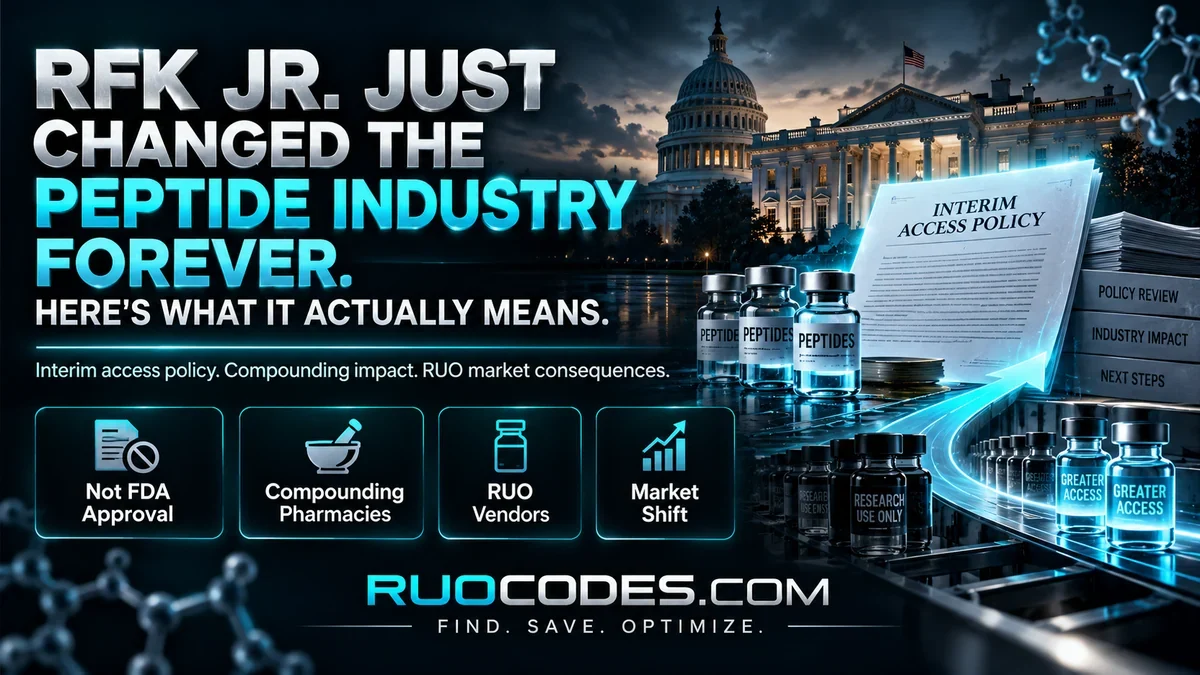
On October 15, 2026, the Trump administration sent a peptide "interim access policy" to the White House Office of Management and Budget. The plan would tell the FDA to exercise "enforcement discretion," meaning compounding pharmacies could begin legally making and dispensing roughly 14 previously restricted peptides under physician prescription. BPC-157, TB-500, Thymosin Alpha-1, GHK-Cu, KPV, Semax, Selank, AOD-9604, Ipamorelin, CJC-1295, MOTS-C, and Epitalon are on the expected list. This is not FDA approval. It is not over-the-counter availability. And it does not resolve the gray zone that Research Use Only (RUO) vendors have operated in for years. But make no mistake: this is the single most significant shift in the peptide landscape in the past decade, and it carries real consequences for every corner of this industry.
What Actually Happened on October 15th
If you are active in the peptide research community, your feed probably exploded the morning of October 15th. Headlines like "Trump Administration Advances Plan for Peptide Drugs" started circulating from CNBC, ABC News, STAT News, and dozens of others. Here is what actually happened, stripped of the hype.
The Department of Health and Human Services (HHS), under Secretary Robert F. Kennedy Jr., formally submitted a peptide interim access policy document to the Office of Management and Budget (OMB) for White House review. In plain terms: HHS wrote a plan, put it through the official regulatory pipeline, and sent it upstairs.
The plan itself is not a law. It is not a new FDA rule. What it proposes is something called "enforcement discretion," which is a formal government mechanism where the FDA would choose not to enforce certain restrictions on licensed 503A and 503B compounding pharmacies producing specific peptides. Think of it as the federal government saying: "We know these rules technically still exist, but we will look the other way when licensed pharmacies compound these compounds under physician oversight."
That is a meaningful distinction. Enforcement discretion can be granted, and it can be taken away. Formal rulemaking, which is the process that would permanently add these peptides to the safe compounding list, takes years, requires public comment periods, and is a far heavier legal lift. Whether this administration pursues that longer path remains an open question.
A Quick Backstory for Researchers Who Are New to This
If you are newer to the peptide research space, here is the context you need.
Back in 2023 and 2024, the FDA moved a series of peptides off the list of substances that compounding pharmacies were allowed to legally prepare. These fell into what regulators call "Category 2," meaning the FDA determined there were enough safety concerns, or enough lack of human safety data, to restrict their compounding. The compounds that landed there included some of the most popular names in the biohacking and performance research world: BPC-157, TB-500 (the commercial name for the Thymosin Beta-4 fragment), Thymosin Alpha-1, Semax, Selank, KPV, and others.
That decision created the gray market environment that Research Use Only vendors have operated in since. When legitimate pharmacies could no longer legally compound these peptides, researchers and consumers who wanted access had one realistic option: RUO suppliers who sell compounds labeled explicitly for laboratory and research purposes only, not for human use.
RFK Kennedy has argued publicly, and consistently, that the gray market that grew up around these restrictions has actually made things more dangerous, not safer. His argument is that when you push demand underground, people end up sourcing from unregulated producers, many of them overseas, with no quality controls and no accountability. That is a reasonable argument, and most people in this community know exactly what he is talking about.
The 14 Peptides Expected to Return
Based on reporting from CNBC, STAT News, Pharmacy Times, and the FDA advisory committee proceedings from July 2026, here is the current best picture of which compounds are expected to move back to Category 1 status under the proposed policy:
- BPC-157 (Body Protection Compound): The most searched peptide in the world right now. Oral and injectable forms. Studied extensively in animal models for gut health, tendon repair, and systemic anti-inflammatory effects.
- TB-500 / Thymosin Beta-4 Fragment (LKKTETQ): Widely researched for tissue repair, recovery acceleration, and flexibility.
- Thymosin Alpha-1 (Ta1): Used in immune modulation research and studied in oncology support contexts.
- GHK-Cu (Copper Peptide): Skin regeneration, wound healing, and anti-aging research.
- KPV: A tripeptide fragment with significant gut inflammation and IBD research literature behind it.
- AOD-9604: A growth hormone fragment originally studied for fat metabolism.
- Ipamorelin: A growth hormone secretagogue with a relatively clean safety profile in clinical literature.
- CJC-1295: Another GH secretagogue, typically studied in combination with Ipamorelin.
- Semax: A neuropeptide with Russian clinical research history, studied for cognitive enhancement and neuroprotection.
- Selank: A synthetic anxiolytic peptide, also with Russian clinical literature behind it.
- MOTS-C: A mitochondrial-derived peptide with emerging research in metabolic health and longevity.
- Epitalon (Epithalon): A tetrapeptide studied for telomere-related longevity research.
Compounds that are expected to remain restricted include Melanotan II, GHRP-2, GHRP-6, Cathelicidin LL-37, and PEG-MGF, largely due to more substantive safety signals in the available data.
One important caveat: the FDA had not published a formally updated list as of the time this piece was written. The OMB review must be completed before any policy changes take effect. Nothing is legally different today from yesterday. What we have is a submitted plan and a direction of travel.
What This Means for the Research Use Only Space
Here is where it gets nuanced, and where I want to give you the honest take rather than the breathless headline version.
This policy does not directly regulate or abolish RUO vendors.
Research Use Only suppliers operate under a separate regulatory framework from compounding pharmacies. Their products carry a label that restricts them to laboratory and research applications, and the legal exposure of those vendors has never primarily been about the compounding rules. So the immediate legal landscape for RUO sellers does not flip overnight because of this policy submission.
But the practical and market reality? That is a different story entirely, and this is where I think the most important analysis lives.
The competitive pressure on RUO vendors just got significantly more intense.
Think about it from a researcher's perspective. Right now, if you want access to BPC-157 or TB-500, your options are essentially limited to RUO suppliers, because licensed pharmacies could not legally compound them. That created and sustained an enormous demand base for the RUO market. If compounding pharmacies begin legally producing these compounds under physician oversight, with USP-grade standards, certificates of analysis, sterility testing, and a physician in the loop, a meaningful portion of that demand moves.
The people who were sourcing from RUO vendors purely because the legal alternative did not exist will now have a legal alternative. Not everyone. People who self-research without a physician will still be looking at RUO sources. People who want lower price points, no prescription requirement, or access to compounds that stay restricted will still be in the market. But the addressable universe of RUO customers just got smaller.
Quality differentiation becomes more critical than ever.
The vendors who will survive and grow through this transition are the ones who have already been doing things right: third-party testing, transparent COAs, consistent purity standards, responsive customer service, and honest product information. The vendors whose value proposition was simply "we have BPC-157 and you can't get it anywhere else" are the ones who face a real squeeze.
If you are a researcher sourcing from RUO vendors, this is also the moment to be more discerning, not less. Independent testing of RUO peptide products has consistently found issues with dosing accuracy, contamination, and in some cases wrong compounds entirely. That has always been true. It becomes more visible now that there is a cleaner comparison point.
The Bigger Picture: Where Is This Industry Heading?
I have been in this space long enough to have watched it go from niche bodybuilding forums to a multi-billion dollar gray market to a moment where the Secretary of Health and Human Services is personally shepherding a peptide access policy through the White House regulatory review process. The legitimization arc is real.
Legitimate medical access is expanding. The pathway from "biohacker workaround" to "physician-supervised therapy" is widening with this policy. Telehealth companies like Hims & Hers and Noom have already publicly indicated they would add peptide offerings if access is eased. Wall Street analysts estimate the market could be worth $2 billion to $3 billion. The clinical infrastructure to deliver these compounds at scale with appropriate oversight is being built right now. Kennedy allies are already celebrating: Brigham Buhler, a wellness clinic operator who sells peptides through an online service, posted on X: "This is huge. This isn't about whether you're for or against peptides. It's about whether you're for or against MEDICAL FREEDOM." That enthusiasm is real. So is the financial interest behind it.
FDA scientists are not sold, and that matters. It is worth being clear-eyed about the fact that the FDA's own internal scientists pushed back on the advisory panel's recommendations, saying that most of the data on these peptides comes from animal studies and that human safety and efficacy have not been adequately established. That is not a trivial objection. It is the scientific honest truth for most of these compounds. Also worth noting: the advisory panel that overruled those scientists was hand-selected by Kennedy's own department and included doctors, pharmacists, and consultants who already work in the peptide field. Whether you read that as stacking the deck or bringing real-world expertise into a room that had been dominated by regulatory caution probably depends on your prior. Either way, the tension between that panel's recommendation and FDA's own scientists is a factual part of this story and researchers deserve to know it.
The gray market does not disappear, it evolves. The compounds that stay restricted, and the population of researchers who prefer to operate outside the prescription system, represent a persistent demand base. RUO vendors are not going away. But the ones who thrive going forward will be the ones who establish themselves as genuine quality standards leaders, not just access providers.
Pricing pressure is coming. When licensed 503B pharmacies can produce BPC-157 at commercial scale under prescription, prices will adjust. That is good for patients and researchers who gain access through the medical system. For RUO vendors, it means competing on quality and value in a more crowded environment.
My Take as a Researcher
I want to be honest with you about where I stand on this.
The direction of this policy is right. Forcing demand into an unregulated gray market has caused real harm. People sourcing from unknown overseas suppliers, buying compounds with no independent purity verification, and self-administering without any medical oversight is not a good outcome for the research community or for public health. If a legitimate, supervised pathway expands access to compounds that have genuine research value, that is a net positive.
At the same time, the FDA scientists raising caution are not the enemy. "A policy announcement on a podcast is not a rule change," as one pharmacist wrote this week. And "enforcement discretion" is not the same as approval. The evidence base for many of these compounds is still primarily animal studies, and researchers who have been around long enough know that animal model results do not always translate. That humility matters.
For the RUO vendor community specifically: this is a fork in the road. The vendors who respond by doubling down on quality, transparency, and researcher education are the ones I am watching with optimism. The ones who respond by panicking, cutting corners, or pretending this news does not change anything are the ones I am watching with concern.
The peptide industry is growing up. That is a good thing. Growth sometimes hurts the parts that were built for a different era.
Frequently Asked Questions
Is BPC-157 legal to buy now?
Not yet, and not through the same channels. The interim access policy has been submitted for White House review but is not in effect. Even when it does take effect, it would allow licensed compounding pharmacies to produce BPC-157 under physician prescription. It does not make BPC-157 available over the counter or change the status of RUO-labeled products. see our BPC-157 compound guide
What is the difference between a compounded peptide and a research use only peptide?
A compounded peptide is produced by a licensed pharmacy under USP standards, dispensed via a physician prescription, with quality verification built into the process. A research use only (RUO) peptide is labeled for laboratory research purposes, not human use, and is sold outside the prescription framework. The quality of RUO products varies widely by vendor. compare verified peptide vendors
Which peptides are staying restricted after this policy?
Melanotan II, GHRP-2, GHRP-6, Cathelicidin LL-37, and PEG-MGF are expected to remain on the restricted compounding list. These compounds have more substantive safety signals in the available data. This list is not yet formally finalized by the FDA.
Does this change where I should buy peptides for research?
It reinforces the importance of sourcing from vendors with documented third-party testing and transparent certificates of analysis. The gap in quality standards between verified and unverified RUO suppliers is real, and that gap matters more as this market matures. verified vendor codes on RUOcodes.com
Will peptide prices drop?
Likely yes for the most popular compounds, once licensed compounding pharmacies ramp up production under the new policy. That process takes time. Pharmacy-scale peptide compounding requires sourcing raw materials, batch validation, and quality systems that are not built overnight.
What does "enforcement discretion" actually mean?
It means the FDA would formally choose not to enforce certain compounding restrictions against licensed pharmacies producing specified peptides. It is a real policy tool with legal standing, but it is not a permanent regulatory change. It can be reversed by a future administration without going through the formal rulemaking process that a permanent rule change would require.
Are RUO vendors going to disappear?
No. Research Use Only vendors serve a segment of the market that will persist regardless of this policy change: compounds that remain restricted, researchers without access to prescription pathways, and price-sensitive buyers. The vendors who have built their business on quality and transparency are in a durable position. The ones whose only value was being the only option available face a harder road.
Should researchers be optimistic or worried about this news?
Optimistic with eyes open. Expanding legitimate, supervised access to compounds with genuine research value is a positive development. The caution from FDA scientists about limited human data is also legitimate and worth keeping in mind. The community benefits from cleaner access and higher standards, not from pretending the evidence base is stronger than it is.
Bottom Line
October 15, 2026 is a date the peptide research community will look back on. The submission of a formal peptide interim access policy to the White House represents the most concrete regulatory movement in favor of expanded peptide access that we have seen, and it carries the full weight of the HHS Secretary's office behind it.
It is not a done deal. It is not FDA approval. It is not the end of the gray market. But it is the clearest signal yet that this industry is moving toward legitimization, and that the rules of the game are changing for everyone operating in this space.
For researchers: keep sourcing from verified vendors, keep demanding COAs, and keep your expectations calibrated to the actual evidence rather than the hype.
For RUO vendors: this is the moment to differentiate on quality, not to hope the market stays static.
For everyone watching: this story is not over. The formal rulemaking process, if the administration pursues it, will take years and include public comment periods. The OMB review of the interim policy has no mandatory deadline. We will be watching and updating this page as developments unfold.
Sources
- Trump administration advances plan for peptide drugs favored by RFK Jr. — CNBC, October 15, 2026
- Trump administration advances plan for peptide drugs favored by RFK Jr. — STAT News, October 15, 2026
- RFK Jr.'s Agency Sends Plan for Peptide Drugs to White House — The Epoch Times, October 2026
- The Peptide Reclassification Everyone's Talking About: A Pharmacist's Take — Pharmacy Times, 2026
- 14 Peptides Returning to Legal Compounding in 2026 — Meto
- In win for RFK Jr., FDA advisory panel narrowly votes to allow compounding of unapproved peptides — STAT News, July 23, 2026
- RFK Jr. wants to make it easier to get peptides. FDA scientists disagree. — NBC News, 2026