In this guide
TLDR
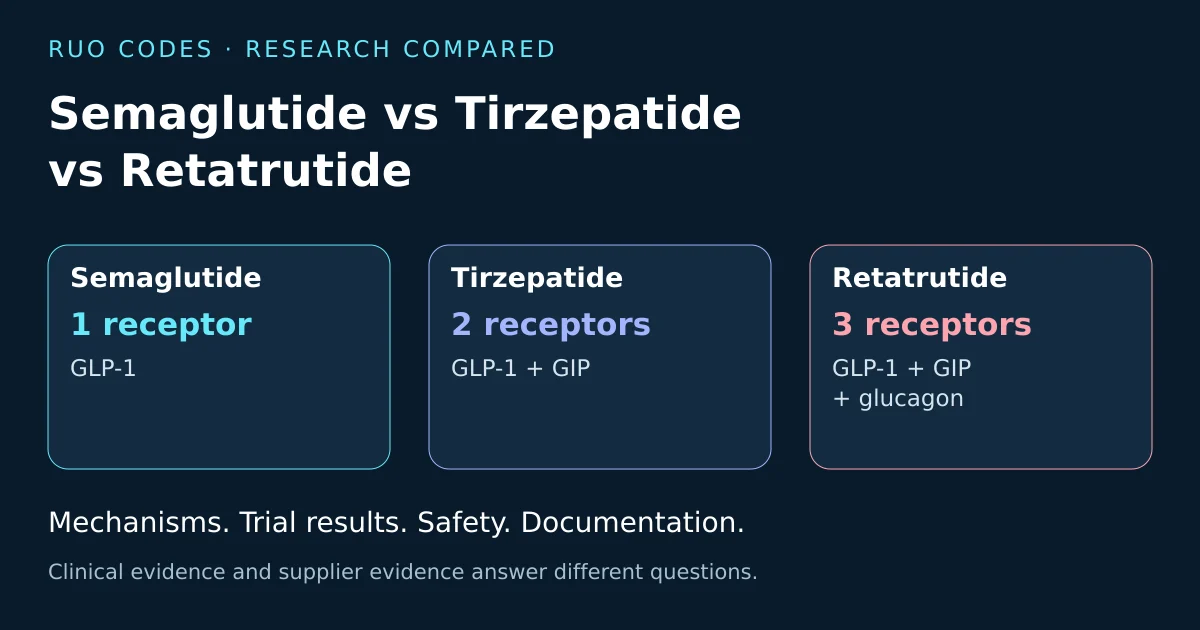
Semaglutide activates one receptor (GLP-1). Tirzepatide activates two (GLP-1 and GIP). Retatrutide activates three (GLP-1, GIP, and glucagon). In the trials run so far, more receptors has meant bigger average weight loss.
Semaglutide and tirzepatide have been compared head to head. In the SURMOUNT-5 trial, tirzepatide produced about 20.2% average weight loss versus 13.7% for semaglutide over 72 weeks.
Retatrutide has never been tested head to head against either one in a published trial. Its Phase 3 numbers look larger, but those come from different studies with different people, so you cannot just line them up and crown a winner.
As of October 2026, semaglutide and tirzepatide are FDA-approved medications. Retatrutide is not. Eli Lilly plans to file for approval in the first quarter of 2027.
Published trials describe the pharmaceutical-grade products used in those studies. They say nothing about a vial from a research supplier. Identity, purity, net content, and sterility documentation are what separate a serious research purchase from a leap of faith.
Why This Comparison Matters
Three names dominate peptide research conversations right now. Everyone wants to know which one “wins.” That is a fair question, and the honest answer is that it depends on which study you are reading, who was in it, how long it ran, and what was measured.
This guide walks through how each compound works, what the major trials found, where the safety questions sit, and what a careful researcher should demand before trusting any material. Think of it as the version you wish someone had handed you before you went down the rabbit hole.
The Core Difference: How Each Compound Works
Semaglutide is a GLP-1 receptor agonist. GLP-1 is a gut hormone that helps the body release insulin when glucose is high, slows how fast the stomach empties, and dials down appetite signals in the brain. Semaglutide research covers type 2 diabetes, body-weight management, and cardiovascular risk.
Tirzepatide hits two targets: GLP-1 and GIP (glucose-dependent insulinotropic polypeptide). GIP is another gut hormone that influences insulin release, fat tissue signaling, and energy balance. Tirzepatide is a single molecule that acts on both receptors, which is why it is called a dual agonist.
Retatrutide adds a third target: the glucagon receptor, alongside GLP-1 and GIP. Glucagon is usually known as the hormone that raises blood sugar, so a glucagon agonist sounds backwards at first. The research interest is that glucagon signaling may raise energy expenditure and reduce fat in the liver. Paired with GLP-1 and GIP, the idea is to push appetite down while nudging the body’s energy use up.
Here is the catch. More receptors does not automatically mean better for every person or every research question. Receptor pharmacology is one layer. Side effects, dropout rates, baseline health, and study design matter just as much.
What the Major Trials Actually Compare
Semaglutide vs tirzepatide in type 2 diabetes: SURPASS-2
SURPASS-2 compared tirzepatide at 5 mg, 10 mg, and 15 mg against semaglutide 1 mg over 40 weeks in adults with type 2 diabetes. Tirzepatide produced larger average drops in HbA1c and body weight at every studied dose. [2]
The fine print is that the semaglutide comparator was 1 mg, not the 2.4 mg dose studied for weight management. So SURPASS-2 answers “tirzepatide versus semaglutide 1 mg in people with type 2 diabetes,” not “tirzepatide versus all semaglutide.”
Semaglutide vs tirzepatide in obesity: SURMOUNT-5
SURMOUNT-5 is the cleanest head-to-head for weight. It enrolled 751 adults with obesity or overweight and at least one weight-related condition, without type 2 diabetes. Participants received the maximum tolerated dose of either tirzepatide or semaglutide for 72 weeks. [1]
Average weight change was minus 20.2% for tirzepatide and minus 13.7% for semaglutide. That works out to about 22.8 kg versus 15.0 kg. Tirzepatide also did better on waist circumference. Treatment discontinuation due to side effects was 6.1% with tirzepatide and 8.0% with semaglutide, though the trial was not built to prove a safety difference. [1]
One more detail worth knowing: SURMOUNT-5 was open-label, meaning participants and investigators knew which drug was being given. That is common in head-to-head studies, but it is worth remembering when you read the results.
Where retatrutide fits: the TRIUMPH program
Retatrutide’s early Phase 2 study in adults with obesity reported average weight loss of about 24.2% at 48 weeks on the highest dose. That grabbed the world’s attention, and Eli Lilly then launched a large Phase 3 program called TRIUMPH. Results so far, all at the 12 mg top dose: [3]
TRIUMPH-1 (adults with obesity or overweight, no diabetes, 80 weeks): Lilly’s May 2026 topline announcement reported 28.3% average weight loss, with 45.3% of participants losing 30% or more. The 9 mg dose reached 25.9% and the 4 mg dose reached 19.0%. The full NEJM paper, published in late September 2026, uses a stricter analysis, and secondary summaries put the 12 mg figure near 25%. [4] [6]
TRIUMPH-2 (type 2 diabetes plus obesity, 80 weeks): topline weight loss of 20.8% on 12 mg, with the full Lancet paper reporting 18.8% under its analysis. HbA1c fell by roughly 1.5 points. [5] [7]
TRIUMPH-3 (severe obesity plus established cardiovascular disease, 80 weeks): topline weight loss of 22.6% on 12 mg, plus improvements in triglycerides, blood pressure, waist circumference, and inflammation markers. [5]
Notice the gap between topline press-release numbers and full-paper numbers. Neither is dishonest. They count participants differently, for example whether people who stopped the drug are treated as if they stayed on it. When you compare compounds, make sure you are comparing the same kind of number.
The Trap: Comparing Across Trials
It is tempting to put 13.7% (semaglutide), 20.2% (tirzepatide), and 28.3% (retatrutide) in a row and call it a ladder. Resist that. Those figures come from different trials, different populations, different durations (72 weeks versus 80), and different analysis methods. Until a published head-to-head trial is complete, the retatrutide-versus-tirzepatide question is open. Lilly does list a head-to-head retatrutide versus tirzepatide study (TRIUMPH-5) as active, so that evidence is on its way.
Endpoints are not interchangeable either. Diabetes trials focus on HbA1c, glucose, and hypoglycemia. Weight trials focus on percentage body-weight change, waist size, and blood pressure. A compound can lead on one measure and carry trade-offs on another.
Safety Signals Deserve the Same Scrutiny
All three compounds share a common side-effect family, mostly gastrointestinal: nausea, vomiting, diarrhea, constipation, and abdominal discomfort. These show up most during dose escalation and are a big reason people stop treatment.
For semaglutide and tirzepatide, prescribing information also discusses gallbladder events, pancreatitis, dehydration-related kidney problems, delayed gastric emptying, and a boxed warning about thyroid C-cell tumors seen in rodents.
Retatrutide’s safety record is still being written. Discontinuation due to side effects in TRIUMPH-3 was 9.8% on 9 mg and 13.5% on 12 mg, compared with 4.8% on placebo. Earlier Phase 2 work also noted dose-related increases in heart rate. Those are exactly the type of details the full Phase 3 publications and the FDA review will sort out. [5]
Nothing in this article, or in any supplier’s marketing, can tell a person whether a compound is right for them. That is a conversation for a licensed clinician.
Approval Status: Not All Three Are Equal
Semaglutide and tirzepatide are FDA-approved medications with established manufacturing standards and prescribing frameworks. Retatrutide is investigational. Lilly has said it plans to submit a Biologics License Application in the first quarter of 2027, and FDA review typically runs 10 to 12 months after that. A planned filing is not an approval. Until there is one, retatrutide is not available by prescription, and any product sold under that name outside a clinical trial is a research-use-only material. [5]
That is where documentation becomes the whole ballgame.
Why Product Documentation Changes the Research Question
Clinical trials assume the investigators know exactly what was administered, because the sponsor manufactured it under strict controls. A research buyer has no such luxury. A label and a purity percentage on a storefront are claims, not evidence.
Here is what real documentation looks like.
Identity: Does independent testing show the material is actually semaglutide, tirzepatide, or retatrutide? Mass spectrometry is the usual tool for confirming this.
Purity: High-performance liquid chromatography (HPLC) estimates how much of the sample is the target peptide versus related impurities. Purity says nothing about identity on its own.
Net content: A vial can pass purity and still contain less peptide than the label claims. If the fill is wrong, every concentration you calculate is wrong too.
Sterility and endotoxin: A purity-only certificate of analysis (COA) does not establish sterility. These are separate tests that answer separate questions.
Lot traceability: A credible COA names the testing lab, the method, and the specific lot. An undated sample report, a cropped chromatogram, or a certificate with no lot number is incomplete evidence.
RUO Codes treats current independent-lab documentation as the baseline for supplier inclusion because marketing language cannot verify a compound. Vendors that cannot document product contents do not get listed. That standard matters most for high-demand names, where familiarity breeds misplaced confidence, and retatrutide is the poster child for that.
A Practical Framework for Reading the Evidence
Step one: Pin down the question. Is it glycemic control, body weight, heart outcomes, mechanism, tolerability, or long-term adherence?
Step two: Check the match. Does the comparator dose, population, and follow-up window actually fit that question?
Step three: Separate clinical evidence from supplier evidence. A trial shows what happened with a controlled study product. It does not prove the identity, purity, content, or sterility of a vial from an unrelated seller. Each claim needs its own paperwork.
Step four: Compare like with like. Topline versus topline, full paper versus full paper, same duration, same population.
The Bottom Line
Tirzepatide has beaten semaglutide on weight in a direct head-to-head, and retatrutide has posted the largest averages yet in its own Phase 3 trials. Semaglutide still carries the deepest evidence base of the three and is not an obsolete comparator. Retatrutide is the one to watch, and the one that most deserves patience until the head-to-head data and FDA review are in.
For anyone evaluating research materials, the standard should be just as direct: confirm what is in the vial first, then decide whether the published literature even applies to the material in front of you.
Frequently Asked Questions
Which is stronger, semaglutide, tirzepatide, or retatrutide?
In published trials, average weight loss has been largest with retatrutide, then tirzepatide, then semaglutide. But only semaglutide versus tirzepatide has been compared head to head (SURMOUNT-5). Retatrutide numbers come from separate trials, so the comparison is suggestive, not settled.
How many receptors does each compound target?
Semaglutide targets GLP-1. Tirzepatide targets GLP-1 and GIP. Retatrutide targets GLP-1, GIP, and glucagon.
Is retatrutide FDA approved?
No. As of October 2026 it is investigational. Eli Lilly has said it plans to submit an application to the FDA in the first quarter of 2027.
What did SURMOUNT-5 show?
In 751 adults with obesity and no diabetes, tirzepatide produced 20.2% average weight loss versus 13.7% for semaglutide at 72 weeks, at maximum tolerated doses.
Does a clinical trial result apply to a research peptide?
No. Trial results describe the specific product used in the study. A research-use-only vial needs its own independent evidence of identity, purity, net content, and sterility.
What should a certificate of analysis include?
The tested lot number, the name of an independent lab, the testing methods (such as HPLC for purity and mass spectrometry for identity), the date, and results traceable to the lot being sold. Sterility and endotoxin results are separate.