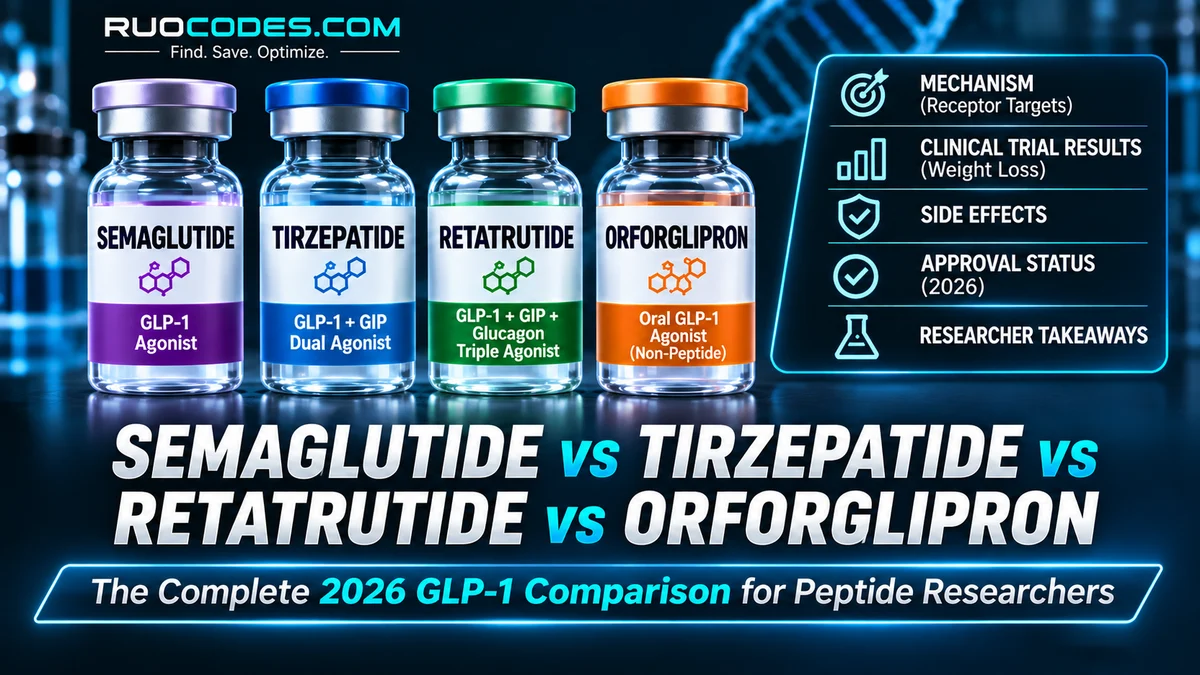
Updated November 2, 2026. Originally published October 23, 2026. This compares clinical evidence, not research-supplier products. Cross-trial numbers are not a four-way head-to-head study.
If you have spent any time in the peptide research world lately, you already know the GLP-1 space is moving fast. Really fast. What started with semaglutide dominating headlines a few years ago has now turned into a four-way race that includes compounds hitting weight loss numbers that nobody thought possible even five years ago.
This post is your complete, no-fluff breakdown of all four major GLP-1 receptor agonists that researchers and the broader health community are watching in 2026: semaglutide, tirzepatide, retatrutide, and orforglipron. We are talking about how each one works, what the clinical data actually says, where they stand on approval, their side effect profiles, and what all of this means if you are doing research in this space.
TLDR
- Semaglutide (Ozempic, Wegovy, Rybelsus): The original GLP-1 benchmark in this comparison. GLP-1 agonist. STEP 1 reported 14.9% average weight loss at 68 weeks with 2.4 mg weekly injections. FDA approved, with injectable and oral formulations. Results depend on the formulation, dose, and trial. [1]
- Tirzepatide (Mounjaro, Zepbound): Dual GIP/GLP-1 agonist. A leading approved option for weight loss. Up to 20.9% average weight loss in SURMOUNT-1. Beat injected semaglutide head-to-head with 20.2% vs 13.7% loss in SURMOUNT-5. FDA approved. [2] [3]
- Retatrutide: Triple agonist (GIP + GLP-1 + glucagon). Investigational. TRIUMPH-1 reported 28.3% average weight loss at 80 weeks using the efficacy estimand at 12 mg; the treatment-regimen estimate was 25.0%. Not FDA approved. Lilly has announced a planned Q1 2027 filing. [6] [7]
- Orforglipron (Foundayo): Eli Lilly's oral, non-peptide GLP-1 agonist. FDA approved for adult weight management on April 1, 2026. ATTAIN-1 reported 12.4% weight loss under the efficacy estimand at the highest studied dose, versus 11.1% under the treatment-regimen estimand. Does not require refrigeration. ACHIEVE-3 showed superiority to the studied oral semaglutide doses in type 2 diabetes, not to every oral GLP-1 formulation. [8] [11] [10]
The short version: Retatrutide has a striking trial result, but cross-trial percentages are not a head-to-head ranking. Tirzepatide beat injected semaglutide in a direct obesity trial. Orforglipron offers convenient oral delivery. Semaglutide has the longest established evidence base among these four.
Why Peptide Researchers Care About This Comparison Right Now
For those of us following the research-use-only (RUO) space, the GLP-1 landscape matters for one key reason: the clinical programs provide substantial human evidence about these mechanisms. Those trials study controlled pharmaceutical formulations, not the products sold by research suppliers. An RUO label does not establish safety or suitability for human use.
Understanding the mechanistic differences between these four options is essential for anyone trying to stay current in peptide research. Each compound targets the same general system in a meaningfully different way, and those differences show up dramatically in outcomes.
Let's break down how the whole system works first.
How GLP-1 Agonists Actually Work
GLP-1 stands for glucagon-like peptide 1. It is a naturally occurring hormone your gut releases after you eat. Its main jobs are to:
- Signal the pancreas to release insulin (lowering blood sugar)
- Slow down how fast your stomach empties food
- Reduce appetite by acting on hunger receptors in the brain
GLP-1 receptor agonists are synthetic molecules that bind to the same receptors as your natural GLP-1, but stay active far longer. Your body's natural GLP-1 degrades in about two minutes. A weekly injectable like semaglutide stays active for about seven days.
The innovation over the past several years has been layering additional receptor targets on top of GLP-1:
- GIP (glucose-dependent insulinotropic polypeptide): Another gut hormone that supports glucose-dependent insulin release. Tirzepatide combines GIP and GLP-1 agonism and has outperformed injected semaglutide in a direct obesity trial. That trial compares the complete medicines; it does not isolate how much of the difference comes from GIP alone.
- Glucagon receptors: Glucagon is the "raise blood sugar" hormone. That sounds counterproductive. Combining glucagon receptor activation with GIP and GLP-1 agonism is being investigated for effects on energy expenditure, fat metabolism, and liver fat. The contribution of each receptor to retatrutide's clinical results is not established by comparing separate trials.
That cascade — from single to dual to triple agonism — is the story of this entire drug class in 2026.
Semaglutide: The Benchmark
Brand names include: Ozempic (T2D), Wegovy (weight management), Rybelsus (oral T2D). Mechanism: GLP-1 agonist. Administration: Injectable and oral products; directions and indications depend on the product. Approval status: FDA approved. The STEP 1 and SURMOUNT-5 figures below concern weekly injections, not oral semaglutide. [12]
What the data shows
The STEP 1 trial, which is the landmark obesity study for semaglutide, showed a mean weight loss of approximately 14.9% over 68 weeks at the 2.4 mg weekly dose in adults without diabetes. That is the number most people cite. [1]
In the head-to-head SURMOUNT-5 trial against tirzepatide, semaglutide produced 13.7% weight loss at 72 weeks — a strong result, but meaningfully behind tirzepatide's 20.2% in the same trial. [3]
Semaglutide has years of clinical and real-world data. The SELECT cardiovascular outcomes trial demonstrated cardiovascular benefit in adults with established cardiovascular disease and overweight or obesity without diabetes. That is an important evidence advantage, but it does not establish that semaglutide is the safest option for every patient. [4]
Side effects
Semaglutide commonly causes nausea, vomiting, constipation, and diarrhea, often during dose escalation. Many events improve over time, but some are severe or lead to stopping treatment. There is no direct four-way trial establishing that it has the mildest side effect profile. The prescribing information also includes serious warnings, including a boxed thyroid C-cell tumor warning.
The takeaway for researchers
Semaglutide is the reference compound. When you see a new drug claim it is "as good as" or "better than" a GLP-1 agonist, they almost always mean semaglutide. It set the ceiling for what this class could do — until tirzepatide arrived.
read more about semaglutide on our compound reference page
Tirzepatide: The Current King of Approved Options
Brand names: Mounjaro (T2D), Zepbound (obesity) Mechanism: Dual GIP and GLP-1 receptor agonist Administration: Weekly subcutaneous injection Approval status: FDA approved
What the data shows
The SURMOUNT-1 trial is the headline: tirzepatide at 15 mg weekly produced a mean weight loss of 20.9% over 72 weeks under the treatment-regimen estimand, which accounts for treatment discontinuation. The efficacy-estimand estimate was 22.5%; that is a group average under an on-treatment assumption, not a maximum reached by individual participants. [2]
The SURMOUNT-5 head-to-head result was clear: 20.2% vs 13.7% average weight loss at 72 weeks. That is a 6.5-percentage-point difference, or roughly 47% greater relative weight reduction with tirzepatide. It answers a specific comparison of these injected medicines at the studied doses, not which treatment is best for every individual. [3]
Side effects
Tirzepatide shares the same general gastrointestinal profile as semaglutide: nausea, vomiting, diarrhea, and constipation. It is not accurate to say that its side effect burden is necessarily higher. In SURMOUNT-5, gastrointestinal adverse events leading to treatment discontinuation occurred in 2.7% with tirzepatide versus 5.6% with semaglutide. [3]
Most adverse events in that head-to-head trial were mild or moderate and occurred during dose escalation. Individual tolerability varies. Tirzepatide also carries serious label warnings, including the boxed thyroid C-cell tumor warning; greater weight loss is not a blanket safety advantage.
The takeaway for researchers
If you are trying to understand the approved injectable market right now, tirzepatide is a key benchmark. The dual GIP/GLP-1 medicine beat injected semaglutide in SURMOUNT-5. Retatrutide is being studied against this evolving standard, but the figures from different trials are not a direct comparison.
read more about tirzepatide on our compound reference page
Retatrutide: The Triple Threat Still in the Pipeline
Investigational name: LY3437943. Mechanism: Triple GIP, GLP-1, and glucagon receptor agonist. Administration: Weekly subcutaneous injection in clinical trials. Approval status: Investigational; multiple Phase 3 trials have reported results. Lilly announced a planned Q1 2027 BLA submission. [7]
What the data shows
Retatrutide is one of the major stories of 2026 in this space. The TRIUMPH-1 Phase 3 trial enrolled 2,339 adults with obesity or overweight without diabetes and followed the main study for 80 weeks. Lilly reported the following efficacy-estimand results, estimating outcomes if participants remained on study treatment:
- 4 mg dose: 19.0% average weight loss (~21.4 kg)
- 9 mg dose: 25.9% average weight loss (~29.2 kg)
- 12 mg dose: 28.3% average weight loss (~31.9 kg)
- Placebo: 2.2%
At the 12 mg dose, 45.3% of participants achieved at least 30% weight loss under the efficacy estimand. The treatment-regimen estimate for average weight loss at that dose was 25.0%, versus 3.9% with placebo. These are substantial results, but the study was not a direct comparison with bariatric surgery, tirzepatide, or semaglutide. [5] [6]
A prespecified 104-week extension enrolled 532 participants with baseline BMI of at least 35 who completed the main study and tolerated their assigned dose. Participants originally assigned 12 mg who continued to a maximum tolerated dose reached 30.3% mean weight loss under the efficacy estimand. This selected extension group is not directly comparable to the full trial population. [6]
TRIUMPH-2 also reported substantial weight loss in adults with obesity or overweight and type 2 diabetes. Lilly announced topline results from TRIUMPH-2 and TRIUMPH-3 on July 23, 2026. TRIUMPH-3 studied people with established cardiovascular disease; improvements in risk factors should not be confused with proof of fewer cardiovascular events. [7]
The glucagon component is scientifically interesting. Retatrutide's triple-receptor design may contribute to effects on energy balance and liver fat, but these obesity results do not prove that it increases energy expenditure or fat oxidation more than tirzepatide in humans. That requires appropriate direct mechanistic evidence.
Side effects
Here is the honest tradeoff: the strong efficacy results come with an important side effect burden. These are TRIUMPH-1 rates, not evidence from a four-way safety comparison.
- Nausea: 28.6% (4 mg), 38.4% (9 mg), 42.4% (12 mg) versus 14.8% on placebo
- Vomiting: 10.6% (4 mg), 22.8% (9 mg), 25.3% (12 mg) versus 4.8% on placebo
- Dysesthesia (altered or abnormal skin sensations): 12.5% at 12 mg versus 0.9% on placebo
- Discontinuation due to adverse events: up to 11.3% at 12 mg
Nausea and vomiting were more frequent at the higher retatrutide doses. Dysesthesia was also reported, but the trial does not establish that glucagon receptor activity causes it. It is not unique proof of higher energy expenditure, and altered sensation has also been described with other GLP-1 medicines. [6]
TRIUMPH-1 used a protocol-controlled escalation schedule under clinical supervision. The study schedule describes how the trial was conducted; it is not a self-administration guide or a validated regimen for products sold outside trials. [6]
Approval timeline
Retatrutide remains investigational and is not FDA approved. TRIUMPH-1 topline results were released in May 2026, followed by TRIUMPH-2 and TRIUMPH-3 in July. Lilly announced that it planned to submit a Biologics License Application in Q1 2027 after completing its manufacturing data package. A planned filing is not an accepted application or a guaranteed approval date. [7]
An August 24, 2026 FDA warning letter to Peptide Partners LLC discussed products including "GLP-3 Reta" as unapproved new drugs and misbranded drugs. That is a regulatory finding about marketing and legal status, not laboratory proof that a particular vial was counterfeit or chemically mislabeled. [14]
The takeaway for researchers
Retatrutide's 28.3% efficacy-estimand result at 12 mg is striking. It remains investigational, the side effect burden matters, and comparing its percentage with other trials cannot establish superiority. Its filing and regulatory review are worth following; a specific approval date cannot be promised.
read more about retatrutide on our compound reference page
Orforglipron: The Oral Revolution
Name: Orforglipron (Foundayo; development code LY3502970). Mechanism: Non-peptide GLP-1 receptor agonist (small molecule). Administration: Once-daily oral tablet. Approval status: FDA approved for adult weight management on April 1, 2026. Approval for one indication or country does not imply approval for every indication or market. [10] [11]
What makes orforglipron different
Every other active ingredient in this comparison is a peptide, which makes oral delivery more difficult. That does not mean peptides must always be injected: oral semaglutide is an important exception. Orforglipron is a non-peptide small molecule developed for oral delivery.
Oral semaglutide (Rybelsus) has specific administration requirements: take it on an empty stomach with no more than 4 ounces of plain water, then wait at least 30 minutes before food, drink, or other oral medicines. It uses an absorption enhancer. Rybelsus tablets are stored at room temperature, not in a refrigerator. Storage and administration instructions are product-specific. [12]
Foundayo is taken once daily, with or without food, and without the fasting or water restrictions used for Rybelsus. Its label specifies room-temperature storage at 20 to 25 °C, with permitted excursions. Follow the current label rather than extrapolating between GLP-1 products. [11]
What the data shows
The Phase 3 ATTAIN-1 trial showed orforglipron significantly reduced weight and improved cardiometabolic risk factors.
ACHIEVE-3 compared orforglipron with oral semaglutide 7 mg and 14 mg in adults with type 2 diabetes inadequately controlled on metformin. Orforglipron improved A1C and weight more at the studied comparisons. It did not test every oral semaglutide dose or formulation, and it was not an obesity head-to-head trial against injectable semaglutide, tirzepatide, or retatrutide. [9]
At 72 weeks in ATTAIN-1, the highest investigational dose of orforglipron produced 12.4% mean weight loss under the efficacy estimand. The treatment-regimen result was 11.1%, versus 2.1% with placebo. The publication used 36 mg of the investigational formulation; the Foundayo label reports the corresponding approved tablet dose as 17.2 mg. Those milligram values are not interchangeable instructions. [8] [11]
The U.S. weight-management approval is already in place. Other indication and international regulatory decisions have their own timelines; future approvals should not be presented as certain.
Side effects
Orforglipron's common adverse effects overlap with injectable GLP-1 medicines, including nausea, diarrhea, constipation, and vomiting. Being GLP-1-only does not establish fewer or milder side effects. Foundayo carries a boxed thyroid C-cell tumor warning and other important label precautions, including severe gastrointestinal reactions and pancreatitis. [11]
The takeaway for researchers
Orforglipron's value proposition is oral access and convenience. A once-daily approved tablet without fasting or water restrictions adds a genuinely different option. The available studies do not establish that it wins or loses a direct efficacy contest against tirzepatide or retatrutide.
read more about orforglipron on our compound reference page
Side-by-Side Comparison Table
These selected results use different populations, durations and estimands. An efficacy estimand estimates outcomes with treatment continued; a treatment-regimen or treatment-policy estimate also accounts for discontinuation. Do not read this as a direct ranking.
| Feature | Semaglutide | Tirzepatide | Retatrutide | Orforglipron |
|---|---|---|---|---|
| Mechanism | GLP-1 agonist | GLP-1 + GIP | GLP-1 + GIP + Glucagon | Non-peptide GLP-1 |
| Administration | Injection (weekly) or oral (daily) | Injection (weekly) | Injection (weekly, investigational) | Oral tablet (daily) |
| Selected Phase 3 Weight Loss | 14.9% at 68 weeks (STEP 1, treatment-policy) | 20.9% at 72 weeks (SURMOUNT-1, treatment-regimen) | 28.3% efficacy / 25.0% treatment-regimen at 80 weeks (TRIUMPH-1) | 12.4% efficacy / 11.1% treatment-regimen at 72 weeks (ATTAIN-1) |
| FDA Approval Status | Approved; product-specific indications | Approved; product-specific indications | Investigational; planned Q1 2027 filing | Approved as Foundayo for adult weight management, April 1, 2026 |
| Brand Names | Ozempic, Wegovy, Rybelsus | Mounjaro, Zepbound | Investigational (LY3437943) | Foundayo (orforglipron) |
| Storage | Product-specific; Rybelsus tablets are room-temperature products | Product-specific injection storage instructions | Investigational; study-controlled handling | Room temperature per Foundayo label |
| Safety Context | GI effects and serious label warnings | GI effects and serious label warnings | GI effects and dysesthesia in trials; not approved | GI effects and serious label warnings; oral does not mean risk-free |
| Long-Term Evidence | Longest established evidence base among these four | Several years of clinical and real-world evidence | Limited; Phase 3 results and selected extension data | Newly approved; longer-term evidence is still developing |
| Head-to-Head Data | Less weight loss than tirzepatide in SURMOUNT-5 | More weight loss than injected semaglutide in SURMOUNT-5 | TRIUMPH-1 was placebo-controlled, not a direct comparison | Superior to studied oral semaglutide doses in ACHIEVE-3 (T2D) |
What This Means for the RUO Research Landscape
A few things stand out for anyone doing research in this space:
The bar has moved. Semaglutide's approximately 15% average weight loss in STEP 1 was a breakthrough. Tirzepatide's SURMOUNT-1 result exceeded 20%, and retatrutide's TRIUMPH-1 efficacy-estimand result approached 30%. The direction is important, but different populations, follow-up durations, and estimands mean those percentages are not a head-to-head league table.
Triple agonism is an important research direction. Adding glucagon receptor activity creates new questions about energy expenditure, liver fat, and tolerability. Dysesthesia is a safety observation, not proof of a particular receptor mechanism or a sign that a compound is "working."
Oral delivery changes the access equation. ATTAIN-1's weight-loss results matter, but so does the practical difference: an approved once-daily tablet without fasting, injection, or refrigeration requirements. That broadens delivery choices without establishing that the tablet is right for every patient.
Unapproved-product marketing remains a real concern. The FDA's August 2026 Peptide Partners letter documents regulatory violations involving products including "GLP-3 Reta." It does not establish the contents of every product sold under similar names. Vendor listings, coupons, and RUO disclaimers do not turn a research product into an approved prescription medicine. [14]
see our peptide vendor directory
Frequently Asked Questions
What is the difference between semaglutide and tirzepatide?
Semaglutide acts only on GLP-1 receptors. Tirzepatide acts on both GLP-1 and GIP receptors. The addition of GIP agonism in tirzepatide produces meaningfully greater weight loss — about 20% versus 14-15% in comparable trials. In the direct head-to-head SURMOUNT-5 trial, tirzepatide produced 20.2% weight loss versus 13.7% for semaglutide. Both are FDA approved and once-weekly injectables.
How does retatrutide compare to tirzepatide?
Retatrutide activates glucagon receptors as well as GIP and GLP-1 receptors, making it a triple agonist. TRIUMPH-1 reported 28.3% average weight loss at 12 mg over 80 weeks under the efficacy estimand, or 25.0% under the treatment-regimen estimand. These cannot establish superiority to tirzepatide's separate SURMOUNT-1 trial. Retatrutide remains investigational; gastrointestinal events and dysesthesia are important safety findings, and the cause of dysesthesia is not established.
Is orforglipron as effective as injectable GLP-1s?
ATTAIN-1 reported 12.4% mean weight loss at the highest investigational dose under the efficacy estimand, or 11.1% under the treatment-regimen estimand. There is no direct comparison here with tirzepatide or retatrutide. ACHIEVE-3 showed superiority to oral semaglutide 7 mg and 14 mg in type 2 diabetes, not every oral GLP-1 product. Foundayo is FDA approved for adult weight management and offers once-daily dosing without fasting or water restrictions.
What does GLP-1 agonist mean?
A GLP-1 agonist is a compound that mimics or activates the GLP-1 receptor — the same receptor your body's natural glucagon-like peptide 1 hormone activates after eating. Activating this receptor reduces appetite, slows gastric emptying, and supports blood sugar regulation. Synthetic GLP-1 agonists like semaglutide are engineered to stay active far longer than the natural hormone, which degrades in about two minutes.
What is a triple agonist GLP-1?
A triple agonist activates GLP-1, GIP, and glucagon receptors. Retatrutide is a prominent investigational example with Phase 3 data. Its design creates a rationale for studying appetite, glucose regulation, energy expenditure, and liver fat, but the separate obesity trials cannot isolate the benefit of glucagon activity or prove superiority to a dual agonist.
Which GLP-1 agonist causes the least side effects?
There is no direct four-way study establishing a safest or mildest option. Gastrointestinal effects are common across the class, and individual tolerability varies. In SURMOUNT-5, gastrointestinal adverse events caused treatment discontinuation in 2.7% with tirzepatide versus 5.6% with semaglutide. TRIUMPH-1 reported substantial nausea, vomiting, and dysesthesia with retatrutide, especially at higher doses. These findings should not be turned into a universal side-effect ranking.
When will retatrutide be FDA approved?
Retatrutide remains investigational. Lilly reported TRIUMPH-1 topline results in May 2026 and TRIUMPH-2 and TRIUMPH-3 results in July. Its announced plan was a Q1 2027 BLA submission, contingent on completing the manufacturing data package. There is no guaranteed FDA approval date; submission, acceptance, review, and approval are different milestones.
Is orforglipron FDA approved?
Yes. The FDA approved Foundayo (orforglipron) on April 1, 2026 for adult weight management alongside a reduced-calorie diet and increased physical activity, in adults with obesity or overweight with at least one weight-related comorbidity. That does not imply approval for every other indication or country. [10]
Can you stack GLP-1 agonists or combine them?
The Foundayo label does not recommend combining it with another GLP-1 receptor agonist; Zepbound labeling also advises against use with another GLP-1 receptor agonist. Combining separate products is not equivalent to the tested single-molecule dual or triple agonists. Combinations with other mechanisms, such as amylin agonism, are being studied, but that research does not establish a safe self-directed stack. [11] [13]
The Bottom Line for Peptide Researchers
The GLP-1 class in 2026 is not the same drug in four wrappers. These four compounds represent genuinely different mechanisms, meaningfully different efficacy profiles, and different delivery innovations. They are evolving fast.
Here is the practical hierarchy right now:
For the approved injectable comparison: Tirzepatide produced more average weight loss than injected semaglutide in SURMOUNT-5. That is useful direct evidence, not a personal treatment recommendation.
For the investigational triple-agonist data: Retatrutide's 28.3% efficacy-estimand result is striking, with a 25.0% treatment-regimen estimate at the same dose. It remains unapproved, its safety findings matter, and cross-trial percentages do not prove it is the most effective compound available.
For convenient oral delivery: Foundayo is an approved option without fasting or water restrictions. ACHIEVE-3 showed superiority to the studied Rybelsus doses in type 2 diabetes. It does not settle every oral or injectable comparison.
If you want the most long-term data and established safety profile: Semaglutide has years of real-world data, cardiovascular outcome studies, and the broadest body of clinical literature of any compound in this class.
For researchers staying current, retatrutide's regulatory progress and the developing real-world evidence for approved orforglipron are two important storylines to watch. Clinical trial results do not validate the identity, purity, safety, or human use of independently sold research products.
compare listed peptide research vendors see current vendor coupon codes and discounts
Sources
- Wilding et al. Once-Weekly Semaglutide in Adults with Overweight or Obesity (STEP 1). NEJM, 2021.
- Jastreboff et al. Tirzepatide Once Weekly for the Treatment of Obesity (SURMOUNT-1). NEJM, 2022.
- Aronne et al. Tirzepatide as Compared with Semaglutide for the Treatment of Obesity (SURMOUNT-5). NEJM, 2025.
- Lincoff et al. Semaglutide and Cardiovascular Outcomes in Obesity without Diabetes (SELECT). NEJM, 2023.
- Jastreboff et al. Retatrutide, a Triple Hormone Receptor Agonist, for Treatment of Obesity (TRIUMPH-1). NEJM, 2026.
- Lilly. TRIUMPH-1 results, estimands, extension eligibility and adverse events. May 21, 2026.
- Lilly. TRIUMPH-2/TRIUMPH-3 results and planned Q1 2027 BLA submission. July 23, 2026.
- Wharton et al. Orforglipron, an Oral Small-Molecule GLP-1 Receptor Agonist for Obesity Treatment (ATTAIN-1). NEJM, 2025.
- Lilly. ACHIEVE-3 study population, comparator doses, endpoints and estimands. September 17, 2025.
- FDA. Foundayo approval announcement. April 1, 2026.
- Foundayo (orforglipron) U.S. prescribing information: indications, warnings, clinical studies and storage.
- Rybelsus (semaglutide) prescribing information: oral administration and room-temperature storage.
- Zepbound (tirzepatide) U.S. prescribing information: warnings and limitations of use.
- FDA. Peptide Partners LLC warning letter, August 24, 2026.
This content is for research and informational purposes only. All compounds discussed are either FDA-approved prescription medications or investigational compounds. Nothing in this post constitutes medical advice. Consult a licensed healthcare provider before starting, stopping, or changing any treatment.