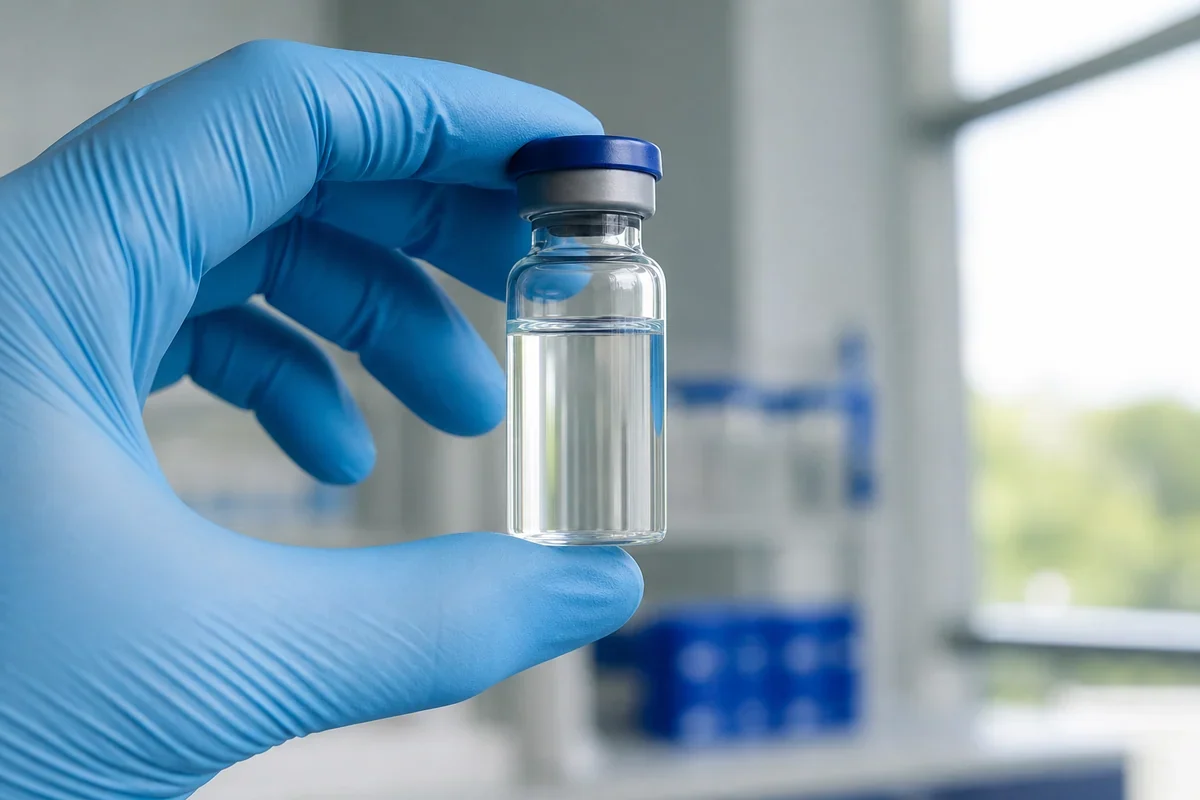
Bacteriostatic water and sterile water look identical in a vial. Both are clear, colorless and sold in small containers with a flip cap. The difference is on the label, and it comes down to one added ingredient and one container rule.
This article compares the two using their FDA-published labels, FDA and CDC reference pages, and peer-reviewed research. It is written for people who compare research suppliers and want to know what a listing should document. RUO Codes is a vendor directory. It does not sell, ship or lab-test products, and nothing here is mixing, handling or dosing guidance.
The short answer
Sterile Water for Injection, USP is water with nothing added. Its FDA label says it contains "no bacteriostat, antimicrobial agent or added buffer" and is supplied only in single-dose containers.
Bacteriostatic Water for Injection, USP is the same grade of water with benzyl alcohol added as a preservative. Its FDA label lists 0.9% or 1.1% benzyl alcohol and describes a multiple-dose container.
So the comparison has two parts:
- Composition: preservative present (bacteriostatic) or absent (sterile).
- Container: multiple-dose (bacteriostatic) or single-dose (sterile).
Both products are sterile when sealed. "Bacteriostatic" does not mean "more sterile". It means the liquid contains an agent that inhibits bacterial growth. Everything else in this article follows from those two differences.
What the bacteriostatic water label says
The clearest reference is the manufacturer's label published on DailyMed, the National Library of Medicine's database of FDA-submitted labeling. The Hospira label for Bacteriostatic Water for Injection, USP describes the product this way:
- A sterile, nonpyrogenic preparation of water for injection.
- Contains 0.9% (9 mg/mL) or 1.1% (11 mg/mL) benzyl alcohol, "added as a bacteriostatic preservative".
- Supplied in a multiple-dose container "from which repeated withdrawals may be made".
- pH of 5.7, with a stated range of 4.5 to 7.0.
- Stored at 20 to 25°C (68 to 77°F), which USP calls controlled room temperature.
The same label lists two presentations. One is a 30 mL plastic flip-top vial at 9 mg/mL benzyl alcohol. The other is a 20 mL fill in a 30 mL glass flip-top vial at 11 mg/mL. Each has its own National Drug Code (NDC).
The label also defines the product's purpose narrowly. It is a diluent for drugs, to be used according to the instructions of the drug's manufacturer. The label says nothing about research compounds, and it carries a warning that benzyl alcohol "has been associated with toxicity in neonates".
That last point matters for anyone reading a listing. The preservative is an active chemical with its own toxicology and its own interactions. It is the reason the product exists, and it is also the reason the label carries warnings that the plain-water label does not.
What the sterile water label says
The Hospira label for Sterile Water for Injection, USP is shorter because there is less to describe:
- A sterile, nonpyrogenic preparation of water for injection.
- Contains "no bacteriostat, antimicrobial agent or added buffer".
- "Supplied only in single-dose containers".
- Vial sizes on this label run from 1 mL to 100 mL, in glass or plastic.
- Stored at 20 to 25°C (68 to 77°F).
- Carries the instruction "Discard unused portion".
The single-dose rule follows from the composition. With no preservative in the liquid, nothing in the vial slows microbial growth once the seal is broken. The manufacturer's answer is a container meant to be opened once.
Like the bacteriostatic label, this one defines the product as a drug diluent used under another manufacturer's instructions. Neither label makes any claim about compatibility with a specific research peptide.
Side-by-side comparison
Every row below comes from the two DailyMed labels linked above or from the FDA endotoxin reference discussed later in this article.
| Attribute | Bacteriostatic Water for Injection, USP | Sterile Water for Injection, USP |
|---|---|---|
| Added ingredients | Benzyl alcohol, 0.9% (9 mg/mL) or 1.1% (11 mg/mL) | None. No bacteriostat, antimicrobial agent or added buffer |
| Sterile when sealed | Yes | Yes |
| Nonpyrogenic | Yes | Yes |
| Container type on the label | Multiple-dose | Single-dose only |
| Vial sizes on the Hospira label | 30 mL plastic; 20 mL fill in 30 mL glass | 1 mL to 100 mL, glass or plastic |
| pH and buffering on the label | pH 5.7 (range 4.5 to 7.0) | No added buffer |
| Label storage temperature | 20 to 25°C (68 to 77°F) | 20 to 25°C (68 to 77°F) |
| Unused contents | Label describes repeated withdrawals | "Discard unused portion" |
| USP endotoxin limit cited by FDA | 0.5 EU/mL | 0.25 EU/mL |
| Preservative warning on the label | Yes, for benzyl alcohol | None needed |
One thing the table makes plain: these are two different regulated products with two different specifications. A listing that treats the names as interchangeable is telling you something about the seller's attention to detail.
Benzyl alcohol: what published research reports
Benzyl alcohol is a common pharmaceutical preservative. A review in the Journal of Pharmaceutical Sciences found that phenol and benzyl alcohol are the two most common antimicrobial preservatives in licensed peptide and protein products. The same review names the "effect on the active ingredient" as one of the main criteria formulators use when choosing a preservative.
That criterion exists because preservatives are not inert. Three peer-reviewed studies show the pattern:
- Interleukin-1 receptor antagonist. In a 2005 study of a freeze-dried therapeutic protein, samples rehydrated with 0.9% benzyl alcohol showed more protein aggregation than samples rehydrated with water alone. The extent depended on how well the protein's structure had survived freeze-drying.
- Interferon alpha-2a. A 2014 study reported that benzyl alcohol induced aggregation of this protein "in a concentration-dependent manner", through partial unfolding.
- An IgG1 antibody. A 2017 study compared four preservatives, including benzyl alcohol. Each one lowered the antibody's conformational stability compared with a preservative-free control.
Read those findings carefully. They cover specific proteins under specific test conditions. They do not show that benzyl alcohol damages every peptide, and they do not show that it is harmless to any given one. What they do show is that preservative compatibility is molecule-specific and has to be established with data.
That has a direct consequence for how you read marketing copy. A sentence like "bacteriostatic water is better for peptides" or "sterile water is gentler" is a general claim about a molecule-specific question. Unless the seller cites data for the compound in question, treat it as opinion.
The label warning about newborns has a research history too. A 1982 report in the New England Journal of Medicine described benzyl alcohol poisoning in premature infants in neonatal intensive care. That report is the background to the neonatal toxicity warning that still appears on bacteriostatic water labels today.
Single-dose, multiple-dose and the 28-day figure
Listings for bacteriostatic water often state that the product "lasts 28 days after opening". It helps to know where that number comes from, because it is not on the Hospira label. The label gives an expiration date for the sealed product and describes repeated withdrawals. It does not print a day count.
The 28-day figure comes from healthcare practice standards. The CDC's injection safety guidance for healthcare facilities says an opened multi-dose vial "should be dated and discarded within 28 days unless the manufacturer states another date". It adds that the date should never go past the manufacturer's original expiration date.
Three points follow for anyone evaluating a listing:
- The figure is a rule for clinical facilities using FDA-approved multi-dose vials. It is not a performance claim that any bottle labeled "bacteriostatic" has earned.
- It depends on the preservative being present at the stated concentration. A product that is low on benzyl alcohol does not meet the definition the rule was written for.
- It says nothing about how long any compound stays stable. Container rules address microbial growth in the vial, not the chemistry of what is added to it.
The second point is not hypothetical. One vendor-commissioned study of 28 research-market products, summarized in our report on bacteriostatic water third-party test results, reported that most samples missed the benzyl alcohol or pH specification. RUO Codes did not run that study and cannot confirm its findings. It is a reason to ask for lot-level documentation, not a verdict on any one product.
Endotoxin limits and sterility claims
"Sterile" and "nonpyrogenic" are two separate claims, and both appear on each label.
Sterile means no viable microorganisms. Nonpyrogenic refers to endotoxins, the fragments of bacterial cell walls that can remain after the bacteria are gone. A liquid can pass a sterility test and still fail an endotoxin test.
FDA's inspection guide on bacterial endotoxins gives the compendial limits. Water for Injection, Sterile Water for Injection and Sterile Water for Irrigation have an allowable limit of 0.25 Endotoxin Units (EU) per mL. Bacteriostatic Water for Injection has what FDA calls a "slightly higher" limit of 0.5 EU/mL.
So the two products differ on a second measurable specification, not only on the preservative. If a certificate of analysis (COA) for a water product reports an endotoxin result, it should be read against the limit for that product type.
Water COAs are also a different document from peptide COAs. A peptide COA centers on identity, purity and net content, usually by HPLC and mass spectrometry. Our comparison of HPLC Versus LCMS Peptide Testing Explained covers those methods. For water, the relevant tests are sterility, endotoxin, pH and, for bacteriostatic water, benzyl alcohol content.
If the terms are new, our guide to what COA tests measure explains each one, and the peptide lab testing page explains what each test can and cannot prove. Two related articles go further on sterility testing and endotoxin testing.
Water names that get mixed up
Search results and product pages use several water names loosely. They are not synonyms.
- Water for Injection (WFI). The bulk grade of water that both products start from. Both labels state that "Water for Injection, USP is chemically designated H2O".
- Sterile Water for Injection. WFI that has been packaged and sterilized, with nothing added, in single-dose containers.
- Bacteriostatic Water for Injection. The same, with benzyl alcohol added, in multiple-dose containers.
- Sterile Water for Irrigation and Sterile Water for Inhalation. Separate USP products that FDA's endotoxin guide lists with their own limits. A different name means a different specification.
- Distilled or deionized water. These words describe how water was purified. They are not sterility claims, and they are not compendial injection grades.
The shorthand "BAC water" adds to the confusion. It is informal, it appears on no FDA label, and sellers use it for anything from an NDC-labeled pharmaceutical product to an unlabeled vial filled by a third party. The abbreviation tells you nothing about which of those you are looking at. The documentation does.

Seven documentation checks for a water listing
Some research suppliers sell water products next to their peptide catalog. The same habits that apply to a peptide listing apply here: match the paperwork to the product in front of you. These checks involve reading documents only.
- Read the exact product name. "Bacteriostatic Water for Injection, USP" and "Sterile Water for Injection, USP" are compendial names with defined specifications. "BAC water", "mixing water" or "research water" are not. If the listing uses only informal names, ask which specification the product is made to.
- Look for the labeler and an NDC. FDA-listed products carry a National Drug Code and a named labeler, and their labels can be looked up on DailyMed. If a listing shows neither, the DailyMed label facts in this article may not describe that product at all.
- Check the stated benzyl alcohol concentration. For bacteriostatic water, the listing or label should state it. The Hospira label lists 0.9% or 1.1%. A listing that says "bacteriostatic" without a number has left out the one fact that defines the product.
- Match the lot number. If the vendor publishes a COA for its water, the lot on the COA should match the lot on the vial or the product page. A COA for a different lot documents a different batch.
- Check the lab name and report date. A water COA should name the laboratory that produced it and carry a date. Compare the report date with the product's expiration date and with how long the listing has been live.
- See which tests are reported. Look for sterility, endotoxin, pH and benzyl alcohol content. Then check the results against the product's own limits, for example 0.5 EU/mL for bacteriostatic water and 0.25 EU/mL for sterile water.
- Compare expiration dating and shipping terms. Check that the expiration date is printed and has not passed, and compare how each vendor says it ships liquids. Confirm shipping terms at checkout, since they change.
None of these checks proves what is in a vial. They show whether a seller documents its product the way the product category requires. Our articles on Peptide Purity Testing: What a COA Must Prove and the 7-step COA verification checklist apply the same lot, lab and date logic to peptide listings.
Red flags on a water listing
Some patterns should slow you down. Each one is a documentation gap, and gaps are what this comparison is meant to help you spot.
- The two names used as if they were the same product. They have different compositions, containers and endotoxin limits.
- "Bacteriostatic" with no preservative named. The label for the FDA-listed product names benzyl alcohol and its concentration.
- A "USP" claim with nothing behind it. USP is a specification. A seller who claims it should be able to show test results against it.
- A shelf-life promise with no source. As covered above, the 28-day figure is a healthcare facility rule tied to labeled multi-dose vials. It is not a general property of a product name.
- Health or outcome claims. Water is a diluent. Any listing that attaches benefits to it is making claims the product's own label does not make.
- One COA reused across lots or years. A certificate documents one batch.
- Instructions for personal use. Research-use-only sellers should not be telling buyers how to use a product on themselves. Our article on research use only regulations and product claims explains why that wording matters.
Supply also varies over time. We covered one period of tight availability in our bacteriostatic water shortage report. When supply is tight, buyers are more likely to consider sources they have not used before, which is when the checks above earn their keep.
Where RUO Codes fits
RUO Codes does not sell water or peptides, and it does not run lab tests. It lists research-use-only peptide vendors that show current independent COAs for net content, net purity (HPLC) and compound identity (MS). Vendors cannot pay to be listed.
Each vendor gets a 7-point COA documentation score. The score measures how much testing documentation a vendor publishes for its peptides. It does not measure product quality, and it is a score for peptide documentation, so do not read it as a statement about a vendor's water products. Endotoxin and sterility or bioburden documentation count as extra credit within that score, so a vendor's profile is a reasonable place to see whether it publishes those tests at all.
A few free tools help with the comparison work described here:
- Vendor Match shows which listed vendors carry a specific compound, with filters for COA standards, price tier and stock status.
- The COA Verification Guide walks through reading a certificate line by line.
- The Reconstitution Calculator does concentration math only. It gives no dosing or handling advice.
- Peptide Laws by State summarizes state rules with sources. Check your own state's law before ordering anything.
If a vendor profile does not list specific tests or labs for a product, the profile will not fill that gap for you. Ask the vendor for the lot COA and read it against the checks above.
Frequently asked questions
Is bacteriostatic water the same as sterile water?
No. Both are sterile, nonpyrogenic water for injection when sealed. Bacteriostatic water also contains benzyl alcohol as a preservative, at 0.9% or 1.1% on the Hospira label, and comes in a multiple-dose container. Sterile water has no bacteriostat, antimicrobial agent or added buffer and comes only in single-dose containers.
What does "bacteriostatic" mean?
It means the liquid contains an agent that inhibits the growth of bacteria. In Bacteriostatic Water for Injection, USP that agent is benzyl alcohol. The term describes a preservative. It does not mean the product is more sterile than sterile water, and it is not a claim about any compound the water is later combined with.
Where does the 28-day figure for bacteriostatic water come from?
From healthcare practice standards, not from the product label. CDC guidance for healthcare facilities says an opened multi-dose vial should be dated and discarded within 28 days unless the manufacturer states another date. The Hospira label itself prints an expiration date for the sealed product and no in-use day count.
Does benzyl alcohol affect peptides or proteins?
Published research reports that it can, depending on the molecule. Studies in the Journal of Pharmaceutical Sciences found that benzyl alcohol increased aggregation of interleukin-1 receptor antagonist and interferon alpha-2a under test conditions. Those results are specific to those proteins. Compatibility for any other compound has to be shown with data for that compound.
Is "BAC water" an official product name?
No. It is shorthand for bacteriostatic water and does not appear on FDA labels. Sellers apply it to very different products, so the abbreviation alone tells you nothing about the specification. Look for the full compendial name, the stated benzyl alcohol concentration, a lot number and a COA that matches that lot.
What should a certificate of analysis for a water product show?
At minimum, the product name, lot number, testing lab and report date. For the tests themselves, look for sterility, endotoxin, pH and, for bacteriostatic water, benzyl alcohol content. FDA cites USP endotoxin limits of 0.25 EU/mL for Sterile Water for Injection and 0.5 EU/mL for Bacteriostatic Water for Injection.
Vendor information reviewed November 2026.
Compare vetted vendors, their COA scores and current codes at RUO Codes, and use code CHAD where listed. RUO Codes earns a commission when you use code CHAD, at no extra cost to you.
Research Use Only: RUO Codes provides research information, not medical advice. Products are for in-vitro laboratory research only, not for human consumption.