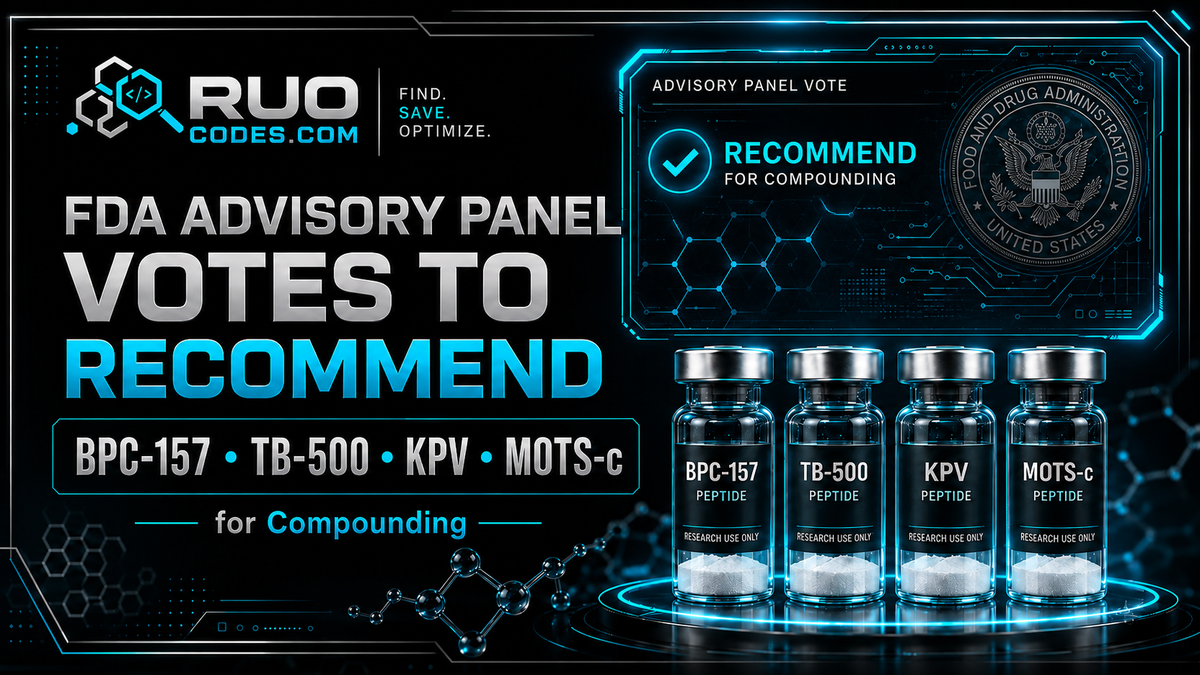
Now that the votes are in, the next question is what actually happens next and when. For the complete five-step road map from advisory recommendation to legal compounding access (including the realistic 2027–2028 timeline and the Category 1 wildcard), read The FDA Voted. Now What? The Complete Regulatory Road Map After the PCAC Peptide Decision.
For research and educational purposes only. Not medical advice.
UPDATED: July 24, 2026. Day 2 votes on Semax, Epitalon (Epithalon), and Emideltide are occurring today as this post is published. We will update with final results as they become available.
TL;DR: What Just Happened at the FDA PCAC Meeting
The FDA's Pharmacy Compounding Advisory Committee (PCAC) voted to recommend BPC-157, KPV, TB-500, and MOTS-c for inclusion on the 503A Bulk Drug Substances List, meaning licensed compounding pharmacies could eventually prepare these compounds for patients with valid prescriptions. The votes were close. The recommendations are non-binding. The FDA makes the final call. Even if the FDA agrees, a formal rulemaking process must follow, and that typically takes 6 to 18 months. Nothing changes at the pharmacy tomorrow. But this is the most significant regulatory development in the peptide space in years, and it matters.
July 2026 PCAC Vote Results at a Glance
| Compound | Day | Vote | Indication Evaluated | Human Trial Data |
|---|---|---|---|---|
| BPC-157 | Day 1 (July 23) | 8–6 In Favor | Wound healing, gastrointestinal | 3 small human studies |
| KPV | Day 1 (July 23) | 8–6 In Favor | Inflammatory conditions, ulcerative colitis | None published |
| TB-500 | Day 1 (July 23) | 8–6 In Favor | Wound healing, tissue repair | None published |
| MOTS-c | Day 1 (July 23) | 7–5 In Favor | Obesity-related metabolic applications | None published |
| Semax | Day 2 (July 24) | Pending | Cerebral ischemia | Russian clinical data |
| Epitalon | Day 2 (July 24) | Pending | Healthy aging, osteoporosis | Russian cohort studies |
| Emideltide (DSIP) | Day 2 (July 24) | Pending | Opioid withdrawal, insomnia | Historical human studies |
How We Got Here: The Context That Makes This Make Sense
To understand why two days of committee meetings in Silver Spring, Maryland are being watched so closely by researchers, physicians, and the biohacking community, readers need to understand what happened three years ago.
In September 2023, the FDA moved a significant number of widely used research peptides into Category 2 of the 503A compounding framework. Category 2 status effectively means a compounding pharmacy cannot legally prepare that substance, regardless of whether a physician prescribes it. The practical result was that patients who had been accessing compounds like BPC-157, TB-500, and Semax through licensed compounding pharmacies with physician prescriptions lost that access overnight.
Many of them did not stop using peptides. They turned to the gray market, meaning unregulated research-use-only vendors with no pharmaceutical oversight, no mandatory quality testing, and no physician supervision. HHS Secretary Robert F. Kennedy Jr. acknowledged this outcome publicly, stating directly that the restrictions had created the gray market they were ostensibly designed to address.
In April 2026, the FDA removed 12 peptides from Category 2 status, clearing the path for a formal advisory committee review. The 12 peptides removed from Category 2 effective April 22, 2026 included BPC-157, LL-37, DiHexa, DSIP, Epitalon, GHK-Cu (injectable), KPV, PEG-MGF, Melanotan II, MOTS-C, Semax, and TB-500. Removal from Category 2 did not authorize compounding on its own. It set the stage for the PCAC meeting to determine whether these compounds should be formally placed on the 503A Bulk Drug Substances List, which is the only remaining legal pathway for compounding pharmacy access.
The July 23 and 24, 2026 meeting at the FDA White Oak Campus in Silver Spring, Maryland was the formal evaluation. The docket, FDA-2025-N-6895, attracted approximately 1,860 public comments, one of the largest comment volumes in recent PCAC history for any single proceeding.
For background on the regulatory framework leading up to this meeting, see our earlier article: FDA Reviewing Popular Peptides: What Researchers Should Know Before July 23.
The FDA's Own Position Heading Into the Meeting
Before getting to the votes, it is important to understand that the FDA's career scientists and the advisory committee were not operating from the same starting point.
The FDA's briefing documents proposed the same conclusion for each of the seven peptides: do not add them to the 503A Bulks List. The agency's career scientists applied the four-factor framework under 21 CFR 216.23(c) covering physical and chemical characterization, historical use in compounding, evidence of effectiveness, and safety, and concluded that none satisfies the applicable criteria for inclusion.
The recurring concerns across all seven compounds were consistent. The substances are not well-characterized by FDA's standards, with inconsistent naming conventions and missing quality data on impurities and aggregates. Human clinical trial evidence was insufficient, ranging from absent for KPV, TB-500, and MOTS-c to small and poorly controlled for BPC-157, Emideltide, and Semax. Safety flags included immunogenicity risks for injectable peptides, adverse event reports in the FDA's FAERS database for BPC-157, and WADA-prohibited status for MOTS-c and TB-500.
This put FDA career staff in direct tension with HHS Secretary Kennedy, who has publicly supported broader peptide access and framed the April 2026 Category 2 removal as a public health measure to shift demand away from unregulated sources.
The committee voted against the FDA scientists' recommendation.
Day 1: July 23, 2026; PCAC Vote Results for BPC-157, KPV, TB-500, and MOTS-c
Four compounds were evaluated on Day 1: BPC-157, KPV, TB-500, and MOTS-c.
BPC-157 PCAC Vote: 8–6 In Favor of Compounding Access
The committee voted 8–6 in favor of recommending BPC-157 for inclusion on the 503A Bulk Drug Substances List, with one abstention.
BPC-157, or Body Protection Compound-157, is a 15-amino-acid synthetic peptide derived from a protein found in human gastric juice. It is the most searched regenerative research peptide in the world and has over 150 published preclinical studies documenting effects in tissue repair, gastrointestinal healing, tendon and ligament recovery, and neuroprotection. The specific indication evaluated by the committee was wound healing and gastrointestinal applications. For a detailed comparison with the other leading regenerative peptide, see our BPC-157 vs TB-500 research guide.
The honest context: the preclinical data for BPC-157 is genuinely extensive. The human clinical data is not. As of mid-2026, three published human studies exist, with the most recent being a 2025 safety study involving just two subjects. The committee voted for it anyway, reflecting a judgment that the preclinical evidence and the historical use data together outweigh the absence of large-scale human trials for a compounding context.
KPV PCAC Vote: 8–6 In Favor of Compounding Access
KPV, the tripeptide Lys-Pro-Val derived from alpha-MSH, was evaluated for inflammatory conditions including ulcerative colitis. The committee voted 8–6 in favor of recommending KPV for inclusion. KPV has no published human clinical trials as of the meeting date. The committee's favorable vote reflects the weight of preclinical evidence in inflammatory models and the historical context of alpha-MSH peptide biology rather than completed human efficacy data.
TB-500 PCAC Vote: 8–6 In Favor of Compounding Access
TB-500, the synthetic fragment of Thymosin Beta-4, was evaluated for wound healing and tissue repair applications. The committee voted 8–6 in favor. TB-500's mechanism of action through actin dynamics and cell migration is well-characterized in preclinical research. Like KPV, it has no published human clinical trials. Its WADA-prohibited status under the S2.3 growth factor category was noted as a flag by FDA scientists but did not prevent the majority recommendation.
MOTS-c PCAC Vote: 7–5 In Favor of Compounding Access
MOTS-c, the mitochondria-derived peptide that activates AMPK to drive metabolic function, was evaluated for obesity-related metabolic applications. The committee voted 7–5 in favor. MOTS-c carries the most scientifically novel profile of the Day 1 compounds, encoded in mitochondrial DNA rather than nuclear DNA, with a 2025 Nature publication expanding its documented role in cellular aging biology. Its WADA-prohibited status was also flagged. The slightly narrower majority vote reflects the thinner evidence base compared to BPC-157. For a deeper look at MOTS-c's longevity research profile, see our guide to SS-31 and MOTS-c mitochondrial peptides.
The dissenting votes across all four compounds came primarily from physician representatives and consumer safety representatives on the panel who cited the absence of human clinical data and the potential safety risks of adding injectable compounds to the compounding framework without completed human trials. Their concerns are not without merit. They simply did not carry the majority.
Day 2: July 24, 2026; Semax, Epitalon, and Emideltide PCAC Review
The three compounds evaluated on Day 2 each represent a distinct category of research interest.
Semax FDA Advisory Committee Review
Semax is the most thoroughly researched nootropic peptide in the community with over 100 peer-reviewed publications and Russian clinical approval for stroke and cognitive disorders dating to the late 1990s. The specific indication evaluated by the committee was cerebral ischemia. Semax has meaningful human clinical data compared to the Day 1 compounds, primarily from Russian clinical practice, but that data has not been independently replicated in Western controlled trials at the standard the FDA typically requires for 503A listing decisions. For a full research profile on Semax and related nootropic peptides, see our nootropic peptide guide.
Epitalon FDA Advisory Committee Review
Epitalon, the synthetic tetrapeptide derived from the pineal gland research of Dr. Vladimir Khavinson, was evaluated for healthy aging and osteoporosis-related applications. Epitalon's human evidence base includes the foundational telomerase activation research and the mortality cohort data from the St. Petersburg Institute, with 2025 independent Western laboratory replications confirming the telomerase activation mechanism. FDA scientists flagged the telomerase activation itself as a potential safety concern given theoretical carcinogenicity implications, a concern that the longevity research community would characterize as unproven and speculative. For background on Khavinson peptides and their research history, see our complete guide to Khavinson peptides.
Emideltide (DSIP) FDA Advisory Committee Review
Emideltide, also known as Delta Sleep-Inducing Peptide, was evaluated for opioid withdrawal and insomnia applications. DSIP has the longest research history of the three Day 2 compounds, having been studied since its isolation in 1977, with human evidence in sleep and stress regulation that predates most of the modern peptide research community's interest. Its mechanism is less precisely characterized than the other compounds under review, which factored into FDA scientists' concerns.
As of publication today, July 24, 2026, the votes on Semax, Epitalon, and Emideltide are being conducted. We will update this post with the results as soon as they are available.
What the PCAC Votes Actually Mean: The Part Most Coverage Is Getting Wrong
This is the section worth reading carefully because the headlines are already misleading people in both directions.
Are the PCAC votes binding on the FDA?
No. The committee votes are advisory, not binding. The FDA is not required to follow the committee's recommendations. It usually does, but it does not have to. The committee voted to recommend these compounds. The FDA will consider those recommendations alongside everything else in the record and issue its own final determination.
Does a positive PCAC recommendation mean immediate pharmacy access?
No. Even if the FDA agrees with the committee's recommendations, formal notice-and-comment rulemaking must follow before these compounds are legally available through compounding pharmacies. That rulemaking process typically takes 6 to 18 months. The realistic timeline for pharmacy availability is late 2026 to Q1 2027 at the earliest, and that timeline assumes the FDA moves expeditiously. For most of these compounds, 2027 is the more realistic target date.
Do the votes affect gray market research vendors?
No. Research-use-only vendors operate outside the 503A compounding framework entirely. The committee votes are about whether licensed pharmacies can legally compound these compounds for individual prescriptions. They have no direct effect on the legal status of research-use-only vendors or on researchers who source outside the compounding pharmacy channel.
Do the PCAC votes change the quality of peptides already purchased?
No. If readers sourced BPC-157 from a gray market vendor last week, the committee vote does not retroactively improve the quality of that product or change anything about the research. Quality sourcing, COA verification, and vendor vetting remain exactly as important as they were before the meeting.
Does a negative PCAC recommendation mean a ban?
No. The April 2026 Category 2 removal already eliminated the most restrictive status these compounds had been in. A negative committee recommendation would mean the FDA is unlikely to add them to the 503A list, but it would not move them back to Category 2. The current intermediate status would persist pending further review or regulatory action.
What This Means for Researchers Going Forward
The PCAC votes represent the most encouraging regulatory development for the peptide research community since the 2023 restrictions created the gray market conditions that RFK acknowledged publicly. An 8–6 favorable vote against the recommendation of the FDA's own career scientists signals that the committee took the public comment record, the preclinical evidence base, and the public health argument for regulated access seriously.
The practical implications unfold over the next 6 to 18 months as the FDA processes these recommendations, conducts its own review, and initiates rulemaking if it agrees with the committee. During that period, the current landscape for research peptides does not change materially. Gray market vendors continue operating. Sourcing quality continues to vary dramatically. The importance of COA verification, vendor vetting, and quality documentation continues to matter as much as it did before the meeting.
For researchers who want to work within legitimate medical channels, the committee votes signal that a compounding pharmacy pathway for these seven compounds is a realistic near-term possibility rather than a distant regulatory aspiration. Finding a physician who is current on the regulatory landscape and working with licensed 503A compounding pharmacies will be the right approach for accessing these compounds through documented medical channels once the rulemaking process is complete.
For the broader research community, the story is not over. The second PCAC meeting, scheduled before February 2027, will evaluate GHK-Cu, PEG-MGF, Melanotan II, DiHexa, and LL-37. The regulatory calendar for peptide compounding access is active through at least the first quarter of next year.
The Five Compounds Still to Come: PCAC Review Before February 2027
Five additional compounds removed from Category 2 in April 2026 are scheduled for PCAC review before the end of February 2027. Each represents significant research community interest.
GHK-Cu (injectable form): The copper tripeptide with extensive skin, wound healing, and anti-inflammatory research. Among the most widely used topical peptides in functional medicine and aesthetics. The injectable form carries different risk and characterization considerations than topical applications.
PEG-MGF: Pegylated Mechano Growth Factor, studied for skeletal muscle repair and satellite cell activation. Among the most tissue-specific of the compounds scheduled for future review.
Melanotan II: The melanocortin agonist with established research in tanning, sexual function, and appetite suppression. Carries the most complex risk profile of the five given its broad melanocortin receptor activity.
DiHexa: The hexapeptide derived from angiotensin IV with documented synaptogenic activity in preclinical models. The 2025 retraction of the foundational HGF/c-Met mechanistic paper will likely factor prominently in the committee's evaluation.
LL-37 (Cathelicidin): The human antimicrobial peptide with immunomodulatory research across multiple applications. Its endogenous human origin and established biological characterization may give it a favorable evidence presentation compared to fully synthetic compounds.
We will cover each of these in detail as the February 2027 meeting approaches.
For current coupon codes, active sales across vetted vendors, and ongoing regulatory updates as the FDA rulemaking process develops, visit RUO Codes.
For research and educational purposes only. Not medical advice. Research peptides are not FDA-approved for human use. Regulatory status may change. This post will be updated with Day 2 vote results as they become available.