For research and educational purposes only. Not medical advice.
The bill that changed the peptide conversation
On September 1, 2026, Congresswoman Nancy Mace introduced the Providing Evidence-based Peptide Therapies to Improve Delivery and Expanded Services for Veterans Act, abbreviated as the PEPTIDES for Veterans Act. According to the official House press release, the legislation directs the Department of Veterans Affairs to study the safety, efficacy, and potential therapeutic benefits of peptide-based therapies for veterans receiving VA care.
The proposal has three sequential components:
- Regulatory review: Within 180 days of enactment, the VA Secretary would review existing peptide regulations and guidance and report to Congress.
- VA study: The VA would conduct an 18-month study of peptide-based therapies for recovery, rehabilitation, chronic pain, mental health, physical wellness, and other service-connected conditions.
- Voluntary pilot program: If the study finds the therapies safe and beneficial, the VA would evaluate real-world outcomes and potential large-scale implementation across VA medical facilities.
This is not a bill that gives veterans immediate access to peptide therapies. It directs the VA to stop treating the topic as invisible and evaluate it through a structured evidence-gathering process.
“Study it. Test it. Follow the evidence. If it works, veterans deserve access.”
The proposal remains at an early legislative stage. Its introduction is nevertheless significant because it places peptide research, veterans' health, and possible clinical access into a formal congressional process.
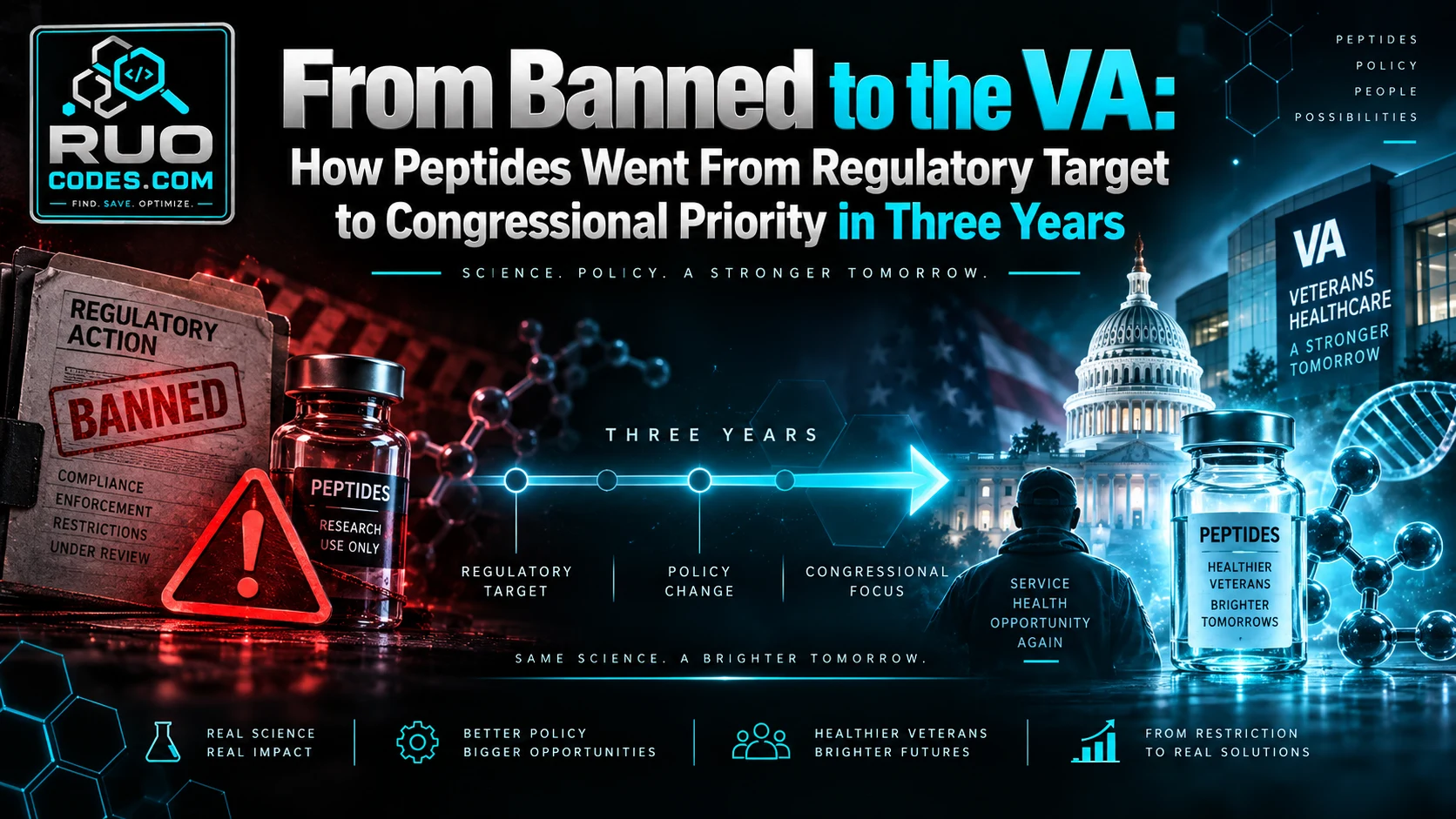
How we got here: the three-year regulatory pendulum
To understand why the PEPTIDES for Veterans Act matters, it helps to compare it with the federal environment that existed in 2023.
September 2023: FDA Category 2 restrictions
The FDA placed BPC-157, TB-500, and other substances in Category 2 of the 503A bulk drug substances framework. Category 2 identified substances that raised significant safety concerns, sharply limiting the legal compounding pathway for patient prescriptions.
December 2024: PCAC votes against several compounds
The Pharmacy Compounding Advisory Committee voted against recommending compounds including ipamorelin, MK-677, CJC-1295, and AOD-9604 for compounding.
January and February 2025: classification and GLP-1 changes
The FDA restructured its classification framework while maintaining restrictions on previously listed substances. The agency later declared the semaglutide shortage resolved, changing the shortage-based compounding environment around semaglutide.
June 2025: high-profile enforcement
A federal enforcement action involving Amino Asylum became one of the research peptide market's most visible regulatory events. By late 2025, the overall trend still appeared to favor tighter federal scrutiny.
The turning point: HHS and the 2026 PCAC meeting
In early 2026, the federal discussion began to change. HHS Secretary Robert F. Kennedy Jr. publicly questioned whether peptide restrictions had encouraged an unregulated market and signaled support for reconsidering some compounds. That announcement was a policy signal rather than a final authorization.
In April 2026, several substances, including BPC-157, TB-500, and CJC-1295, were removed from Category 2 following withdrawal of their nominations. Removal from Category 2 did not itself authorize compounding. It changed their regulatory position while leaving formal authorization dependent on the advisory and rulemaking process.
On July 23 and 24, 2026, the Pharmacy Compounding Advisory Committee met at the FDA's White Oak campus. The FDA's official PCAC meeting page lists BPC-157, KPV, TB-500, MOTS-c, Semax, and Epitalon (Epithalon) among the substances considered for the 503A Bulks List.
The committee recommended six of the seven compound groups under review. These were non-binding recommendations, not final permission to compound. Formal FDA rulemaking is still required before any recommendation becomes an authorized pathway.
For a detailed breakdown of those votes and what they do (and do not) mean, read our 2026 FDA peptide advisory panel analysis.
Why veterans, and why now?
Veterans are central to this proposal because chronic pain, service-related injury, rehabilitation needs, traumatic brain injury, and mental health challenges remain major concerns across the VA system. The search for evidence-based alternatives to traditional pain-management approaches also has bipartisan relevance after the disproportionate impact of the opioid crisis on veteran populations.
The applications named in the bill (recovery, rehabilitation, chronic pain, mental health, and physical wellness) overlap with active areas of peptide research. BPC-157 has preclinical research related to tissue repair; TB-500 is studied in tissue-repair models; KPV has an anti-inflammatory research profile; and Semax has been examined for neuroprotective and cognitive mechanisms. These research areas do not establish clinical efficacy in veterans, which is precisely why a controlled federal study would matter.
The bill's staged design is also deliberately cautious. It begins with regulatory review, proceeds to an 18-month study, and permits a voluntary pilot only if the evidence supports safety and benefit.
What the research community should understand
The PEPTIDES for Veterans Act is not guaranteed to pass, and it would not create immediate clinical access if enacted. Moving legislation through committee, the House, the Senate, and presidential approval can take years. Any VA study and pilot would add further time.
Its importance is political and institutional: an elected member of Congress is formally arguing that peptide-based therapies deserve clinical evaluation rather than automatic dismissal. Combined with the July 2026 PCAC recommendations, that represents a substantially different federal discussion than the one surrounding Category 2 restrictions in September 2023.
The direction has changed, but the process is incomplete. PCAC recommendations still require formal rulemaking, and congressional passage remains uncertain. Researchers should distinguish political momentum, regulatory review, advisory recommendations, clinical evidence, and legal authorization rather than treating them as interchangeable.
The sourcing and quality point that does not change
Growing mainstream attention increases the incentive for low-quality suppliers to enter the market. The regulatory climate may change, but product identity, purity, and contamination risks remain technical questions that require documentation.
Mass spectrometry identity confirmation, HPLC purity documentation, endotoxin testing by LAL method, and sterility documentation from named independent laboratories remain important signals of research product quality.
The listed research text specifies using the RUO Codes COA verification guide to learn how to read laboratory reports, review our vendor vetting standards, and browse the vetted research peptide vendor directory for current testing and sourcing information.
Primary sources and further reading
- Office of Rep. Nancy Mace: PEPTIDES for Veterans Act announcement (September 1, 2026)
- FDA: July 23–24, 2026 Pharmacy Compounding Advisory Committee meeting
- RUO Codes: FDA peptide advisory panel vote analysis
- RUO Codes peptide laws and regulations by state
For research and educational purposes only. Not medical advice. Research compounds are not FDA-approved for human use unless specifically noted.